5
Love
Cymene Howe
In the future, we human beings will have more love for the more-than-humans with whom we share the world.
Future, love, more-than-humans
A prediction about the future is a forecast, a projection, a proleptic speculation. It is a probability or a likelihood, or perhaps simply a fantasy. The future, by necessity, operates in a subjunctive mood grammatically; its temporal coordinates form themselves around an ‘as though.’ In the subjunctive mood, uncertainty arises to open space, discursively and affectively, around those things we might want to happen, that we hope will happen, that we dread could happen. While future forecasting may demand a subjunctive bent, we can challenge that equivocation by resorting to the ‘simple future’ tense. Not an ‘as if’ but an ‘it will.’ Thinking the future leads us toward nostalgia for the present as well as the past, because the futurescape is necessarily a spacetime dimension that holds only the seeds of its history, never its quotidian rhythms. Creating memories of the forthcoming, or a future nostalgia, allows us to gather souvenirs from the future and to hold them in our hands in the present. Or, in the words of Christina Sharpe: ‘A memory that is not mine returns to me’ (Sharpe 2023, 130).
The term ‘more-than-humans’1 may seem ungainly, awkward, and perhaps even imprecise. But the phrase is an invitation to consider those beings and non-living entities that are our constant companions on earth. In the more-than-human we find earthly nature – the flora, fauna, and bioregions – that has contextualised our existence since forever. The more-than-human is also an invitation to rethink what we mean by ‘human’ in the first place, since we humans are all, by all accounts, composed of inert matter like carbon and water and populated by trillions of organisms.2 Our very being is affected by all matter of matter: from disease vectors and pollutants to allergens and pharmaceuticals and from gravitational forces to the rotation of the planet. We humans are indebted to the more-than-human.
Any sort of prognostication about a feeling, or about love, is never easily quantified through the neat metrics of economics, demographic sciences or statistical measures. Perhaps love is not even the right word. Maybe better is ‘appreciation’ or ‘recognition,’ in essence: more feeling. In feeling our way through the more-than-human world, the feminist philosopher and theoretical physicist Karen Barad’s words are useful. For Barad, ‘matter matters as much as mattering’ (2003). That is, the physical matter of the world, its effects and its intrarelationships with humans and others, is just as important as the symbolic domain of meaning or ‘mattering.’ Put another way, the noun that is ‘matter,’ a physical substance with mass, is as vital to our experience of being as the infinitive verb ‘to matter,’ to hold significance. The lesson of the more-than-human world is that it exercises its causal powers upon us, all the time; it has capacities of its own, that become our own. In the more-than-human we find natureculture’s3 arms encircling us.
Predictions
In the future, extinctions will hang heavily in the air. Media will busy itself with regular reports and weekly updates of all the creatures – plant, and animal – that have exited earth.
Extinctions are not only losses in the present, but an absence in the future as well. ‘What is lost with each species is not just its current form—not just the particular mode of life and physical manifestation—but all of what they have been, and all of what in the fullness of evolutionary time they might have become’ (Van Dooren 2022, 109). Adding a further temporal edge, it is clear that ‘to kill species, to kill generations, is in an important sense to kill time itself.’
But the unfolding of the sixth great extinction (Kolbert 2014) will also be a call to appreciate, to love, those lost life forms. The ‘knots of connectedness’ (Govindrajan 2017, 3) that create relationality between humans and nonhumans will become more taut. Animal absences will alert us to the presences of those that remain.
In the future, we will also be introduced to new creatures. Artificial Intelligence will generate new life forms, large and small. At times prompted, and other times roguishly executed, we will have in the world AI’s new chimeras for a new age. What began with synthetic biology a handful of decades ago will evolve to a machinic tempo. For, ‘one way to inherit an appreciation for a biotic world going extinct is to build a new organism ‘from scratch’ (Roosth 2017, 4).4 These will not be AI replications of life but waves of new mongrel organisms.
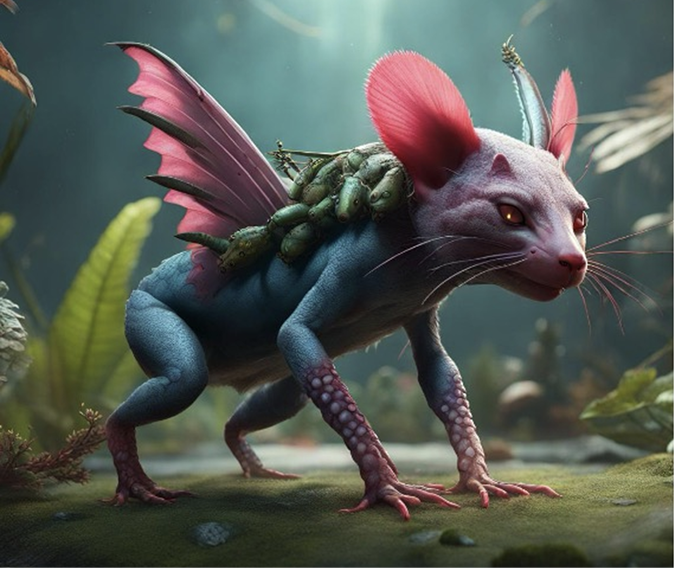
Fig. 4.1 Resilient subtropical omnivore (axolotl combined with jaguar, raccoon, and grasshopper). Created by NightCafe AI Art Generator.
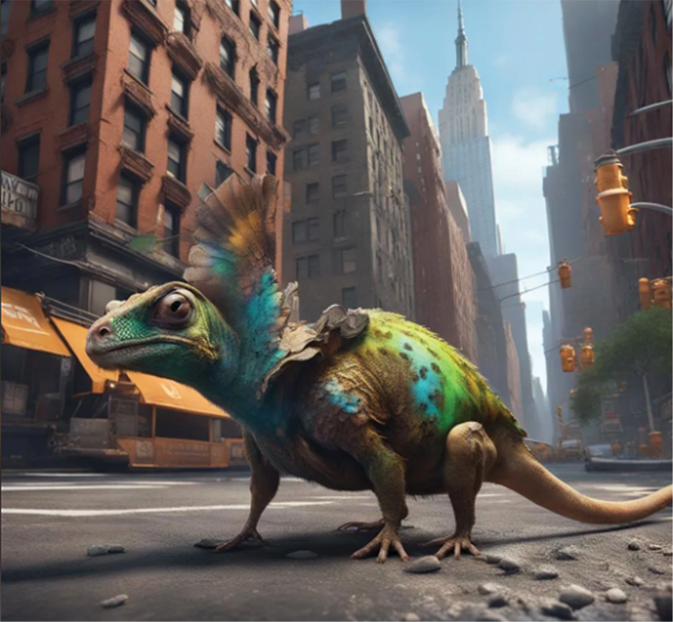
Fig. 4.2 Urban scavenger (chameleon mixed with rodent and pigeon). Generated by NightCafe AI Art Generator.
In the coming years, ecosexuality will surge. Tree hugging, sensual encounters with grass (the fresh blades that tickle) and carnal moments with earth forms will multiply. In this era of eros, nature is your lover, not your mother (Theobald 2017). She will not be taken for granted. Communing with plants and trees, a small number of people will experiment with becoming photosynthetic, altering their biochemical composition through injections that allow skin cells to metabolise carbon dioxide into sugar. A new horizon of human/plant hybridity.
A new world religion will evolve, called Harawaynism. Its prophet will be the (then) late Donna Haraway, and its doctrine her collected works. Liturgy will be drawn from The Companion Species Manifesto (2003) and a handful of rituals will revolve around the art of humans becoming humus – that is, going from subject to soil. The temples will be many, but hierarchies and eschatology will be levelled; the new pastoralism of Harawaynism will be compostable.
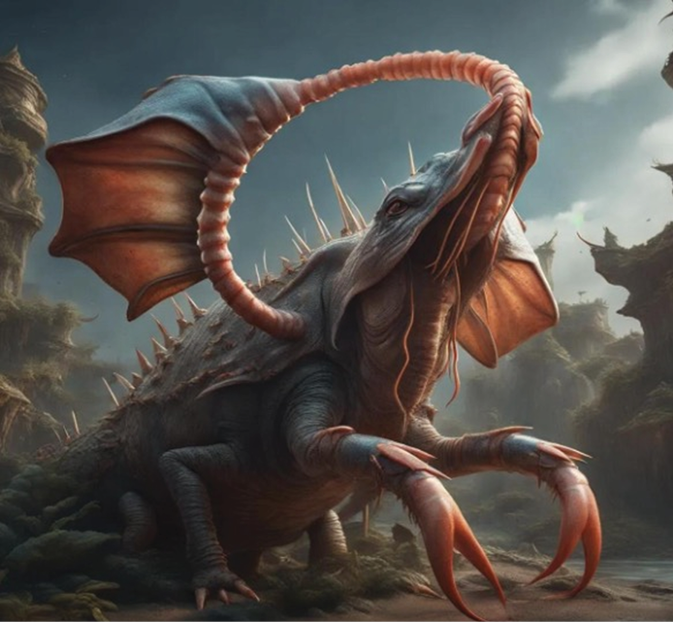
Fig. 4.3 Amphibious megafauna (giant shrimp with elephant and bearded dragon). Created by NightCafe AI Art Generator.
Tails will come into fashion. Celebrities will set the trend with bushy foxtails erupting from just above their derrieres and sweeping to the ground. Others will impress with alligator, horse and ermine tails. The edgy among us will don skunk and okapi. Anime fans will lead the charge with kawaii tails: hamster, squirrel, bunny.
In the future, we will have finally deciphered the language of dogs. Digital translators will allow us to speak in multiple human languages and for our canine companions to respond to us in their own doggish languages. We will finally know what dogs really think of us, these creatures with whom we have co-evolved for millennia.
Sentient landscapes – those places of geomorphological being – will begin to see broader appreciation. The ‘earth beings’ that Marisol de la Cadena describes (2015), will accrue more affection; more of us will finally value the more-than-human worldscapes that many Indigenous people have long recognised and loved. Rivers and glaciers that have already achieved legal designations of personhood under the Rights of Nature, will be joined by mountains and fjords, deltas and forests. Sentience will be recast and its contours redefined.
Every continent will be home to a Terrarium Colosseus. They will resemble the parks, reserves and preserves of the present. They will be massive protected zones where human beings are not welcome.5 Like Area X in Annihilation (2014) these will be places uninhabited by human beings as well as unvisited by them. The giant terrariums of the world will not follow the logic of John Muir-ism (or its racialised underpinnings) – land and space conserved for the pleasure of people – but instead will exist for the ecocentric rationale of nature, for nature. The Icelandic Highlands will be the first of the Terrarium Colosseus, but many more will follow.
New celebrations will be held, birth ceremonies for infant earth, as volcanoes churn forth magma and freshly birthed stone. The arrival of more earth forms will be marked ceremoniously, with awe and compassion for the newborn earth erupting from deep within our planetary core.
The ingestion of soil will become a health trend the world over, spurred by influencers advocating its energetic properties, its purifying mineral and biotic forms. When consumed directly, or placed under the tongue for a few minutes, its benefits include a certain shimmer to the skin. We will feel humus become us.
It is already common knowledge that the world’s islands, like the world’s creatures, are disappearing under the weight of a rapidly changing climate. Though islands may appear to be sinking beneath rising seas, they are instead being engulfed by the World Ocean, eroded away (Howe 2020). The beaches and shores of islands and coasts will continue to diminish. Sand will become a vanishing earth form.6 The sandboxes familiar to so many childhoods will be augmented with sandcircles where a multitude of sand types, by the ton, will be available. Adults will immerse themselves in coarse grains and silted dust; we will be eager to feel the stony particles between our toes, scraping away tired skin. Sand play will be a new therapeutic.
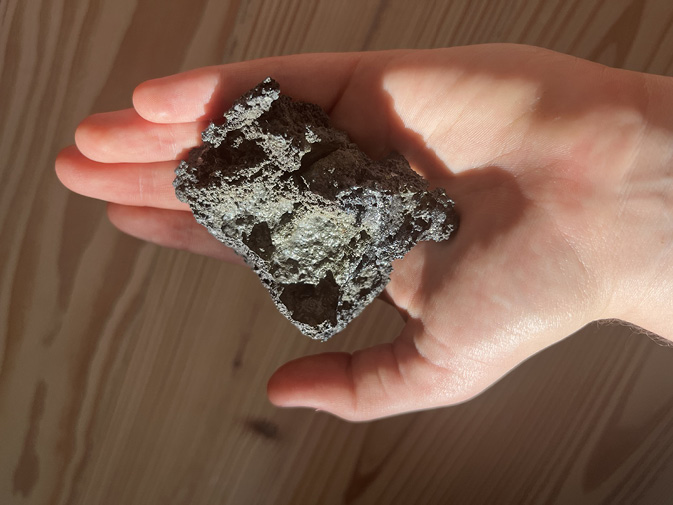
Fig. 4.4 Cradling infant earth (extrusive igneous rock). Image by author.
The weather of the future will be different. Hotter and wetter but also colder and drier. In most all ways, different. We will be nostalgic for the way that weather was: how it felt across a neck, how it tasted on the tongue, how it sounded through the ear’s spiral crevasse. This kind of ‘vernacular climate knowledge’7 will be fading. We will begin to don weather suits encasing ourselves entirely so that we might mimic the weather that we once felt standing on a cliff at the edge of the Pacific at dawn, or in the bright heat of the Sahara reflected off golden dunes.
Weathering is a process of being worn down, of becoming dilapidated or diminished by time and exposure. Chronic contact with inequalities produces its own kind of weathering: an accelerated decline in human health and wellbeing brought on by systems of disadvantage (Geronimus 2023). The future world will, unfortunately, have this kind of weathering too. Future weather – the more-than-human forces of wind, storm and water – will also contextualise a ‘temporal frame of ‘thick time,’ a transcorporeal stretching between present, future, and past’ (Neimanis and Walker 2014, 558). This can be a way ‘to reimagine our bodies as archives of climate’ (ibid.). Our human bodies will serve as archival documents, narrating a more-than-human compendium of effect (like pollutants and heat) and affect – the ambivalences and appreciation for weathering the weather.
The trouble
‘The trouble with the future,’ said the distinguished anthropologist Marshall Sahlins, ‘is that it has no content.’8 If that content is limited to facts and empirically observable events, then Sahlins’ point is true. But the future is also bursting with content when the imaginary and the speculative become the stuff of time. The future is tempus nullius – not the imperial theft of land in terra nullius – but an aperture for conjecture, a space of un-appropriated time. Free time. As Michel-Rolph Trouillot has taught us, ‘The past, or more accurately, pastness…is a position’ (Trouillot 1995, 15). So too is the future.
In the coming decades all these ways to show more love for the more-than-human will come to pass. Or perhaps they will not. Either the subjunctive mood or the simple future will win out and its content will finally be known.