9
Super/Semiconductors
Anne Pasek
Do you remember the superconductor breakthrough of 2023? It happened in July when a three-person team from Korea University uploaded a preprint paper describing the synthesis of LK-99, a form of lead apatite doped with copper atoms. An accompanying video showed the black glassy crystal wobbling on a magnet, levitating in the air. Its subtle dance with gravity has its charm, but the real shock was the presence of the scientist’s hand, nudging it gently with a pen (fig 1). Until then, all known superconductors only functioned in extremely low temperatures or high pressures, the likes of which exert considerable violence on the human body. The proximity of this bare hand to the material was thus also a proximity to a very different kind of future. As the paper’s authors assert, ‘we believe that our new development will be a brand-new historical event that opens a new era for humankind’ (Lee, Kim, and Kwon 2023, 13).
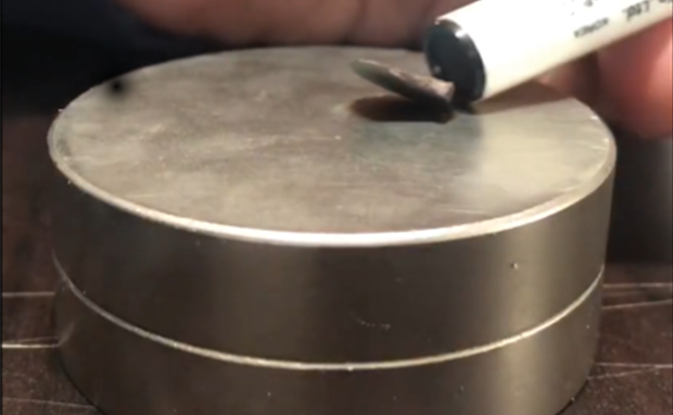
Fig. 9.1 A researcher manipulates a small sample of LK-99.1
This claim is at once neither modest nor aggrandising. To date, superconductors only play a limited role in highly specialised technologies, at work in MRI machines and Maglev trains where they are used to manipulate magnetic fields (though only within highly pressurised or thermally controlled enclosures). Free from the energetic and mechanical limitations of producing these conditions, however, superconductors could do so much more. Because they have no electrical resistance, they can store electricity indefinitely and transmit it perfectly, without heat or signal loss. This has the potential to revolutionise the fundamental principles of both the electrical grid and computing. Clean energy could be indefinitely stored in superconductor batteries and dispatched to distant locations over 100% efficient transmission networks. Electronic devices would never get hot to the touch and data centres would not need to be cooled. Most significant, however, is the material and conceptual leap LK-99 would allow in the fundamental design of computer architectures. Traditional computing relies on binary circuits in silicon semiconductors; quantum computing instead manipulates qubits on superconductors, with a vastly increased theoretical processing speed. The current shackling of superconductors to expensive and highly-calibrated cryogenic cooling systems, however, keeps quantum computing a highly specialised area of academic research. LK-99 was the first sign that it could be otherwise.
How should we make predictions about the possible worlds that might be formed by fundamentally different material physics than the ones that define our present? This is the sort of question normally handled by science fiction novelists or archaeologists, both of whom rely on vast temporal horizons to bring into relief the shaping character of otherwise quotidian technologies. Such authors, along with the Korean University team, can thus credibly speak of ‘eras’ defined by the physics of dominant materials, whether they are steel, silicon or LK-99. For the field of Science and Technology Studies, it also presents the question of the ‘possible technocultural moves’ (Galison 2000, 389) innovations leave in their wake. It is an invitation to consider how new materials make new thoughts possible.
These are vertiginous ideas, and also almost unavoidably emotional. Alex Kaplan, a Princeton grad and early commentator on the paper, is a case in point. In a Twitter thread with more than 30 million views he summarised the synthesis of LK-99 as ‘the biggest physics discovery of my lifetime’ (Alex Kaplan [@alexkaplan0] 2023). In addition to outlining several society-changing applications for ambient pressure and temperature superconductors, he also shared a mixture of feelings of uncontainable excitement and social gravity. Alluding to the early days of the COVID-19 pandemic, he writes, ‘It feels like January of 2020 with a huge wave coming that no one realises yet, but in a much better way.’ In both pathogen and crystal, dystopia and utopia, reconfigurations of the present are perceived as rapid and largely inhuman questions of material action. We merely watch them arrive and struggle to think with them.
These predictions were all utterly wrong. The properties observed by the Korean University team turned out to be a side effect of contaminants rather than the work of a genuine superconductor.2 Its levitation was a simple case of ferromagnetism. LK-99 is not a material of world historical significance; the possible technocultural moves at hand remain unchanged.
It is thus with due deference to the fallibility of such predictions that I now make my own: we will continue to fail to create a material that can live up to the promise of LK-99. We will never enter the superconductor era.
I do not make this assertion out of an abundance of expertise in material chemistry or advanced physics; I am as lost in the question of quantum states as I assume is true of my reader. Instead, I bring only an analytic pessimism to bear on the problem of forecasting the future, as well as a practiced study of the past and all the times we have desperately wanted a deception of the laws of physics to be true.
Most relevant to my view here is Moore’s Law, a foundational principle in the history and political economy of semiconductors. It holds that the number of components in mass-produced chips will double every one to two years, steadily and exponentially making the stuff of computation cheaper, smaller, more powerful and more energy efficient. It was foretold in 1965 and set the pace for both industrial and cultural expectations for digital technologies (Lison 2020). Moore’s Law is the reason why computers became personal, inexpensive and ubiquitous. It derives from the distinct material properties of silicon semiconductors, which could be doped and photoengraved to form ever greater numbers of electrical transistors on the same area of material. To many, it presented a tantalising spectre of techno-determinism (Ceruzzi 2005). Ultimately, however, it only described a momentary economic trend and feat of social coordination rather than an unchanging physical truth (Mody 2017). Moore’s Law ended in the 2010s as researchers began to run out of room in which to fit more transistors onto a finite number of atoms. At the nanoscale, quantum entanglement creates new sources of noise in electrical circuits. At the edge of traditional computing we thus find a divide that cannot be crossed without making the switch from semiconductors to superconductors. A revolution in materials is needed to maintain the lie of Moore’s Law.
I am so suspicious of our ability to cross this divide because of how desperately we want to do so. Desires can bend our sense of the possible and the plausible. As I discuss elsewhere (Pasek 2023; 2019), there is presently an inglorious and imperfect attempt to maintain the spirit of Moore’s Law in the build out of cloud computing, in the use of energy efficiency as a ‘resource’ to enable green growth, and in the expectations around the cost curves of green energy technologies, all of which are expected to follow the exponential trends of Moore’s Law if they are to be taken as a plausible promise. Thinking under the shadow of Moore’s Law has meant presuming that it is the materiality of silicon technologies, rather than the social and economic forces that mediate them, that drive the future forward. We want to expect – and so we are apt to fantasise – that the future will feel as revolutionary and frictionless as early consumer experiences of the silicon era.
Predictions have political consequences. The seriousness with which we approach climate change is the most obvious and important of these, but they also surface in the affective ties and expectations we have for technoscience more broadly. Pessimism here can be generative rather than merely functioning to block progress towards potential innovations. Presuming that we will continue to live in a world of accumulating data centres, heat, and energy losses will help guide us to better ways of living with the externalities of the systems we inhabit, rather than assuming that they will become irrelevant in the forthcoming materials revolution. Let LK-99 be a reminder of this, rather than a footnote to a future we still expect to arrive.
Acknowledgements
This research is supported by the Canada Research Chairs programme (grant number 950-233016).