13
Embodying patterns of textile machinery: A dialogue
Caroline Radcliffe and Alex McLean
Introduction
The following is an edited transcription of a discussion between Caroline Radcliffe and Alex McLean, where the former is interviewed by the latter. Caroline and Alex have quite different backgrounds in performance practice and research: Caroline is a musician, theatre maker and clog dancer, and Alex writes code to make live music as a ‘live coder’.1 There are correspondences, however, with Caroline’s clog dancing relating closely to the technology of the Industrial Revolution, and Alex’s coding relating to the technology of the information revolution. The following particularly relates to Caroline’s work, ‘The Machinery’, a multi-media performance based on a traditional dance from Lancashire, which she learned from Pat Tracey, that incorporates the movements and sounds of industrial cotton mills. In collaboration with Sarah Angliss, Caroline has aligned this dance with the equivalent modern-day setting of the call centre (Radcliffe and Angliss 2012). Approaching nine minutes, this piece centres on Caroline’s clog dancing, with a focus on the repetitive, clattering movements of her feet, backed by a projection mixing footage of industrial machines with contemporary call centres and performed to the sounds of cotton machinery from Quarry Bank mill in Styal, Cheshire. For the fullest picture, the reader is encouraged to watch video documentation of one of Angliss and Radcliffe’s performances of the machinery.2
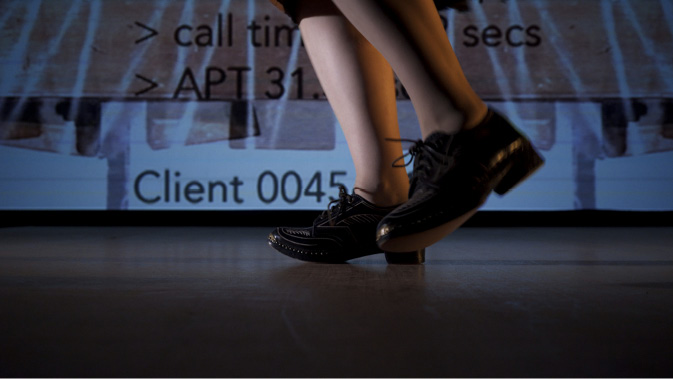
Fig. 13.1 Still from Caroline Radcliffe and Sarah Angliss’ rendition of ‘The Machinery’, where repetitive clog dancing mimics the movements and sounds of industrial machines (photo and video by Jon Harrison in 2018)
Interview
The following interview took place over video conferencing during May 2020, with Caroline Radcliffe in Birmingham, UK and Alex McLean in Sheffield, UK, during the first coronavirus lockdown. It begins with reflections on their prior shared interest in making screen-based works, and how these works were reframed by their ongoing experience of COVID-19 restrictions, and wider cultural movements towards alienation.
COVID-19 and alienation
Caroline Radcliffe: With the coronavirus pandemic in mind, I’ve been thinking again about Marx’s theories of alienation which had really framed mine and Sarah Angliss’ piece ‘The Machinery’. There is ongoing discussion about how working from home during the lockdown has affected labour, and it got me thinking about the transition from artisan weaving to the textile factories – the process that Ellen Harlizius-Klück describes in her article on weaving and the Jacquard loom (Harlizius-Klück 2017). I looked at the most recent film of ‘The Machinery’, an immersive installation work which Sarah and I made with filmmaker Jon Harrison. All of our planned work for this installation has fallen through this year, as it has for most other artists, and I was thinking, how can I not look at it now in the light of everything having to go on screen – every meeting and everything that I’m doing now being on screen – and not only on one screen? In the past I have written a great deal about Victorian drama and the windowed effect of what are called ‘compartmental scenes’, and how they mirror the computer windowed screen. That just seems to be even more present now, in everything that we’re doing. So I watched ‘The Machinery’ again and in the light of what the entire art world is having to adapt to now, it seemed like this horrible premonition! I think it will completely change the meaning of the piece – one of the things that was really interesting when it was shown for the first time as an immersive installation (at Ironbridge Gorge Museums in 2018), were people’s responses and emotions to the piece. Their reactions were very individual, they really applied it to their experiences of either the workplace, or how they felt in terms of their social relations with other people, how they felt about art, how they felt about movement – we got so many different responses.
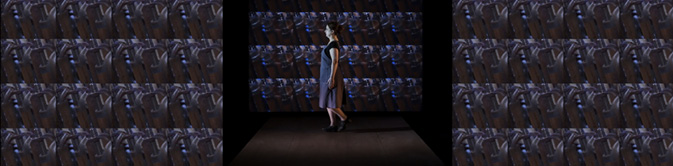
Fig. 13.2 Still from ‘The Machinery’ as a three-channel video installation, with Caroline Radcliffe performing the clog dance surrounded by repeated and mirrored screens-within-screens, representing repetition in labour (photo and video by Jon Harrison in 2018)
As soon as I watched ‘The Machinery’ again in the light of this crisis, it took on a completely clear (to me) articulation of what Marx talks about when he discusses the fourth version of alienation, which is to cut the worker off from society. He talks about that being the ultimate aim of capitalism, anticipating the current neoliberal agenda to disempower the worker. In education and particularly in universities there’s a lot of fear at the moment about everything going online now. Will the worker no longer be needed face to face? Does it mean that we lose even more agency over the work we produce? All these questions were all being asked by Marx in terms of valorisation; he says that once the worker is alienated, and the agency is taken away from the worker, that’s when they lose the feeling of creativity that otherwise enables the human spirit to engage with work.
In her article on the Weaving Codes/Coding Weaves project, Emma Cocker challenges this, talking about how ‘privileging efficiency and optimization can delimit creative possibilities, reducing the potential of human intervention and invention in the seizing of opportunity, accident, chance and contingency’ (Cocker 2017: 124). So following this I stick by what I said in my original article about ‘The Machinery’. It’s a provocation, a challenge to Marx’s statement that capitalism will destroy creativity, that capitalism will subsume the worker and alienate them, and that their life becomes meaningless. This clog dance shows that the human spirit can overcome adversity through creativity. ‘The Machinery’ is a really good example of how people do find creative ways to address these attempts to alienate them in the workplace. This seems particularly pertinent when I revisited the piece. It’s all repeated screens, and the call centre worker is on her own, in little boxes looking at lots of other call centre workers.
I think the other significance about this piece which I hadn’t fully realised, was the fact that I took it away from the group, Camden Clog, who it was initially choreographed for. So initially Pat Tracey3 had choreographed it for six of us, and so we were machine components working together – we moved in patterns, in and out, and you got much more of the topography of the actual textile machines. If you were to look at it from above you could see those patterns working backwards and forwards, like the weft of the loom, with the six of us. I took it away from that to become an individual piece, in order to make it about alienation. I think if I was making it now, for the first time, in response to this coronavirus lockdown, it would have had to have been on my own, and I’d probably have done it on screen, with lots of versions of me – which is actually what we already did! This is what Jon and me and Sarah did with it when we filmed it in 2018. So I think that when people finally see it they’ll think that it was made in response to COVID-19. Actually, one of the things I was thinking at the start of this lockdown is ‘God, I hope I don’t have to watch loads of theatre about isolation!’ Then I watched my own piece, and it is entirely about isolation! Now I wonder whether, when we finally manage to tour it, people might actually really not want to watch it…
. . .
Alex McLean: I guess people will be hungry for what they’ve been missing, but it’s hard to know what’s going to happen isn’t it? It’s all up in the air.
Caroline: The significance about the piece is that it does seem to be timeless – we originally made it in 2007, and it just keeps popping back, creating different meanings for different people. It seems to adapt to political and global circumstances every time. So I enjoyed reading Ellen’s article about how weaving went so much further back, and the ideas that are inherent in weaving don’t really change – even when you bring them up to computer programmed coding and stuff.
Alex: This makes me reflect on my own live coding practice, which is obviously very screen based as well! Of course, everyone has been staring at screens for the last few years, their phones and computers. Actually I’ve started using the Skype call jingle music in my performances. The Skype music is annoying because it doesn’t loop properly – the steady beat jars when it loops. So it’s quite nice to remix it, to take that away so it’s actually got a steady rhythm. This calls back to ‘The Machinery’ really, taking something which has bad associations like Skype… I guess like a lot of things around the office, Skype has found its way into family life, so now we use Skype to talk to our family and friends… But still, there’s something about having to be hyper-present and always online, even though you’re not in the workplace… and in retrospect it’s interesting that I’ve started working that into my music.
Work in the home
Caroline: Well the thing you mention about the family – Marx also talks about that in the context of alienation. He says that during the Industrial Revolution, women and children got taken from the home and everyone moved into the workplace. They then had to start commodifying everything within the home, in order to get that hidden labour complete. I think it’s Feuerbach who talks about the family as being this ideal relationship, so that the home and the family become the thing that you escape to, and they become the thing that replaces the kind of misery. I was thinking of that in relation to how, at the moment, people are rediscovering family values through this isolation; they’re going back to doing things as a family, and back to nature, which Marx also foresees – he says we have to be connected to nature, and that when you lose that, you lose the human spirit. So I do think that the whole thing can be explained in terms of capitalism, and I think some workplaces will take advantage of this, in trying to outsource work to the home so that people get even more confused about these boundaries.
Alex: Maybe that’s things going back to how people were producing in the home, for example doing artisan weaving in the home. This is something that my colleague Annapurna Mamidipudi is working on – trying to come up with a certification for artisan weaving. So instead of Fairtrade, the idea is that if you buy something like a sari, and know that that was made in someone’s home… and that their systems of knowledge around handmade/homemade weaving is respected… So I suppose moving away from the ‘presenteeism’ of being in the workplace, and working at home… There could be a nice side to that I think.
Caroline: I think there is, but I think in Marx’s terms it’s about whether or not you have ownership of your products – the idea of valorisation is whether you still have the creative input. If Annapurna achieves some kind of authentication, the question is whether we take this as being something that valorises creative work, or whether you’re just doing it for somebody who will take it away, and doesn’t see the end product, or the profit from it. So it has to be something that you still have control of – that’s the thing that will stop you becoming alienated as a worker … it’s that you’re still invested in the work that you’re doing, you’re not just producing a commodity for somebody else.
Ownership of algorithms
Alex: Yes, I enjoy the message of your work that there’s always resistance – whether it’s electronic musicians in Detroit coming up with Techno, or clog dancers working in Lancashire mills coming up with a similar kind of noise music before that. Both are political responses to mechanisation which celebrate human creativity.
Caroline: Yes, I think it also creates that ownership that we were just talking about – when the machines replace what you were previously doing manually, then you still have ownership of those machines by appropriating them, and by imitating them with your body – by embodying them.
Alex: Yes. Tim Ingold puts it this way, ‘… at the same time that narratives of use are converted by technology into algorithmic structures, these structures are themselves put to use within the ongoing activities of inhabitants, and through the stories of this use they are reincorporated into the field of effective action, within which all life is lived’ (Ingold 2011: 62). It’s this response to things being formalised and automated. But then somehow we respond by inhabiting it in some way, creating another layer on top. I was thinking about this in terms of this ongoing push to get kids to understand algorithms, the ‘get kids coding’ movement. Is this about giving them power or not? The book ‘Data Feminism’ has a nice table comparing concepts on one side which obscure power, with concepts that challenge power (D’Ignazio and Klein 2020). You’d think by helping a child understand algorithms, that would give them power, but actually it’s like putting a child in a mill, really! It doesn’t give them power over the machine, the machine has power over them. They’re just fitting into a predefined framework about what an algorithm is, defined in terms of control structures. So we say that Facebook has algorithms that control what we talk about, and AI is an algorithm that tells us what music to listen to. But if you actually put it in historical and cultural context, that allows you to challenge power, because you understand the history of the algorithm, and how our relationships with algorithms aren’t inevitable – that we can actually define them ourselves and bring them into culture in a way that’s meaningful.
Algorithmic tradition
Caroline: I think that’s why trans-historical work is so interesting, and is the reason why we didn’t make ‘The Machinery’ a direct reconstruction of the nineteenth-century dance. Although I work in historical performance practice, Sarah and I deliberately didn’t want it to be that. We wanted it to feel contemporary, we wanted to create a piece that was timeless that could be read both within its historic cultural meaning and a contemporary meaning. I think that’s worked, because its history brings new meaning to its current position when people view it.
The table in the Data Feminism book notes that ‘by acknowledging structural power we can work towards dismantling of it’ – how do you think that would work with dancing in a nightclub, or in a school? Like you have done with live coding, pre-pandemic, I was about to go into schools with ‘The Machinery’, we were going to create noise music there. We were working with some students from the Argent College (run by the Ruskin Mill Trust), who do silver-smithing, jewellery making, gardening. We were going to use their tools to create music, and try to do something similar to what Sarah and I had done with ‘The Machinery’.
Alex: I think anything that puts an algorithmic structure in a historical context of textile or a musical pattern is going to give children the idea that algorithms are about patterns, and about procedures, and this is something humans have always done – it’s not something that was invented in the last 50 years. It is good to also make clear that this is something that they develop by themselves – they can come up with new ways of making music. They can start with some noises, look for patterns, build things up, and start making their own traditions. I think anything that gives children the idea that nothing is fixed, that a different future can be imagined, is positive right now.
Caroline: This reminds me of Malke Rosenfeld teaching maths through dance – that no choreography was the same. Even though she’d only used a small set of patterns, you know, as with musical notation, it will never be the same – she found that every single mathematical combination made by the children was different, so it became something really original.
Tradition, ownership and notation
Alex: This is a tension in ‘The Machinery’ I think. Because it is a particular dance that you’ve been taught, and you’ve also been told not to teach anyone else! So it has an identity with Pat Tracey, it’s something that she’s choreographed. But it’s also something that’s come from her ancestors, who have worked in the mills. So it’s something that has been passed down, but it’s also something that’s fixed. But then you’ve changed it! So there’s all kinds of tensions – you share it openly just by dancing, but not teaching it. But then you’re giving talks about it, and are writing about it. There’s an interesting balancing act that you have here, between respecting a composition that comes with certain constraints about what you can do with it, and also celebrating or getting across the idea of a tradition that can change. So what would be the next step for ‘The Machinery’, if in some way it’s something which is fixed, how can the tradition continue for you, do you think?
Caroline: Well I think this is something that’s really inherent in popular culture, and particularly popular culture that’s passed on through the vernacular, that isn’t written down. One of the most important elements about clog dancing was what they called originality. Clog dancing was often done in competitions, at fairs or music halls or whatever – similar to the breakdance and hip-hop battles of today. You had different categories for judging, so it might be how many beats you did, or missed, and timing – whether you were rhythmic. But then there was the category of originality. So it’s given that clog dances will always change – the nature of popular culture is that it will always develop. If clog dancing stops developing, it becomes something else, it becomes a kind of museum piece that’s no longer part of that evolution. So I would question the whole idea of tradition, in the way writers such as Hobsbawm have written about the invention of tradition (Hobsbawm 2012). I think, well okay, that was Pat’s dance, and she created that choreography, and each dancer has a few dances where they say, this is my dance and nobody can copy it. That comes from that competition mentality that clog dancers had, because it was so much about the skill of being able to create more interesting, more original, or more technically complex steps. In fact, when she taught us she would often change things, and we’d say ‘Oh but you told us it was like that last week.’ ‘Did I? Oh well, it’s like this.’ So there was a constant flux, so it was fluid, it was constantly moving. Even now, when it’s written down, when it’s notated, it often differs from the way we were taught. There’ll be a very slight variant and it doesn’t matter, because that’s the nature of it. We’re not trying to preserve it in amber, it’s something that has to develop. So Pat knew that when she said that she didn’t mind me doing the dance as a performance piece. I was very wary because I knew that she felt very strongly it was not only her dance, but a Camden Clog dance (our clog group that I danced with). We were the only ones that could perform it. She said, well okay, yes you can do this, this sounds good. But she said, ‘Don’t teach it, don’t teach it.’ So I said I wouldn’t, but this is tricky now because people have started filming it. It will obviously never be the way that Pat danced it because I’m not Pat. Actually, I missed out a step, and I can’t remember whether I did that deliberately or whether I’d just forgotten.
Notation and memory
Caroline: Today, because I was thinking about what you’d asked me to consider, I looked up the notation that she’d given me and that’s all I’ve got – so that’s it, that’s the whole dance (shows AM a list of steps and numbers)
Alex: Notations are often there just to jog your memory, aren’t they?
Caroline: Well that one certainly is because unless you knew the basic elements of those steps, there’s no way anybody could replicate that, the only people who could translate that would be Camden – the clog group –or myself. Whereas these are her most complete notations… (shows AM a more detailed version of step notation).
Alex: Wow that’s really interesting, and so I guess this is quite particular to her, this style.
Caroline: Yes, but again, if you didn’t know her style, there’s no way you could translate that really is there? When I take that to my group I say, ‘Look it’s really easy, it’s written down, here it is.’ And they say, ‘I find it really difficult to understand’, and I say ‘But it’s simple, look, it’s left, right, tap.’
Alex: Yes! I suppose they’re just like way-markers, these little things, they’re just to help you remember.
Caroline: Another example of clog notation is Newcastle notation; it was made by somebody who wanted it to be really readable. He created a much more complex system so that you got more nuance about things like the angle of the foot. Maybe because I don’t dance that particular clog style I find it totally incomprehensible – as have others I’ve met. So I think really there has to be an element of … what’s the words when you pass it down, when you relay?
Alex: Oral culture is how you described it in your talk at the Homo Textor conference, but it’s also tacit knowledge I think, knowledge that you can’t write down. That’s something that’s come up a lot in our Penelope project – how to value and understand knowledge that can’t be written down. During my PhD I got very interested in Scottish bagpipe notation, Canntaireachd, where you can ‘speak’ the bagpipes in the same way you can speak drums. But once you write that down as words you lose the rhythm, so it’s very much a vocal tradition. If you read out those clog instructions to do the steps, there’d be information in the intonation and the rhythm of the way that you’re describing the steps, I’m sure, that wouldn’t translate to the written page. But we’re so used to writing as a form of transcription now, especially Western staff notation.
Artisan vs artist, visible knowledge
Caroline: Another interesting thing that came up through the Homo Textor conference was this idea of the artisan versus the artist. I’ve just been reading Diderot’s Encyclopédie, where he talks about what the artisan is, and what the artist is. Actually he dismisses the role of the artisan because, he says, it comes down to the idea of ‘technê’ (which kept coming up in the conference), this idea of technical skill and repeated skill. Diderot said, basically, that that’s just repetition – it’s not artistic because there’s no thinking behind it.4 Artisans were subservient to rules for the pursuit of profit, that there was a lack of education, and that it was done through habit. Artisans don’t require intelligence. So that’s really the distinction he makes, and that we now suffer from – artists have genius and intelligence, and artisans don’t – they’re literally just users of tools (Diderot and d’Alembert 2017). I mention this because you said that we’re so used to notating everything. A lot of what I study is to do with popular culture, and not the written word, not the text. So I think that popular culture is still persistently invalidated because it hasn’t ever been written down, actually you can’t write it down. The notation is something that becomes just part of an ‘insider knowledge’, isn’t it? People talk about insider and outsider knowledge. If you’re a member of Camden Clog you’re an insider, and you can read this notation. If you’re an outsider you can’t. So Diderot doesn’t take into account this idea of insider knowledge, which certainly, in terms of something like dancing or Canntaireachd, is embodied knowledge. You may not be able to write it down or articulate it, but your body’s articulating it.
Alex: The interesting thing with Canntaireachd is that it has been written down, but then it’s useless once the practice has died, because only the words have been written, and not how they are articulated.
Caroline: Which is exactly the same for clog notation. Complete notation of mechanisation vs incomplete notation as waymarkers in embodied knowledge.
Alex: Yes, my Mum wanted to make a jumper for my son, so I sent her a pattern that I downloaded and she just couldn’t understand it. She couldn’t go to the local knitting circle due to COVID-19. So she’s had to email the creators of the pattern to try and work out how to do it. They’ve been very helpful, it was a pattern I paid for. But the problem is that the pattern is American, and so there’s all kinds of embodied knowledge. The pattern on its own isn’t useful because you don’t know the language behind it – you don’t know the bodily movements you have to do. You need the knowledge in your fingers. But then when it comes to mechanisation, things change. Because that notation of the weaving pattern is then complete. When you punch those holes in the cards that are fed into the Jacquard device, that’s exactly what the machine does – it just reproduces the notation. There’s nothing extra.
Caroline: That’s different from what we were talking about, about whether ‘The Machinery’ would change – in that it won’t evolve, that punch card. That’s not going to evolve or change. Whereas with ‘The Machinery’, I’ve recently seen Camden dancing it, and it’s very different to how Pat did it. But then they would never claim it was exactly the same, because it never can be, you know, we’re not Pat!
Alex: But I think people don’t recognise that once you mechanise, once you reproduce notation… Like, you must have heard MIDI files where you transcribe some music onto a computer, and then play it back. There’s no articulation or interpretation, it’s just reproducing the notes and it sounds very mechanistic and empty of life.
Caroline: But that goes back to ideas about the dualism between mind and body. I’m thinking about doing a project about Descartes and music. In the seventeenth and eighteenth centuries there was a whole movement of musical instruments that were regarded as mechanical. So you had the hurdy gurdy, the bagpipe, the organ, the harpsichord… They were really a kind of pre-Enlightenment recognition of dualism – between the emotional instruments which came from breathing – like the flute, or the violin where you could alter the bow – emotional instruments that expressed thought and feeling, and then you had the mechanical instruments. So they were thinking about mechanisation – how much emotion can it convey and whether it can convey the anima or the soul, or expressiveness… whether you can convey it through a mechanical instrument. It’s interesting that they were trying to link those with things like electricity, even at that time, like the electrical harpsichord which they wrote about in the eighteenth century.
Mechanical movement and labour
Alex: I think it’s different for mechanised music and for mechanised weaving though. Because on the hurdy gurdy you still have the expression through how you turn the handle. With weaving it’s completely automated by a machine, and people look at it and think that’s all that weaving is. But there’s so much missing – it’s treating weaving as a two-dimensional structure when it is a three-dimensional one, and artisan weavers have so many techniques which a Jacquard machine isn’t able to do. A machine loom isn’t even able to weave the edges of textile, so it just cuts them off. There’s all kinds of weird three-dimensional things you can do on a hand loom that you can’t do on a machine loom. But when you look at machine looms, you think that’s all weaving is, and then you see a human weaver work, and these structures are invisible to you, so you just see the repetitive labour, and you just see the human weaver as being a kind of machine themselves. So the aim of the Penelope project I suppose, is to bring out and make visible the tacit knowledge and understanding that a hand weaver has.
In music, like with Techno, it’s very mechanised, it’s made by a sequencer. But still there’s movement in it in how the effects are controlled, and the music is shaped to do that. Also when you are listening to it, you’re not just listening, it’s a very active listening where you’re actually dancing, or at least thinking about dancing to it. It’s the kind of music you dance to for hours on end, in the dark.
Caroline: Yes and with clog dancing, you’ve got a whole dimension that will never be written down, things like volume, crescendos and diminuendos, emphasis of beats. You can’t possibly get any of that from the notation. You can really differentiate between a dancer who dances ‘heavily’, where all the beats are the same, or somebody who brings out the integral rhythm of the piece.
Alex: Yes it’s almost as if the notation just gives you the ground, and the actual figure is the movement – this kind of shaping of the building of anticipation, the crescendos. But that all comes through the interpretation of the notation. I mean, the similarity between the results of the clogging you do and Techno is really really striking. With the kind of noise music aspect that you’re taking something industrial, working within that mechanical repetition, and creating something astonishing. To me it’s just exactly the same process as Techno.
Caroline: I worked a bit with a Kathak dancer in Leeds (Jyoti Manral), and she said that the roots of Kathak came via Spain from flamenco. We found once she put clogs on it seemed like a clog dance. It was so similar – Kathak is very percussive. She said that flamenco in turn came from blacksmithing and ironwork. It’s another dance form that comes out of labour. Flamenco imitates the percussive noise of that labour. There are all sorts of similar examples.
Analogue vs digital
Caroline: One thing I wanted to ask you, because I also read your paper about ‘what is digital’, and it makes me realise how ignorant I am, because not only do I not know what the Jacquard loom really did, but I realised I didn’t know what digital really means either (McLean, Harlizius-Klück, and Griffiths 2018). I was interested in this idea of it being basically binary. Not just something that’s computed. I wonder if you see anything digital – apart from algorithms – is there something digital about ‘The Machinery’ that you can identify, or not.
Alex: Yes definitely. I think digital is a word with an increasingly confused meaning. There’s no clear definition, unless you take it down to first principles, and talk about digital being the opposite of analogue, where analogue is a smooth shape – like that crescendo you were talking about – and the digital is like an impulse, a kind of discontinuity like a clog dance move. So I think there is digital and analogue in everything. In music it’s clear that digital just means discrete notes or discrete steps, and analogue means a smooth flow, such as the overall shape of a piece. So the digital is the points – the notation – and the analogue is how you move between the points. You can think about Western classical music as generally focusing on the notes, whereas for example certain practices in Indian classical music focus on the movement between the notes. For me that’s the difference between digital or analogue.
Algorithmic pattern
Alex: I’ve become really interested in all kinds of patterns – I associate digital art with pattern, really. I think that’s what it’s all about. So if you perceive patterns in clog dancing, which I’m sure you do, then there’s definitely some interesting work to be done in codifying that pattern, in code. I think once you codify this, you get to work with the structure in an interesting way. So once you write down the notation in a way that encodes the repetitions, like when you notate music you just write out the notes, but when you write out the patterns, like with my knitting pattern that I’m following at the moment (which I just bought in a craft shop) it has things like, repeat this eight times, but only if you’re making it for a particular size, and so on. That’s where you’re kind of taking repetitions, and describing the repetition rather than just writing out the notes over and over again. You might then say on the fourth repetition, do something else instead. That’s when you’re starting to work with patterns on the level of composition. Once you’re doing that, not to just notate a pattern but actually create a new one, I think that gives you a lot of possibilities because you’re not working with individual steps or individual notes, you’re working with lots of notes at the same time. So you get further away from the actual steps, but you sort of shift up on this upper level where you’re working with the patterns. That’s where I like to work, describing music in terms of pattern.
Powers of two and anticipation
Caroline: Folk music and clog dances are very limited to groups of eight, aren’t they? Like 8 bars, 16 bars, 32 bars. Many of them, such as Hornpipes and Reels, are in 4/4 and the steps generally break down into groups of 16 or 32s or 64, both within each bar and in the overall musical structure.
Alex: That’s really good for the audience, because they can anticipate when there’s going to be a change.
Caroline: Yes it’s very formulaic, you’d never vary from that unless you were some amazing contemporary clog dancer who breaks with every single convention, which, at some point, let’s hope somebody does. You will always stick within that kind of 8 bar / 16 / 32 pattern. I’m not sure why, other than it’s traditional and conventional, and that somebody like Steve Reich hasn’t written for clogs. But there’s no reason why you shouldn’t break with that pattern, the only variation you get on that is triplets. But they still break down to 12s and 24s and 36s. So in terms of numbers, it will always be two, four, eight, sixteen, always.
Alex: Yes, it’s all about powers of two, isn’t it? It’s the same with the kind of music I make in general, you have to make a change after that eight or sixteenth, or 32nd repetition otherwise the music will just sound stale. Suddenly the repetition loses its magic. I think it’s about anticipation – you’re anticipating that change, and everything’s moving towards that change, and if it doesn’t happen.
Caroline: But why do you think it always divides into eight, sixteen, thirty-two? Because you know Quantz in the eighteenth century talks about basic beats as adhering to your heartbeat, which around that time was about sixty per minute. That all locks into all the ideas about time, the way it’s all related to tides, and all that stuff. But you know often when you listen to music it’s 60, or 120 bpm. I’m thinking, how does that relate to this 8, 16, 32 that’s so prevalent within clog dance steps.
Alex: I don’t know, it’s strange for me because when I was growing up I had an obsessive-compulsion to do everything in groups of four. Like if I touched something, I’d do it four times, or sixteen times.
Caroline: So you’re a born clog dancer!
Alex: It’s something I really didn’t like at the time, and it’s not something I would talk to anyone about. It was a kind of this obsession which I felt I had to do, but I didn’t know why – it was pretty horrible. But then after a while I just embraced it really, through listening to Techno music, which is always in these powers of two. It’s not something that worries me anymore. But yes, it does feel like an obsession.
Metrical structure
Caroline: When you were talking earlier about it being an innate, felt, embodied knowledge, that is the way that I remember dances. You know when it’s going to go into the next step because you’ve got that innate sense of what eight bars feel like. I know when the next step will come. I’ve got an appalling memory, but obviously a lot of it is from motor memory, from repetition, from learning the steps over and over and over again until they’re fixed, until you are just remembering the movement. But what I’m listening out for is that change of eight bars. I’m not counting the bars, I just know when it happens.
So it’s really important that we have an AABB structure – it will always be AABBAABB, always, you can feel it, you know when it’s going to change. Our version of ‘The Machinery’ doesn’t comply with an identifiable AABB structure because we created the composition from cotton machinery noises rather than using the traditional reel that Pat liked (Far From Home), which is perhaps why I find our version harder to dance.
Alex: When you look into Indian classical music, there’s a lot more variety in the metrical structure, with much longer form. But they have different ways of counting things out, and still being aware of a metrical structure or tala. They still know when the next start of the next cycle is starting, the next sam they call it, because they clap it out. When they’re listening they’re moving their hands to feel the metre.
Caroline: They do that with Irish dance as well which is really similar to clog dance, because it’s step dancing. A lot of the steps that I do were brought over from Irish workers. In the potato famine they came over and worked in Liverpool and Lancashire. So one of the dances I do is the Lancashire Irish, which is a mix of Irish step-dancing and Lancashire clog dancing. But they do have a hand system.
Mouth music and worksong
Caroline: Did you ever see that YouTube phenomenon that was a man and a woman (Suzanne Cleary and Peter Harding) doing this amazing Irish hand dancing? Kathak dancers and Indian musicians do a similar rhythmic speaking, what’s it called?
Alex: Konnakol or Bol syllables?
Caroline: Yes, when they count out rhythms, tabla players, they speak first, and then they play it. That’s an Irish (lilting and diddling) and Scottish (Puirt à beul) tradition as well, There’s a whole language. I don’t know whether Lancashire clog dancers do it.
Alex: Yes I read a thesis about non-lexical syllables (Chambers 1980), mainly about Canntaireachd, and other ways of using syllables to represent sounds. It’s very interesting, and I suppose connecting back to weaving, it seems like a lot of this practice might come from worksong, not just from the mills but from people working in their homes and singing songs that help them remember the patterns that they’re following. I saw a short film directed by Mehdi Aminian, of Iranian craftspeople making rugs and singing to each other, to communicate which threads they’re picking and so on (Aminian 2019).
Caroline: I saw a video of Scottish weavers singing as they beat the cloth (waulking songs). There are loads of women’s work songs associated with textile making. I tried to find written examples of clog dancing within the mills. I think what I need to do is go to actual mill archives, and see if there are any references to disciplinary action because someone was caught clog dancing while they were working or something! There isn’t anything in general histories of mills. I did find a reference to psalm singing. A lot of those towns were very Methodist, and there seems to be a tradition of women singing Psalms very loudly over the noise of the machines while they worked. So that’s the idea of what Marx talks about, about that need for social interaction and communication with other people in the workplace. That’s a way that they can overcome the repetition and the dehumanisation of machine labour – by doing a communal activity like that. I think it’s not just machines, but even just knitting, doing a complicated pattern is difficult work, and you have to do it over and over and over again. So even for artisan crafts, you still need to make music out of it to help the memory, but also stop yourself from just going crazy with the repetition of it.
Endnotes
1 See e.g., Collins, McLean, Rohrhuber, and Ward 2003.
2 A recording of a 2016 staging of ‘The Machinery’ at AlgoMech festival in Sheffield (organised by McLean) is available online: https://www.youtube.com/watch?v=pGEUhjWGQ2I.
3 Pat Tracey (1927–2008) was the clog dancer who taught Caroline Radcliffe the steps for ‘The Machinery’.
4 ‘In drawing the difference between artiste and artisan, Diderot emphasised whether the art they practised required intelligence or not. There were arts that demanded only repetitive actions, while others benefited from ‘genius’, defined by an anonymous contributor to the Encyclopédie as “the fire and invention” that artistes put in their work’ (Bertucci (2017: 9; with reference to Encyclopédie 7: 584).
References
Aminian, M., ‘“The Woven Sounds”: Demo documentary by Mehdi Aminian on pattern singing-Persian carpets’, https://www.youtube.com/watch?v=vhgHJ6xiau8 [accessed 30 October 2023].
Bertucci, P., Artisanal Enlightenment: Science and the Mechanical Arts in Old Regime France (New Haven and London: Yale University Press, 2017).
Chambers, C., ‘Non-Lexical Vocables in Scottish Traditional Music’, (PhD Thesis, University of Edinburgh, 1980.
Cocker, E., ‘Weaving Codes/Coding Weaves: Penelopean Mêtis and the Weaver-Coder’s Kairos’, TEXTILE, 15.2 (2017): 124–41. https://doi.org/10.1080/14759756.2017.1298233.
Collins, N., A. McLean, J. Rohrhuber, and A. Ward, ‘Live Coding in Laptop Performance’ Organised Sound, 8.3 (2003): 321–30. https://doi.org/10.1017/s135577180300030x.
Diderot, D. and J. d’Alembert, eds, Encyclopédie, ou dictionnaire raisonné des sciences, des arts et des metiers, R. Morrissey and G. Roe, eds., University of Chicago: ARTFL Encyclopédie Project (Autumn 2017 Edition), http://encyclopedie.uchicago.edu/.
D’Ignazio, C. and L. F. Klein, Data Feminism (Cambridge, Massachusetts: MIT Press, 2020).
Harlizius-Klück, E., ‘Weaving as Binary Art and the Algebra of Patterns’, TEXTILE, 15.2 (2017): 176–96.
Hobsbawm, E., ed., The Invention of Tradition. Reissue edition (Cambridge Cambridgeshire: Cambridge University Press, 2012).
Ingold, T., Being Alive: Essays on Movement, Knowledge and Description (London and New York: Routledge, 2011).
McLean, A., ‘Making Programming Languages to Dance to: Live Coding with Tidal’, Proceedings of the 2nd ACM SIGPLAN International Workshop on Functional Art, Music, Modelling and Design (Gothenburg: ACM, 2014): 63–70. https://doi.org/10.1145/2633638.2633647.
McLean, A., E. Harlizius-Klück, and D. Griffiths, ‘Digital Art: A Long History’, 4th International Conference on Live Interfaces (ICLI 2018) (Porto, Portugal, 2018): 71–77. http://doi.org/10.5281/zenodo.2556604
Radcliffe, C., and S. Angliss, ‘Revolution: Challenging the Automaton: Repetitive Labour and Dance in the Industrial Workspace’, Performance Research, 17.6 (2012): 40–47. https://doi.org/10.1080/13528165.2013.775758.