8
Poikilia, geometry and living patterns in the Greek Archaic and Classical mind
Adeline Grand-Clément1
Introduction: from kolam to poikilia
In his Art and Agency (1998), which deals with various kinds of artefacts from a range of cultures around the world, the anthropologist Alfred Gell argued that the nonfigurative decorations of some crafted objects (usually labelled as ‘works of art’) possess an active power.2 This effect, he claimed, provides the key to understanding the social meaning and function of the objects. Indeed, Gell explains that the very nature of what we call ‘art objects’ does not stem from their beautiful appearance but rather from the agency and intentionality they possess: they deeply affect the viewer by rousing in them a kind of shock (‘captivation’). These objects draw their power from the intricacy of an ornamentation that plays with repetition, symmetry, translation and inversion, and it is for this reason that Gell pays special attention in his studies to designs, patterns and the structures that underlie them. He shows that certain visual tricks developed by the craftsmen who produced these works aim to give the observer an impression of animation and movement. The inability of the viewer to distinguish figure from ground, together with the complexity of relations at play in the patterns, means that the captive gaze is unable to unravel the geometrical rules according to which the design is constructed.
These patterns thus ‘slow perception down, or even halt it, so that the decorated object is never fully possessed at all, but is always in the process of becoming possessed’ (Gell 1998: 81). Gell gives as an example the Indian kolam designs, which are drawn on the doorsteps of houses using colourful powders. These designs are hard to ‘read’, in that the viewer is unable to apprehend the general principle that guides the pattern of the kolam. In a way, kolam designs work like the Cretan labyrinth, made up of twists and turns on a path that leads from the starting point to the centre; in making the kolam, Indian women aim to mislead the demons who must be repelled or trapped by the colourful designs (Gell 1998: 107).
Textiles did not fall within the scope of Gell’s analysis of non-figurative decorations,3 but I suggest that the same kind of process is at play in the art of weaving. The notions of ‘agency’ and ‘captivation’ are, I think, useful if we want to gain a better understanding of the value attached to decorated textiles in ancient Greece. The process of weaving, i.e., of intertwining different threads, shares some common features with the designing of kolam: both belong to what Gell calls the ‘technology of enchantment’ (1994). The main argument I deploy in support of this hypothesis relies on the meaning of a key notion intimately associated with the technology of weaving in the Greek mind: poikilia, usually translated as ‘variegation’, although the word is applied to such a variety of things in the written sources that it is very difficult to render it accurately. The Greeks used the adjective poikilos to describe all kinds of artefacts characterised by the juxtaposition of varied colours and materials, and with an elaborate arrangement of patterns on their surface. Its usage thus overlaps in large part with the range of artefacts considered by Gell. However, the application of this language to the products of weaving as well helps us to see how the domain of Gell’s analysis can usefully be extended. Indeed, interlacing threads for the crafting of colourful textiles was one of the main means by which a craftsman could achieve such a visual arrangement. What all these variegated artefacts had in common was a visual appearance that was intended to exert a seductive effect on the viewer, in the same manner as did the various decorated objects or surfaces studied by Gell. But there is more: as I have demonstrated elsewhere,4 the mode of action of poikilia does not result only from the visual, for other sensory perceptions (like sound, for instance) are also stimulated and interfere with each other, generating a broader cross-sensory effect (LeVen 2013).
In this paper, I will not present and analyse the different ways in which the term poikilos is used to characterise artefacts, especially textiles, in Archaic and Classical Greek texts, since this lexical work has already been carried out (Rinaudo 2009). Rather, I will endeavour to tackle the key notion of poikilia in a fresh way: I will look closely at some of the few cases in which we find poikilos attributed not to decorated and colourful textiles but, rather, to living beings whose appearance and behaviour appear in some ‘unnatural’ way and thus somehow blur the divide between the natural world and the realm of craftsmanship.5 In this paper, I will focus in particular on two animals that were closely connected to the notion of poikilia in Archaic and Classical Greek texts. First, I will consider an intriguing bird, the wryneck (iunx in ancient Greek), whose feathers display complex and intricate patterns, and which, as we will see, moves quite ‘unnaturally’. Secondly, I will explore the imagery of snakes, whose scales display a certain kind of geometric arrangement and whose behaviour was often perceived as being unpredictable. My aim will be to identify which features of these animals the Greek mind associated with woven textiles, and to understand the reasons underlying this perceived affinity. In doing so I will address a number of related questions. To what extent does geometry play an important role in these associations? Does the visual appearance of poikiloi textiles and animals provoke the same kind of effect in the viewer? And are there other, non-visual, sensory features which also need to be taken into account if we are to understand the connection between living beings and woven artefacts?
From the wryneck to the ‘magic’ girdle of Aphrodite
The wryneck (Iunx torquilla)6 is a Eurasian bird which possesses a distinctive, extraordinarily complex plumage (figures 8.1, 8.2, 8.3). With its fine lines, stripes and spots mixing subtle shades of grey, brown and black, the feathery body of the wryneck has the outstanding appearance of tree bark or the scaly skin of a snake. The first ancient writer to provide a somewhat detailed description of the bird, including remarks on its physical appearance, is Aristotle in his History of Animals (written sometime around the end of the fourth century BCE). The philosopher stresses several features that mark the wryneck out as different from the vast majority of birds.
[…] ὀλίγοι δέ τινες δύο [δακτύλους] μὲν ἔμπροσθεν δύο δ´ ὄπισθεν, οἷον ἡ καλουμένη ἴυγξ. Αὕτη δ´ ἐστὶ μικρῷ μὲν μείζων σπίζης, τὸ δ´ εἶδος ποικίλον, ἴδια δ´ ἔχει τά τε περὶ τοὺς δακτύλους καὶ τὴν γλῶτταν ὁμοίαν τοῖς ὄφεσιν· ἔχει γὰρ ἐπὶ μῆκος ἔκτασιν καὶ ἐπὶ τέτταρας δακτύλους, καὶ πάλιν συστέλλεται εἰς ἑαυτήν. Ἔτι δὲ περιστρέφει τὸν τράχηλον εἰς τοὐπίσω τοῦ λοιποῦ σώματος ἠρεμοῦντος, καθάπερ οἱ ὄφεις. Ὄνυχας δ´ ἔχει μεγάλους μὲν ὁμοίως μέντοι πεφυκότας τοῖς τῶν κολοιῶν· τῇ δὲ φωνῇ τρίζει.
A few [birds] have two [toes] in front and two behind, such as the bird called the wryneck. This bird is slightly larger than the chaffinch, and mottled in appearance. The arrangement of its toes is peculiar, and its tongue is like the serpents’: it can extend its tongue for a distance of four fingerbreadths and then draw it again. Further, it can turn its neck round right back while keeping the rest of its body unmoved, like the serpent. It has large claws, though in nature they are similar to those of the green woodpecker. Its note is a shrill cry.7
Aristotle uses poikilos in his description of the bird but does not provide any accurate details regarding the nature of the patterns that generate the impression of poikilia. We may initially feel a little bit disappointed that Aristotle remains so allusive. But a closer look at the wryneck (figure 8.1) helps us to see how difficult it might be to describe through words the intricate colouring and patterns on its body. Perhaps only specialists in textiles and weaving, well-trained in identifying shapes and motifs, would be able to do so? In any case, looking at this fascinating plumage brings to mind Gell’s allusion to the tricky composition of ornamentation on some of the artefacts he had studied. As he writes, ‘the motifs in decorative art often do seem to be engaged in a mazy dance in which our eyes become readily lost’ (1998: 76). The wryneck’s poikilia acts on the viewer in a similar way, despite not being the product of a skilled craftsman. At first sight, the poikilia of the wryneck displays no regularity at all: the blurring of patterns is impressive, making it impossible for a viewer to distinguish figure from background.

Fig. 8.1 Eurasian wryneck (Jynx torquilla) (photo by Pepe Reigada in May 2015; https://commons.wikimedia.org/wiki/File:Wryneck_by_Pepe_Reigada.jpg

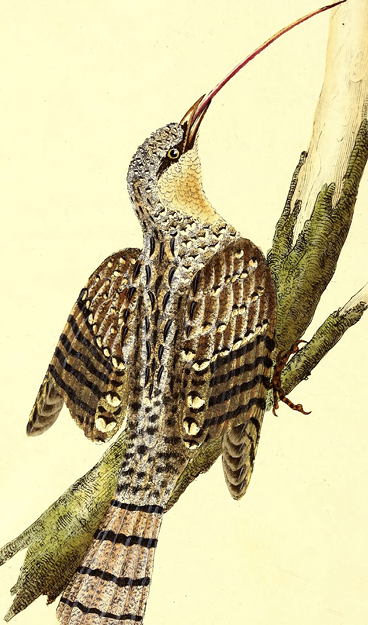
Fig. 8.2 A wryneck expanding its tongue. Image from The natural history of British birds, or, A selection of the most rare, beautiful and interesting birds which inhabit this country: the descriptions from the Systema naturae of Linnaeus, London, 1794, 63; https://archive.org/stream/naturalhistoryof41797dono/naturalhistoryof41797dono#page/n63/mode/1up
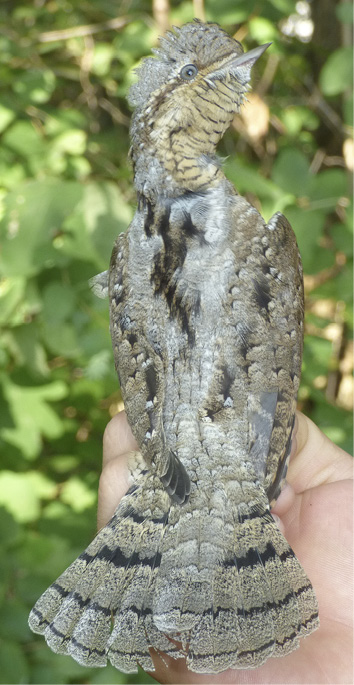
Fig. 8.3 The snaky bird: a wryneck turning his head (photo by Solymári in August 2017, https://commons.wikimedia.org/wiki/File:Jynx_torquilla_%C3%93csa_1.jpg

It might be said that such complexity is not unique to the wryneck. And this is indeed correct: many other birds do have variegated feathers. Still, there is a significant difference that distinguishes this particular species from the wider crowd: the poikilia of the wryneck does not stem only from its plumage. If we turn back to the description provided by Aristotle we can note that the philosopher stresses two other distinctive features of the bird: first, the length of its tongue, and second, the unusual mobility of its neck. It is these features that account for the comparison Aristotle draws between wrynecks and snakes – a comparison that modern ornithologists would not gainsay. First, the impressive tongue of the wryneck is retractile and is equipped with a viscous fluid that enables the bird to catch its prey (figure 8.2). Second, the wryneck can move its head in all directions while keeping its body still. The bird uses this capacity – now thought to be the mimicking of the behaviour of a snake – to ward off potential threats (figure 8.3).8 Aristotle is certainly right to note these unusual characteristics: the reptilian features of the wryneck are uncommon for a bird. They create a sight which is both fascinating and troubling, generating the impression of a supernatural potency. The snake-like characteristics of the bird do not stop at the visual level: when the wryneck is attacked, in order to discourage the potential predator, it emits a whistling that is quite similar to the hissing of a snake. It is possible that Aristotle refers to this particular noise when he uses the verb trizô, which refers to a shrill, high-pitched sound.9 Moreover, this sonic specificity is in tune with the possible etymology of the noun, for iunx might be cognate with the verb iuzô, ‘shout, cry out’, ‘emitting a sound similar to the snake hissing’.10 Moreover, according to myth, Iunx was the name of the daughter of Pan and the sonorous nymph Echo. She was turned into a bird by Hera either because she seduced Zeus or because she helped him to have his love affair with Io.11
The visual poikilia displayed by the bird thus goes hand in hand with its undulating and snake-like mobility. These features make the wryneck look like a hybrid being, blurring the frontiers between the avian and the reptilian animal classes. Moreover, the iunx-bird is truly poikilos in the sense that the ‘variegation’ is not restricted to the visual appearance of the wryneck but is also related to its deceptive behaviour. Indeed, we know that the notion of poikilia is intimately related to the field of mètis, a crafty and cunning kind of intelligence that plays a crucial role in the Greek imaginary.12 Mètis refers to a non-dialectical kind of thought which proceeds by circumvention and follows indirect and somewhat maze-like routes. Polumèkhanos and poikilometès Odysseus is probably the best example of a man full of mètis, which helps him greatly during his long trip back to his home.13 Of course, this form of intelligence is not restricted to humans: it helps Zeus – who swallowed the goddess Mètis, his spouse – to maintain his power as king and to govern the cosmos wisely. Other deities are also associated with mètis: Athena, Hermes, Prometheus, and, as we shall see below, Aphrodite and Eros. We may add that the iunx-bird is not the only animal that behaves in a poikilon way: the Greeks associated a series of animals with this concept, including the octopus, the fox, and the snake. What these species all have in common is behaviour that is connected to notions of shiftiness, instability, undulation, twistiness, and enticement.14
The intriguing abilities of the snake-like bird might account for the fact that, according to Pindar, it was used for the fashioning of a magical device, a kind of wheel that was also called iunx.15 Indeed, in a poem composed in 462 BCE for Arkesilas of Cyrene, who won the chariot race at Delphi, Pindar narrates the story of the invention of the object by Aphrodite herself, the goddess of erotic desire:
πότνια δ᾽ ὀξυτάτων βελέων
ποικίλαν ἴϋγγα τετράκναμον Οὐλυμπόθεν
ἐν ἀλύτῳ ζεύξαισα κύκλῳ
μαινάδ᾽ ὄρνιν Κυπρογένεια φέρεν
πρῶτον ἀνθρώποισι, λιτάς τ᾽ ἐπαοιδὰς ἐκδιδάσκησεν σοφὸν Αἰσονίδαν·
ὄφρα Μηδείας τοκέων ἀφέλοιτ᾽ αἰδῶ, ποθεινὰ δ᾽ Ἑλλὰς αὐτάν
ἐν φρασὶ καιομέναν δονέοι μάστιγι Πειθοῦς.
And the queen of sharpest arrows brought the dappled iunx from Olympus, bound to the four spokes of the indissoluble wheel: Kyprogeneia brought the driven-mad bird to mortals for the first time, and she taught the wise son of Aeson prayers and incantations, so that he could rob Medea of reverence for her parents, and a longing for Greece would lash her, her mind on fire, with the whip of Persuasion.16
In this poem, Pindar explains how Jason succeeded in his quest thanks to the help of Medea, who fell in love with him. It was the mighty goddess Aphrodite who taught the hero certain magic spells and gave him a powerful tool – a magic wheel – to seduce Medea. This device was created by taking advantage of the extraordinary faculty of the poikilon bird. Pindar indicates that the goddess chained the wryneck on a four-spoked wheel in order to control its movement: we can infer – although it is not clearly stated here – that when the wheel was activated17 the wryneck would swirl and produce its shrill whistling, which carried a persuasive and bewitching power. The iunx-wheel created by Aphrodite was useful for the erotic purpose of arousing lust. The seductive power of the instrument probably lies both in its physical motions (the spinning of the wheel) and in the sound it produced.18 The importance of sound comes out clearly in a passage of the poem Pharmakeutriai by Theocritus (beginning of the third century BCE), in which the author depicts the auditory aspect of the iunx (which is closely linked to its visual aspect). Indeed, the iunx is ‘invoked’ like a refrain that gives incantatory rhythm to poetry and contributes to the efficacy of the love charm (Idylls, 2.17–63). This refrain, meant to be sung, evokes a circular movement, close to the whirling of a spinning wheel. Again, we deal here with the multisensory dimension of poikilia.
We do not know whether Pindar was the first to imagine a connection between the origin of the iunx-wheel and the iunx-bird. As a matter of fact, none of the fourth-century BCE vase-paintings that might depict the iunx-wheel19 features a bird yoked on it. In these images, the presumed iunx-wheel looks like a kind of small jewel-like or plaything-like spoked wheel, with a cord or a string passed through two holes in the middle of it (figure 8.4). Drawing on the visual testimony provided by these vase-paintings, Gow (1934: 7) attempted a reconstruction of the iunx-wheel to show how it worked. The ends of the string were tied together so that the cord formed a loop; by alternately pulling and releasing the loop from either end, the metallic wheel could be made to spin rapidly. Most of the vase-paintings show the wheel held by Aphrodite herself, or by Eros, suggesting that it was used during weddings or for love magic20 – which would account for the fact that, in some Greek texts, the term iunx happened to mean ‘love, attraction, love charm’.21
Unfortunately, very few archaeological finds have been identified as possible votive iunx-wheels and in the case of those that have, the identification remains highly unconvincing. For example, one item from the fourth century BCE that has been so identified consists of round metallic objects formed of two shallow bowls of bronze joined together, pierced through the centre and mounted on a forked rod. However, since the device differs from the wheel activated by a string depicted in our images, it cannot reasonably be considered to be a iunx-wheel.22 Another type of artefact that has been compared to a iunx-wheel is a series of terracotta wheels or disks decorated with birds that date from the Geometric period, but these are far bigger that the jewel-like objects displayed on vases and their function remains completely unknown.23
Nonetheless, I think that one of these finds – a four-spoked wheel now in Boston and dating from the late eighth century BCE – might deserve our attention.24 Indeed, the artefact carries an impressive decoration with elaborate geometric designs. On the upper side of the wheel, eleven birds with folded wings are seated on the rim, their bodies displaying a mix of various motifs such as dots, lines, zigzag patterns and diamonds. The four spokes are decorated with a checkerboard pattern.25 On the underside of the wheel, the painted decoration consists of alternating eye-shaped or leaf-shaped designs, checkerboard patterns, cross-hatching and cross-hatched triangles. The overall effect conveys ‘a weird impression of occult power’, pointing to a sort of magical instrument, according to the archaeologist Grace W. Nelson.26 The various perforations for suspension found on the item indicate that the whirling device was activated in a manner that differed from the iunx-wheel: it was probably intended to be hung from a roof. What is more interesting for us is that the Boston wheel should probably be considered as the most ancient (and the most successful?) attempt at depicting wrynecks in Greek visual art, for the black lines and designs covering the body of the birds convey a deep sense of variegation – poikilia – even though only two colours are used. On vase-paintings of the Classical period, by contrast, the birds identified by modern scholars as iunx27 display no distinctive features and are not variegated at all.28 Actually, we cannot even be sure that we are dealing here with wrynecks, since the identification is inferred only from the erotic context and, sometimes, from the presence of the iunx-wheel on the same image – see, for instance, the scene on the fourth-century BCE Apulian amphora from Ruvo held in London (British Museum, F331) (figure 8.4).29
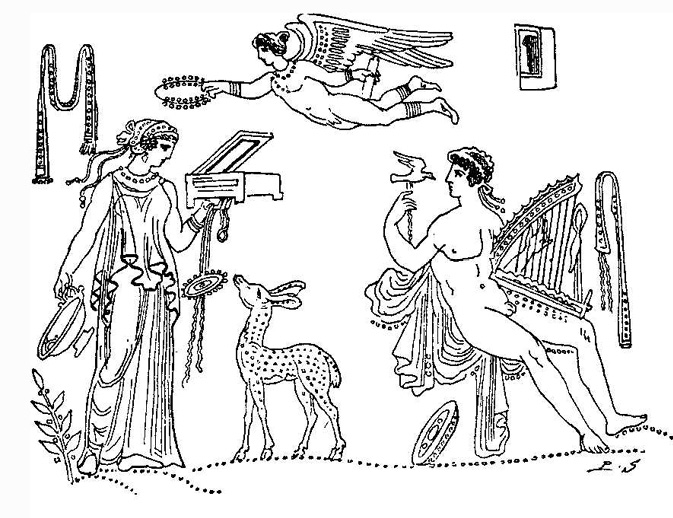
Fig. 8.4 A iunx-wheel and a iunx-bird? Drawing from Daremberg et Saglio, Dictionnaire des Antiquités grecques et romaines, Paris, 1817, 864, showing a detail of a fourth century BCE Apulian amphora from Ruvo held in London (British Museum, F331)
As far as texts are concerned, we have to read through the Greek Anthology, a collection of poems composed during the Hellenistic (through the Imperial) period, to find a short (anonymous) Alexandrian poem that may evoke the appearance of an iunx-wheel dedicated as a gift to Aphrodite:
ἴυγξ ἡ Νικοῦς, ἡ καὶ διαπόντιον ἕλκειν
ἄνδρα καὶ ἐκ θαλάμων παῖδας ἐπισταμένη,
χρυσῷ ποικιλθεῖσα, διαυγέος ἐξ ἀμεθύστου
γλυπτή, σοὶ κεῖται, Κύπρι, φίλον κτέανον,
πορφυρέης ἀμνοῦ μαλακῇ τριχὶ μέσσα δεθεῖσα,
τῆς Λαρισσαίης ξείνια φαρμακίδος.
Nikô’s iunx, which can draw a man from across the sea and children out of their rooms, carved from translucent amethyst, inlaid with gold, and hung upon a soft thread of purple wool, is dedicated to you, Kypris, by the Larissan enchantress, as your own possession.30[my emphasis]
It is very difficult to reconstruct the actual appearance of the iunx-object dedicated by Nikô31 and to determine whether it was genuinely a magic wheel (as the English translator suggests) or rather a kind of amulet. No bird decoration is mentioned. Nonetheless, what is clear from the poem is that the iunx is linked to magic (pharmakis, translated here by ‘enchantress’, meaning ‘expert in pharmaka, i.e., all kinds of drugs and charms’) and to Thessaly, a place that was famous in Antiquity for being full of sorceresses. The iunx that is carefully described in the epigram is truly poikilos: the object is made of different colours and materials, purple wool, precious stone and glimmering gold – a mix of brilliant colours and animated surfaces that were chosen because they perfectly suited Aphrodite and her divine erotic power and were credited with a special efficacy in the field of love magic. As mentioned above, the goddess herself is cunning and resourceful: she shows mētis.32 With the help of both her son Eros and poikiloi devices, she knows how to turn human and divine hearts upside down, to change minds by generating passion and overwhelming desire.
What has emerged from our analysis so far is that the poikilia of both the iunx-bird and the iunx-wheel stems from a multisensory combination of colours and textures, a swirling movement and a sonorous whistling. Both characteristics were regarded by the Greeks as potential ‘weapons’ that might be used by Aphrodite to attract and seduce humans. Are we far from the realm of woven textiles here? I do not think so, since Aphrodite is also ‘the one who braids wiles’ (doloploke), as Sappho puts it at the beginning of a prayer invoking the help of the mighty goddess.33 Indeed, among the poikiloi devices that generate erotic attraction we find woven textiles. The variegated girdle that Aphrodite gives to Hera in the Iliad, in order to seduce Zeus, is a powerful ‘weapon’ that may parallel the iunx-wheel:34
Ἦ, καὶ ἀπὸ στήθεσφιν ἐλύσατο κεστὸν ἱμάντα
ποικίλον, ἔνθα δέ οἱ θελκτήρια πάντα τέτυκτο·
ἔνθ’ ἔνι μὲν φιλότης, ἐν δ’ ἵμερος, ἐν δ’ ὀαριστὺς
πάρφασις, ἥ τ’ ἔκλεψε νόον πύκα περ φρονεόντων.
τόν ῥά οἱ ἔμβαλε χερσὶν ἔπος τ’ ἔφατ’ ἔκ τ’ ὀνόμαζε·
τῆ νῦν τοῦτον ἱμάντα τεῷ ἐγκάτθεο κόλπῳ
ποικίλον, ᾧ ἔνι πάντα τετεύχαται· οὐδέ σέ θημι
ἄπρηκτόν γε νέεσθαι, ὅ τι φρεσὶ θῇθι μενοινᾷς.
She [Aphrodite] spoke, and loosed from her bosom the embroidered girdle, variegated, in which are fashioned all the charms; in it is love, in it desire, in it dalliance – seduction that steals the wits even of the wise. This she placed in her hands, and spoke and addressed her: ‘Take now and place in your bosom this variegated girdle, in which all things are fashioned; I say you will not return without having whatever you desire in your heart be accomplished.’35 [my emphasis]
It is difficult to deceive Zeus, since he is the supreme god who owns mētis. Hera thus needs the help of Aphrodite if she wants to convince her husband to turn away from the battlefield and make love to her. The transfer of power from one goddess to the other is achieved through the giving of a piece of cloth called himas, which has been variously interpreted by modern scholars.36 Be it a waistband or a bra, a strap or a girdle, it is certainly not a casual accessoire: its strong power of enchantment, which Gell would have called its ‘agency’, lies in its rich ornamentation, probably playing with different colours, patterns, and, likely, shapes and materials (various fabrics, beads and metallic applications). Unfortunately, we have no visual representation of this mythical waistband on any vase-painting. But the verb teukhô, translated here by ‘fashioned’, refers less to weaving than to the making of metallic artefacts, notably the weapons and armour of warriors, which are composite and variegated, inlaid with bronze, gold, silver, tin, lapis-lazuli and so on. The word thelkterion indicates that the motifs of the garments are magical: they are charms that can affect the viewer and assert a strong hold over him.37
However, we know nothing about the shape of the patterns woven onto the fabric. Gabriella Pironti has persuasively suggested a link with the strong effect produced by Athena’s aegis.38 We may think indeed of the description provided in the Iliad when the goddess joins the Achaeans on the battlefield: ‘bearing the precious aegis – ageless, immortal, from which a hundred solid gold tassels are hung, all of them cunningly woven, each worth a hundred oxen’.39 Of course, this ‘dazzling’ and ‘awful’ talisman,40 a protective and aggressive weapon at the same time, is not expected to produce the same result as the beautiful waistband. Nevertheless, in both cases the agency of the divine attribute seems to be activated by motion: the girdle has to be tied and untied to produce its alluring effect (perhaps enhanced by the rattling of metallic ornaments); the aegis has to be shaken to repel enemies.41
In summary, we have seen that the connection between the bewitching wryneck, the magic iunx-wheel and the beautiful girdle of Aphrodite arises from an array of common features: complexity of pattern, combination of textures and hues, mobility and even sonic effect (whistling, hissing, rattling). It is possible that a conjunction with perfume might also be at play,42 which would further emphasise the multi-sensory dimension of the seductive power of this class of things. The bird, the wheel and the textile are therefore all intimately connected to the notion of poikilia, which goes beyond the visual and tends to blur the frontiers between living beings and (woven) artefacts.43
From unpredictable snakes to Persian trousers
We saw that Aristotle compared the wryneck to a snake. As we will now see, exploring the Greek imagery related to snakes will help in taking us a step further and expanding our enquiry to the role played by geometry in the association between decorated textiles and animals. Even more than wrynecks, snakes were considered by the Greeks as living beings characterised by poikilia. We find a large number of occurrences in Archaic and Classical texts where snakes are said to be poikiloi. The written evidence strongly suggests that the poikilia of the snake was not solely a matter of visual appearance: snakes were also thought to have a poikilon behaviour. Indeed, ancient writers underlined the hybrid nature of the snake: an elusive and deceptive animal whose twisting movements conveyed a sense of unpredictability. Serpents were conceived of as connecting the subterranean with the earthly parts of the world. They were also ambivalent in the Greek mind – depending of course on the species, whether grass snakes or vipers: some of them were benevolent guardians whereas others were dangerous enemies.44 This is the reason why the poet Theognis (sixth century BCE) warned his nephew Kyrnos to beware of the man concealing the poikilon snake he was carrying with him:
Cursed be you, hated by the gods and distrusted by men,
who kept a cold and variegated (poikilon) snake in your bosom45
Here, the poikilon snake seems to be a dangerous weapon, used by traitors. It might be, thus, as powerful as the iunx-wheel and the Aphroditean waistband are, although it is used for a different purpose. It especially reminds one of the fearsome aegis worn by Athena on the battlefield.
There are many architectural sculptures and images on vases that offer insights into the ways in which the Greeks conceived of the poikilia of reptiles, and the potential relations these conceptions established with woven textiles. Fortunately, these images are both much more detailed and far more numerous than those we have of the wryneck. It is therefore possible to analyse the various graphic and chromatic strategies used by craftsmen. On most of the vase-paintings, the backs of the snakes are mottled with dots and circles, or decorated with scaly patterns, zigzag lines or stripes. The use of the dot pattern was not specific to snakes: the same graphic device also featured on other animals, such as birds, panthers and fawns. A similar pattern appears on certain garments as well, which establishes a link between the poikilia of snakes and the poikilia of fabrics.46
There is nonetheless a slight difference between the dotted costumes and the dotted wild animals: in the first case, the decorative pattern tends to be more regularly distributed, whereas in the second case the dots sometimes cluster more densely and are, generally, distributed in a random fashion, probably to convey the idea of the untamed. There are, however, exceptions: two peculiar kinds of dress were depicted in a way that bore significant similarities to the depictions of the bodies of snakes: first, the garments worn by the Persians and the Amazons, to which we will shortly return; second, the aegis worn by Athena − which should not be too surprising, since it bore the Gorgon head, with its serpentine hair.47 Indeed, we can easily recognise the goddess’ aegis on images thanks to the presence of snake’s heads all around its borders. Indeed, in some notable cases, the painter accentuates the serpentine aspect by rendering the whole surface of the aegis as covered in scales, which seems quite odd when we recall that the aegis was made of a goat’s skin.48 For an example of this type, see, for instance a red-figured Athenian cup painted by Douris around 480–470 BCE, on which we see Jason being regurgitated by the snake who guards the Golden Fleece. Athena stands to the right, with her helmet, holding a spear in her right hand and a bird in her left hand. The goddess’ aegis perfectly echoes the skin of the great serpent.49
The connection between snakes and textiles turns out to be much more consistent on sculptures, whose forms invariably provided canvases for applied polychromy in Antiquity.50 Indeed, the craftsmen tended to use geometrical patterns to suggest the poikilia of the snakes. A good example can be seen on the fragment of a poros limestone sculpture that decorated the pediment of a sixth-century BCE temple on the Akropolis of Athens (figure 8.5). The body of the reptile is covered by a regular pattern made of diamonds, bands and egg friezes. The decoration is incised on the stone and the remaining traces of red, blue (or green?), and yellow pigments testify that the original was vividly colourful. The main goal of the painter was not to imitate the appearance of an actual snake: the alternation of patches of contrasted colours, following a geometric and regular pattern, aim rather at generating a sort of hypnotic effect. Additionally, the coiling movement of the snake’s body contributed to the animation of the sculpture, providing a sense of elasticity and motion to the viewer. This device, in both its plastic and graphic dimensions, was intended to display the rich poikilia of snakes: the scaly – almost metallic – and heterogeneous texture of their skin, very different from that of humans, and their undulating motion.
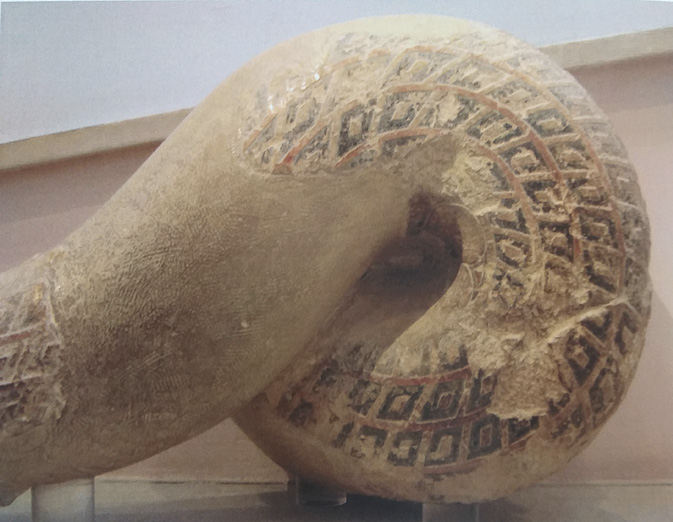
Fig. 8.5 Detail of the coiled body of one snake, at the corner of the East pediment of an Archaic temple on the Athenian Akropolis, around 570 BCE. The pôros sculpture, which was originally brightly painted, retains some traces of pigments (Athens, Akropolis Museum, inv. 37)
As on vase paintings, but in an even more obvious way, on sculptures the geometric patterns that decorated the bodies of snakes were also used for the distinctive garments worn by Asian people (such as Persians, Scythians or Medes), whose poikilia is frequently emphasised by written sources (see, for example, the description of the Persian army by Herodotus).51 For instance, the statue of a horseman known as the ‘Persian rider’, dating from approximately the same period and also coming from the Athenian Akropolis, strongly reminds us of the snake of the pediment. The sculptor aimed to show the specificity of the costume: trousers (anaxyrides) and a long-sleeved jacket (kandys), which differed markedly from the loose and draped garments worn by the Greeks. The horseman is therefore dressed as a Barbarian warrior: probably a Persian rider – hence the name given to the sculpture by modern archaeologists. A reconstruction of the original polychromy has been proposed by Vinzenz Brinkmann and Ulrike Koch-Brinkmann, thanks to the analysis of the remaining pigments to be found on the surface of the marble (figure 8.6).52
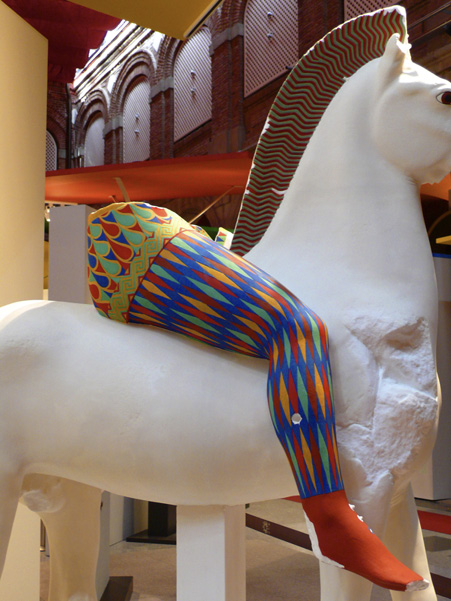
Fig. 8.6 Colour reconstruction by Vinzenz Brinkmann and Ulrike Koch-Brinkmann of the so-called ‘Persian horseman’ found on the Athenian Akropolis. The original marble sculpture, from the late sixth century or early fifth century BCE, is held in the Akropolis Museum (inv. 606) and retains remains of pigments (photo by Ana Belén Cantero Paz in 2010) https://commons.wikimedia.org/wiki/File:Jinete_persa.jpg

The legs of the warrior here clearly resemble the colourful body of the snake. Another significant example is the statue of a Trojan archer (Paris, perhaps) found at the corner of the West pediment of the temple of Aphaia on Aegina (built at the beginning of the fifth century BCE). When the sculpture was unearthed in the spring of 1811, it retained traces of pigments, primarily blue and red. Unfortunately, the remains of the original polychromy are now lost and technical analysis undertaken in the 1990s was unable to provide any conclusive evidence regarding the colour scheme. Nevertheless, an investigation of the surface under ultraviolet light showed that the marble had been unevenly preserved and revealed a complex diamond pattern on the archer’s leg and undergarment. Drawing a comparison with contemporaneous sculptures like the Akropolis horseman enabled Vinzenz Brinkmann and Ulrike Koch-Brinkmann to propose a polychrome reconstruction in 2003, based on a five-colour scheme (red, blue, yellow, green, brown).53 Although their experimental reconstruction remains highly hypothetical as regards the colour-scheme,54 the geometry of the pattern seems to be quite secure. Here again we find a diamond network, although this example is even more elaborate than that on the leg of the Persian rider, since the craftsman has differentiated between the sleeved top, with its zigzag pattern, and the trousers, which were decorated with a double zigzag pattern. Was such an elaborate pattern a work of pure creativity on the craftsman’s behalf? The answer is no. Thanks to experiments led by the textile conservator of the Bavarian National Museum, Dagmar Drinkler, we now know that all these motifs could also be achieved on real fabrics using the sprang technique (Drinkler 2009). According to Drinkler, this technique is the only way to obtain the elasticity required to make this kind of tight-fitting outfit. A two-colour reconstruction of the hose and shirt has been made, and the comparison with the painted sculpture is highly convincing (figure 8.7).
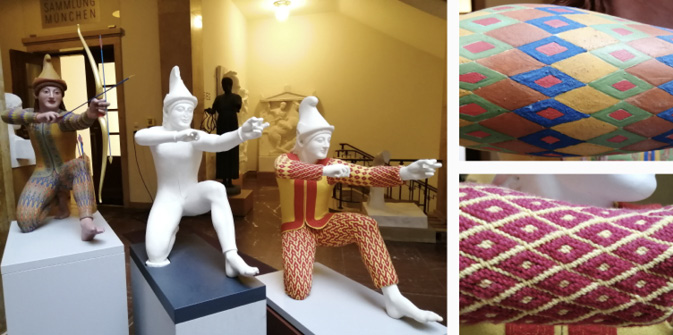
Fig. 8.7 Plaster reconstructions of the Trojan archer from the pediment of the temple of Athena Aphaia in Aegina (one painted reconstruction, by Vinzenz Brinkmann and Ulrike Koch-Brinkmann, and one plaster cast covered with a garment woven by the textile conservator of the Bavarian National Museum, Dagmar Drinkler). The original marble sculpture, from the beginning of the fifth century BCE, is held in the Glyptothek in Munich (photo by A. Grand-Clément during the Homo Textor conference, in September 2019 in Munich)
Now, the question is: did the sculptor aim to reproduce the visual appearance of an actual Asian outfit? To this we may answer ‘Not necessarily’. As in the depictions of snakes, I suggest that the main goal of the sculptor was to trigger the imagination of the viewer and to make him realise that the vivid garments were non-Greek; from the Greco-Persian wars onwards, Trojans, like Amazons, were mythical equivalents for Scythians and Persians. In fact, when we look at Achaemenid images, it does not seem that the Persians depicted themselves with diamond-patterned and tight clothing at all, to which we may add that the archaeological findings suggest that they probably wore loose garments.55 Nevertheless, a glaze brick from the walls of the palace of Darius I at Susa shows part of the leg and foot of a Median servant wearing trousers decorated with a zigzag pattern with three different alternating colours:56 this image gives us some reason to think that diamond patterns were linked with the Median people rather than with the Persians. Additionally, the scarce archaeological evidence we have for Scythian textiles of the fifth century BCE indicates that rhombic patterns appear among other geometrical patterns on their carpets, headdress, and saddlecloths. However, we do not know to what extent this pattern was used on other pieces of clothing, especially trousers.57
While we are thus unable to draw strong conclusions about the actual historical clothing styles of Asian peoples, we can safely conclude that diamond patterns and tight-fitting trousers became part of the Greek imagery that was used to depict them. The Greeks knew that Barbarian outfits were made of fabric that might differ from wool or linen (felt or leather, for instance), and were cut in a different shape, clinging more closely to the body. It was therefore a challenge for the Greek craftsmen to convey a sense of otherness in their works. In crafting their depictions, they probably had in mind the elaborate pieces58 of clothing made with sprang technique, but also, as I will argue below, the scaly and elastic skin of poikiloi snakes.
In the remaining part of this paper, I would like to expand on the reasons for the Greek use of a diamond pattern in characterising the Eastern Barbarians. My hypothesis is that the network of diamond shapes, which was closely connected to snakes, was regarded as visually encoding the notions of otherness and hybridity. To support this idea, it will be necessary to explore further a number of issues relating to geometry and graphics. Michel Pastoureau’s typology for medieval images, although very schematic, may be useful in this regard for reading and understanding Greek iconography. In his book L’étoffe du diable,59 the historian draws a distinction between three main ways of depicting garments on images: first, there are plain, monochrome, undecorated textiles (‘l’uni’); second, spangled textiles (‘le semé’) with the motifs regularly and sparingly distributed; third, spotted, striped, hatched, chequered or variegated textiles (‘le bigarré’) which include a large range of patterns that are denser in their distribution. The last two kinds of decorated textiles do not convey the same values; ‘le semé’ is a mark of belonging to a high-status class, whereas ‘le bigarré’ is depreciated and points towards transgression or deviance: Pastoureau (2008: 47) shows that striped clothes are used to stigmatise ridiculous people, fools, prostitutes and even evil figures. The character of Harlequin is one of the most familiar figures of the ‘dark side’ of variegation. Pastoureau also argues that striped or diamond-patterned garments were associated with dissident characters because of the deceitful appearance of the decoration. He explains that, in the case of an alternation of stripes or diamonds, it proves impossible to distinguish the background from the motif; the eye of the viewer is lost and trapped – as it is with the kolam designs with which we began.
My hypothesis is that the Greek choice of a diamond pattern for depicting Barbarian garb may well have its origins in similar thought processes. Indeed, the concentration of motifs and the saturation of colours would have been regarded by the Greeks as a mark of disorder and threat. Since the sight of such a decorated pattern could rouse fascination and allure, it might at the same time constitute a threat, a danger. In this light, it is worth noting that, according to Euripides, the Trojan war broke out because of the fancy trousers worn by Paris: Helen was driven mad when she saw his beautiful poikiloi trousers, which made her immediately fall in love with him.60 The effect of the trousers here is similar to what we might expect if Paris had used an iunx-wheel or displayed Aphrodite’s band.
Pastoureau focuses mainly on stripes in his book. We have already seen that the Greek sculptors tended to use lozenges, rather than stripes or chequerboard patterns, to decorate the body of snakes as well as the surfaces of Persian clothing. The term used in Euclidean geometry to designate a lozenge is rhombos, which Aristotle defines as ‘a four-sided figure with all the sides, but only the opposite angles, equal’61, which means an equilateral parallelogram with oblique angles. However, the use of the term rhombos was not restricted to the field of geometry and mathematics. Indeed, it has in ancient Greek the basic meaning of ‘anything that may be whirled’.62 In Pindar, it refers to the trajectory of a javelin and to the swoop of an eagle, which seems to point towards a vibrating, rotating movement.63 But it was above all the name given to certain devices used by the Greeks for the purpose of specific rituals or as toys for children, the efficacy of which stemmed from the swiftness of the whirling and from the whistling sound thus produced. Indeed, among the basic definitions of rhombus to be read in dictionaries, we have ‘bullroarer’, that is, an oblong block of wood or metal attached to a cord and whirled around the head to produce a ‘roaring’ sound – a kind of instrument well known to anthropologists.64 Another meaning is ‘spinning top’ or ‘magic wheel, spun alternately in each direction by the tension of two cords passed through two holes in it, used as a love charm’.65 The rhombos so defined certainly reminds us strongly of the iunx. In fact, modern scholars still debate whether both terms might in fact denote the same kind of object66 (rhombos being a more generic category, under which the iunx-wheels fall) or if the words refer to two very distinct wheel-like/spinning devices used for magic and rituals. I find the second option more convincing, for it does indeed seem that the rhombos rotated in the same direction, while the iunx-wheel went around first in one direction and then turned backward, thanks to the twisting of the wire.67 In any case, the rhombos undoubtedly pertained to the field of poikilia and cunning intelligence (mètis), as did the iunx-wheel.
Why was the word rhombos also used to designate the lozenge? The connection between the two meanings remains unclear. In etymological dictionaries, rhombos is connected with the verb rhembomai, meaning ‘to turn round and round’, ‘to go about, to wander, to roam around, to act at random’.68 This etymology accounts for the ‘spinning instrument’ meaning, but there is nothing here that helps to provide a convincing explanation of the way rhombos came to mean ‘diamond-shaped’. Chantraine suggests that it was probably the shape of the spinning devices that led the Greeks to designate lozenges as rhomboi,69 but I would like to consider another hypothesis, according to which the processes of translation and distortion might have played a role. Indeed, a diamond can be understood as a square that has been twisted and whose angles have consequently been distorted. It is even possible that the sprang technique, involving the twisting of threads in order to achieve elastic textiles, was associated with rhomboi, whereas the traditional weaving technique on the warp-weighted loom was used to produce rather squared patterns.
In any case, what kind of link can be established with Asian dress? It has been shown that, in the Greek mind, Scythian, Thracian and Persian warriors were perceived as being unfair, cowardly, and deceitful fighters, in contrast to the courageous hoplites struggling along with their fellow citizens in the rectangular-shaped phalanx while firmly grasping their round shields.70 Asian riders, like Amazons, were credited with a potentially deceptive, ‘twisting’ behaviour, the action of the mounted archer who sets his horse to run from the enemy but then twists round to fire off his arrows. The rhombus could thus have been taken as an appropriate graphic device for conveying otherness. Such a hypothesis would also account for the numerous images in which we find rhombuses or scaly patterns on Athena’s aegis – as is the case, for instance, on the pediment of the temple of Aphaia, where the colourful aegis worn by the goddess71 echoes the Asian garb of the archer: ‘the multi-coloured scaly aegis then points to its nature as an artful, complex, magical and potentially dangerous monster’s skin’.72 The Asian archer of the Aegina pediment was certainly depicted as being on the wild side, positioned in the Greek mind next to the coiling, unpredictable and deceitful snake, and the powerful and fearsome divine aegis.
Concluding remarks
In this paper, I have tried to determine what was at play in the connection that the Greeks established between certain peculiar animals and decorated textiles. I took the examples of wrynecks and snakes, exploring both texts and images to analyse how these animals were depicted and why they were considered to be living examples of poikilia. In both cases, the connection between poikilia and mètis came to the fore, as did the importance of the sensory (often multi- and cross-sensory) perception that constitutes such a fundamental part of the notion of poikilia in Archaic and Classical Greece. Both animals display multiple or changing colours, intricacy of patterns, unpredictable motion and a whistling sound. Although in a different manner – the wryneck, because of its plumage and snaky features, the snake, because the regular geometry of its scales changes as it moves in its distinctive way – both embody the idea of optical illusion, trickery, something that cannot be trusted by the eye, like Gell’s technology of enchantment, and which may thus arouse mixed feelings compounded of both repulsion and attraction. Hence, there is no barrier between nature and craftsmanship. The bird has the magic iunx-wheel as a counterpart, but also the Aphroditean ribbon; the snake is on the side of the sonorous rhombus, as well as Athena’s aegis and Asian trousers.
The fact that many sensory features – especially movements, colours, textures and sounds – are at play in the imagery we have studied might be interesting in the context of the broader scope of the technology of weaving taken as a ‘mode of existence’. In their seminal study, Giovanni Fanfani and Ellen Harlizius-Klück rightly point out ‘that weaving in antiquity is not a clear gesture nor a simple unification of opposites but a complex composition of woven and plaited parts integrated into a finished product by repeated gestures of turning the piece around or upside down’.73 We might add that weaving also implies a peculiar sensorium: we may think of the role played by sounds, music and songs during the weaving process, or of the choreography of hands and threads induced by sprang technique or tablet-weaving. One might, for instance, suggest that the use of erotic iunx-wheels had something to do with weaving techniques, since the use of the string and the twisting motion of the alternating forward and backward movement recalls the process of tablet-weaving, while the diamond pattern may be associated with the result achieved with sprang technique. Perhaps weaving and magic have much more in common than we usually think.
Endnotes
1 I would like to warmly thank Giovanni Fanfani, Ellen Harlizius-Klück, Annapurna Mamidipudi, David Konstan, Jan S. Østergaard and Thomas Galoppin for their pertinent comments and valuable advice on this paper. Paul Scade was also of great help in revising the English but also in clarifying some ideas. All remaining mistakes are, of course, mine.
2 Gell 1998. Gell’s theory relies on ideas already advanced by Gombrich (1979: 66), according to whom the artist’s virtuosity may still consist in working the materials so well that ‘miraculous transformations’ seem to take place: wood looks like lace, needlework becomes similar to a painting. For a critical view of Gell’s work, see Derlon and Jeudy-Ballini 2010. The authors emphasise that the power of fascination is not unique to art and invite the reader to reassess the importance of the notion of beauty, which they believe was neglected by Gell. They rightly argue that beauty and efficiency go hand in hand and are not mutually exclusive.
3 He does, however, take tattoos into account in one of his chapters. I find it rather surprising that Gell did not pay due attention to the realm of textiles, since we know that in many societies certain items of clothing were endowed with the same kind of agency as other valuable artefacts: they were also ‘works of art’.
4 Grand-Clément 2015, esp. 412–16.
5 Of course, we should bear in mind that the divide between what we might call ‘nature’ and ‘culture’ is a modern Western cultural construct, beyond which scholars must move if they are to understand properly many past and present societies: see Descola 2015. Indeed, Ellen Harlizius-Klück and Giovanni Fanfani (2016: 62–64), drawing on the works of H. Blumenberg, rightly stress that, for the ancient Greeks, physis (nature) and technè (technology) were closely interconnected.
6 On the Iunx torquilla, a bird that is widespread throughout Europe, see Thompson 1936: 124–28; Arnott 2007: 118–119.
7 Aristotle, Historia Animalium, 2.12 504a (transl. A. L. Peck, modified).
8 See, for instance, two videos showing the snaky movement of the head: https://commons.wikimedia.org/wiki/File:Wryneck.ogv and https://www.youtube.com/watch?v=0reJ84wB5yg. I thank Jan S. Østergaard for sending me the link. Dionysius (On Birds 1.23) writes that the bird moves its neck incessantly, like celebrants worshipping the goddess Rhea.
9 The basic meaning is ‘utter a shrill cry’, according to Liddell, Scott, and Jones (1996); the verb is mainly used to denote sounds emitted by animals, especially birds. Aelian describes the wryneck cry as sounding like the aulos (De Natura Animalium, 6.20). For an insightful inquiry on the imagery of the snake hissing and its potential relation to music in Greek sources, see Perrot 2012 (although without reference to the wryneck).
10 Another possible etymology considers iunx as an expressive word (as is the case for a number of names of birds and musical instruments). Consequently, the connection between iunx and iuzô would be a folk etymology. Chantraine (2009: 455) does not choose between the two possibilities, while Beekes (2010: 605) argues in favour of the second and suggests that iunx is a loan word.
11 See, for instance, Callimachus fr. 685 Pfeiffer. On the different versions of the myth, see Detienne 1972: 163; Pirenne-Delforge 1993: 285–6; and Johnston 1995: 182.
12 See Detienne and Vernant 1974. On the close connection that originally existed between poikilia and mètis, see 25–31.
13 Polumèkhanos: Il. 2.173; 4.358; 8.93; Od. 1.205; 5.203; 10.40; poikilometès: Il. 11.482; Od. 3.163; 7.168; 13.293; 22.115, 202, 281.
14 Detienne and Vernant 1974: 32–57.
15 On the iunx-wheel, which is mentioned in a number of written sources, see for instance Gow 1934; Pirenne-Delforge 1993: 283–84. A full bibliography is given in Johnston 1995.
16 Pindar, Pythian 4.213–19 (transl. D. Arnson Svarlien, modified).
17 Contra Faraone (1993:11–16), who thinks that the device was not intended to be moved. Faraone also believes that the bird was tortured (driven mad) and that the effect produced on it was intended to be transferred to the victim.
18 Sarah Iles Johnston (1995: 178) convincingly argues that the sonic effect has predominance over the visual agency: according to her, ‘the iynx was understood to work by emitting a sound that was seductive and persuasive but that also – like so many seductive and persuasive sounds – was possibly deceptive, spelling ruin for its listener’.
19 We should be cautious with the interpretation of the toy-like objects as iunx-wheels, as Faraone argues (1993: 2 n. 3).
20 Reproductions of some of these vase paintings are discussed in Gow (1934: 4–5). Greek jewellery of the Classical and Hellenistic periods also shows figures of erotes manipulating such wheels: see Williams and Ogden 1994: 9.
21 See, for instance, Pindar, Nemean 4.35; Aeschylus, Persians 989 (the Persian king evokes the grief precipitated by the loss of his beloved companions); Aristophanes, Lysistrata 1110.
22 Gow 1934: 11.
23 Therefore, the identification with the iunx-wheel is problematic: see Génière 1958; Karageorghis 1989.
24 Museum of Fine Arts, Boston, inv. 28.49. Diameter 21.5 cm. Images can be found in Nelson 1989.
26 Nelson 1989: 455.
27 See, for instance, an Apulian hydria painted at the beginning of the fourth century BCE (British Museum, F94).
28 This is why Tavenner (1933: 120) is not convinced by the identification and argues persuasively that these birds might be doves. But we can also mention the decoration of a Paestan vase, with the bird’s cross stripes picked out on tail and wings (Bohr 1997, fig. 1).
29 See also the Athenian red-figured hydria from the end of the fifth century BCE held in Florence (Museo Archeologico Etrusco, 81948), on which both the iunx-bird and the iunx-wheel have been identified; for other examples, see Nelson 1946: 454.
30 Greek Anthology, 5.205 (transl. W. R. Paton, slightly modified).
31 Faraone (1993: 152) suggests that Nikô was probably a successful courtesan, ‘who at the end of a long career dedicated this valuable device to Aphrodite, the patron goddess of her profession’.
32 Fifth-century BCE Athenian playwright Aeschylus calls the goddess aiolomètis, ‘dappled-minded’ (Libation Bearers 1037).
33 Sappho, fr. 1 Page. The poem has been brilliantly studied by Privitera (1967), who shows that the use of the epithets poikilothronos and doloplokos is part of the device created to guarantee the efficacy of the prayer. The author supports the traditional view that poikilothronos has the meaning of ‘ornate-throned’, whereas other scholars have argued that it might refer to the flowery garment of the goddess: see Vickers 1999: 22; Scheid and Svenbro 1993: 51–55.
34 A parallel was already drawn by Pirenne-Delforge (1993: 283).
35 Homer, Iliad, 14. 214–21 (transl. A. T. Murray and W. F. Wyatt, slightly modified).
36 See Grand-Clément 2011: 458–59.
37 On the agency of the garment and the meaning of thelkteria, see Carastro 2006: 95–98.
38 Pironti 2007: 97–98.
39 Il. 2.447–49.
40 Il. 15.307–10.
41 On Athena’s aegis, see Vierck 1991.
42 Detienne (1974: 164, 168), who draws a comparison between two mythical young women (Mintha and Iunx), also establishes a connection with perfumes. According to him, seduction may play with visual, sonic and olfactory devices.
43 Another good example of the agency exerted by a poikiloi artefact, blurring the frontier between craftsmanship and living beings, is provided by the round shield of Achilles in the Iliad. I thank David Konstan for drawing my attention to this example. I will not develop this point further here since it goes beyond the scope of the present chapter.
44 On the Greek imagery of snakes, see Sancassano 1997; on the Greek taxonomy of snakes, Bodson 1981; on the role played by snakes in mythology and cult, see Ogden 2013.
45 Theognis, I, 601–2 (transl. D. E. Gerber modified).
46 With regard to textiles, the use of black dots, circles and stars was also a means of conveying the image of variegated, colourful garments for the vase painters, who did not have a great range of colours at their disposal due to the firing process involved in vase production.
47 In this paper, I will not discuss Athena’s colourful and elaborately woven peplos, which also conveys the notion of poikilia but which, I think, works in a quite different way.
48 Other traditions claim that it was forged by Hephaistos: Deacy and Villing (2009: 111).
49 Red-figured cup by Douris, c. 480–470 BC. From Cerveteri (Etruria). Museo Gregoriano Etrusco, inv.16545: https://fr.wikipedia.org/wiki/Fichier:Douris_cup_Jason_Vatican_16545.jpg.

50 For two of the more recent updates on the polychromy of ancient Greek sculpture, with full bibliography, see Østergaard 2018 and Brinkmann 2007. Among the many catalogues of exhibitions held on the topic, see Brinkmann and Wünsche 2007; Østergaard and Nielsen 2014.
51 Herodotus, Historia, 7.61 and 65. For the link between poikilia and Barbarians, see Grand-Clément 2013: 249–53.
52 For the details of the pigment analysis and painting process, see Brinkmann and Koch-Brinkmann 2010: 115–20.
53 See Brinkmann and Koch-Brinkmann 2003. Since then, they have proposed two other experimental colour reconstructions: one in 2006, with a slightly different colour-scheme, and another in 2019, with golden flecks added to the clothing (https://buntegoetter.liebieghaus.de/en/).
54 The great deal of interpretation involved in this colour reconstruction has been criticised by modern scholars (see, for instance, Schmaltz 2009).
55 See the sensational discovery in 1994 of the mummified remains of ancient miners who worked in the fifth and fourth centuries BCE.
in the opencast salt mine of Douzlakh, in north-western Iran. The woven trouser worn by salt mummy no. 4, now in the Archaeological Museum Zanjan, was rather loose and made of plain wool: Grömer 2016.
56 Paris, Musée du Louvre, inv. Sb 14426. Image: http://www.achemenet.com/fr/item/?/musee-achemenide/categories-d-objets/architecture/decor-architectural/3018977
57 For an analysis of the geometric patterns in ancient Scythian and Chinese textiles, see Berczi 2009.
58 Deacy and Villing 2009: 117.
59 His book was translated into English in 2001 with the title The Devil’s Cloth: A History of Stripes.
60 Euripides, Cyclops, 182–85. See Harlizius-Klück, this volume.
61 See Euclides, Elements, 1.22; Ps-Aristotle, Mechanics 854b16).
62 The noun comes from the verb rhembô, meaning ‘to turn round and round’, ‘to roam, rove, roll about’, according to Liddel, Scott and Jones 1996.
63 Pindar, Olympians 13.94; Isthmians 4.47 (3.65).
64 The bullroarer is considered to be the earliest and longest surviving among artefacts that can be termed musical instruments. Its use has been widespread all over the world, but its ritual and symbolic significance have varied from one culture to another. For a few bibliographical references, see Oliver and Johnson 2003.
65 See Liddell, Scott, and Jones 1996: 1574 and suppl. 271 (the word might even designate a tambourine or a ‘kettle-drum’, used in the worship of Rhea and of Dionysus: Aristophanes, fr. 303; Apollonius Rhodius, Argonautica, 1.1139). A Hellenistic epigram mentions a rhombos among the playthings dedicated to Hermes by a young man on becoming an adult: Greek Anthology, 6.309.
66 Tavenner (1933) thinks that rhombus and iunx are both tops. Moreover, he challenges the common view that the so-called iunges depicted on vase-paintings are magic wheels, contending that the objects are rather playthings or love gifts, such as wreaths.
67 According to Gow (1934: 6), followed by Johnston (1995), the iynx was a wheel on a loop of string, whereas the rhombos was rather a bullroarer, but in the ancient texts the difference is not so clear. It seems that, in contrast to the iunx, we do not have any depiction of a bullroarer on a Greek vase.
68 Beekes 2010: 1280; Chantraine 2009: 935–36 (who suggests that the etymological root is possibly *wer, to turn).
69 Chantraine 2009: 935. Archimedes uses the term ‘solid rhombos’ to designate two right circular cones sharing a common base.
70 See Lissarrague 1990. Regarding the Thracians, more specifically, it must be stressed that, on vase paintings, their long cloak (the zeira) quite often featured patterns, stripes, and sometimes dots. However, this garment is never depicted with lozenges. I suggest that the reason for the difference between Persian tops and trousers is that the zeira is not regarded as being tight-fitting. We may add that the Thracians (especially women) are also depicted with tattoos on their skin, which is another way of suggesting the poikilia of Barbarians.
71 See the reconstruction in Brinkmann 2004: 120–21.
72 Deacy and Villing 2009: 117.
73 Harlizius-Klück and Fanfani 2016: 95.
References
Arnott, W. G., Birds in the Ancient World from A to Z (London; New York: Routledge, 2007).
Beekes, R., Etymological Dictionary of Greek (Leiden; Boston: Brill, 2010).
Berczi, S., ‘Geometry of Royal Tomb Art of Ancient Eurasia: Scythian, Xiongnu and Chinese Ethnomathematics from Ukraine, Russia, Mongolia and China’, Pollack Periodica, 7 (2012): 199–211.
Bodson L., ‘Les Grecs et leurs serpents. Premiers résultats de taxonomique des sources anciennes’, L’Antiquité classique, 50.1–2 (1981): 57–78.
Bodson, L., ‘Introduction to the Ancient Greek System of Snake Naming: the Ophionym dipsas and its Synonyms’, Anthropozoologica, 47.1 (2012): 73–155.
Bohr, E., ‘A Rare Bird on Greek Vases: The Wryneck’, in J. H. Oakley, W. D. E. Coulson and O. Palagia, eds, Athenian Potters and Painters (Oxford: Oxbow Books, 1997), pp. 109–23).
Brinkmann, V., ‘The Polychromy of Archaic and Classical Greek Sculpture’, in J. S. Østergaard and A.-M. Nielsen, eds, Transformations: Classical Sculpture in Colour (Copenhagen: Ny Carlsberg Glyptotek, 2014), pp. 80–115.
Brinkmann, V., and U. Koch-Brinkmann, Der prächtige Prinz (Munich: Biering & Brinkmann, 2003).
Brinkmann, V., ‘Il Principe e la divinità: La riscoperta della policromia sulle sculture del Tempio di Egina’, in P. Liverani, ed., I Colori del Bianco. Policromia nella Scultura Antica (Roma: De Luca, 2004), pp. 107–32.
Brinkmann, V., and U. Koch-Brinkmann, ‘On the Reconstruction of Antique Polychromy Techniques’, in V. Brinkmann, O. Primavesi, and M. Hollein, eds, Circumlitio: The Polychromy of Antique and Mediaeval Sculpture (Munich: Hirmer, 2010), pp. 114–35.
Brinkmann, V., and R. Wünsche, Gods in Color: Painted Sculpture of Classical Antiquity; Exhibition at the Arthur M. Sackler Museum, Harvard University Art Museums, in Cooperation with Staatliche Antikensammlungen and Glyptothek Munich and Stiftung Archäologie Munich, September 22, 2007–January 20, 2008 (Munich: Stiftung Archäologie Glyptothek, 2007).
Carastro, M., La cité des mages. Penser la magie en Grèce ancienne (Grenoble: Millon, 2006).
Chantraine, P., Dictionnaire étymologique de la langue grecque: Histoire des mots. Avec Supplément (Paris: Klincksieck, 2009).
Deacy, S., and A. Villing, ‘What Was the Colour of Athena’s Aegis?’, Journal of Hellenic Studies, 129 (2009): 111–29.
Derlon, B., and M. Jeudy-Ballini, ‘L’art d’Alfred Gell’, L’Homme, 193 (2010): 167–84.
Déléage, P., ‘Les répertoires graphiques amazoniens’, Journal de la société des américanistes, 93.1 (2007): 105–26.
Descola, F., Par-delà nature et culture (Paris: Gallimard, 2015).
Detienne, M., Les Jardins d’Adonis: La mythologie des aromates en Grèce (Paris: Gallimard, 1972).
Detienne, M., and J.-P. Vernant, Les ruses de l’intelligence: La mètis des Grecs (Paris: Flammarion, 1974).
Drinkler, D., ‘Tight-Fitting Clothes in Antiquity – Experimental Reconstruction’, Archaeological Textiles Newsletter, 49 (2009):11–15.
Faraone, C., ‘The Wheel, the Whip and Other Implements of Torture: Erotic Magic in Pindar Pythian 4.213–19’, Classical Journal, 89 (1993): 1–19.
Faraone, C., Ancient Greek Love Magic (Cambridge, MA: Harvard University Press, 1999).
Gell, A., Art and Agency: An Anthropological Theory (Oxford: Clarendon Press, 1998).
Gell, A., ‘The Technology of Enchantment and the Enchantment of Technology’, in J. Coote, ed., Anthropology, Art, and Aesthetics (Oxford: Clarendon Press, 1994), pp. 40–63.
Génière, J. (de la), ‘Une roue à oiseau du Cabinet des Médailles’, Revue archéologique, 60 (1958): 27–35.
Gombrich, E., The Sense of Order: A Study in the Psychology of Decorative Art (Oxford: Phaidon, 1979).
Gow, A. S. F., ‘ΙΥΓΞ, ΡΟΜΒΟΣ, Rhombus, Turbo’, Journal of Hellenic Studies, 54 (1934): 1–13.
Grand-Clément, A., La fabrique des couleurs. Histoire du paysage sensible des Grecs anciens (VIIIe–début du Ve s. av. n. è.) (Paris: De Boccard, 2011).
Grand-Clément, A., ‘Poikilia. Pour une anthropologie de la bigarrure en Grèce ancienne’, in C. Bonnet, P. Payen, and E. Scheid, eds, Anthropologie de l’Antiquité. Anciens objets, nouvelles approches (Turnhout: Brepols, 2013), pp. 239–62.
Grand-Clément, A., ‘Poikilia’, in P. Destrée and P. Murray, eds, A Companion to Ancient Aesthetics (London: Blackwell, 2015), pp. 406–21.
Grömer, K., ‘Durchdacht gemacht: Die Kleidung eines Salzmannes aus Chehrabad Iran’, Universum Magazin, 3 (2016): 108–9.
Harlizius-Klück, E., and G. Fanfani, ‘(B)orders in Ancient Weaving and Archaic Greek Poetry’, in G. Fanfani, M. Harlow, and M.-L. Nosch, eds, Spinning Fates and the Song of the Loom: The Use of Textiles, Clothing and Cloth Production as Metaphor, Symbol and Narrative Device in Greek and Latin Literature (Oxford & Philadelphia: Oxbow Books, 2016), pp. 61–99.
Johnston, S. I., ‘The Song of the Iynx: Magic and Rhetoric in Pythian 4’, Transactions of the American Philological Association, 125 (1995): 177–206.
Karageorghis, V., ‘Two Votive Iynx-Wheels from Cyprus’, in Architecture et poésie dans le monde grec. Hommage à Georges Roux (Lyon: Maison de l’Orient et de la Méditerranée Jean Pouilloux, 1989), pp. 263–68.
Lagrou, E., ‘Le graphisme sur les corps amérindiens: Des chimères abstraites?’, Gradhiva, 13.1 (2011): 68–93.
LeVen, P., ‘The Colours of Sound: Poikilia in its Aesthetic Contexts’, Greek and Roman Musical Studies, 1 (2013): 229–42.
Liddell, H. G., R. Scott, and H. S. Jones, Greek-English Lexicon, with a revised Supplement (Oxford: Clarendon Press, 1996 [1946]).
Lissarrague, F., L’autre Guerrier: archers, peltastes, cavaliers dans l’imagerie attique (Paris: La Découverte, 1990).
Nelson, G. W., ‘A Greek Votive Iynx-Wheel in Boston’, American Journal of Archaeology, 64 (1946): 443–56.
Ogden, D., Drakon: Dragon Myths and Serpent Cult in the Greek and Roman World (Oxford: Oxford University Press, 2013).
Oliver, P., and B. Johnson, ‘Bullroarer’, in J. Sheperd, ed., Continuum Encyclopedia of Popular Music of the World (New-York; London: Continuum, 2003, vol. 2), p. 412.
Østergaard, J. S., ‘Polychromy, Sculptural, Greek and Roman’, in The New Oxford Classical Dictionary, Oxford: Oxford University Press, 2018 https://doi.org/10.1093/acrefore/9780199381135.013.8118 [accessed 11 November 2023].
Østergaard, J. S., and A.-M Nielsen, Transformations: Classical Sculpture in Colour (Copenhagen: Ny Carlsberg Glyptotek, 2014).
Pastoureau, M., L’Étoffe du diable. Une histoire des rayures et des tissus rayés (Paris: Seuil, 2008).
Perrot, S., ‘Le sifflement du serpent: du son inarticulé à la mise en musique’, Anthropozoologica, 47.1 (2012): 345–61.
Pirenne-Delforge, V., ‘L’Iynge dans le discours mythique et les procédures magiques’, Kernos, 6 (1993): 277–89.
Pironti, G., Entre ciel et guerre. Figures d’Aphrodite en Grèce ancienne (Liège: CIERGA, 2007).
Privitera, G. A., ‘La rete di Afrodite. Ricerche sulla prima ode di Saffo’, Quaderni Urbinati di Cultura Classica, 4 (1967): 7–58.
Rinaudo, M., ‘Sviluppi semantici e ambiti d’uso di poikilos e derivati da Omero ad Aristotele’, in E. Berardi, ed., Poikilia: Variazioni sul tema (Acireale: Bonanno Editore, 2009), pp. 25–64.
Sancassano, M. L., Il serpente e le sue immagini: Il motivo del serpente nella poesia greca dall’Iliade all’Orestea (Como: Edizioni New Press, 1997).
Scheid, J., and J. Svenbro, Le métier de Zeus: Mythe du tissage et du tissu dans le monde gréco-romain (Paris: Errance, 2003).
Schmaltz, B., ‘Die Kore Akropolismuseum inv.682. Versuch einer Rekonstruktion’, Jahrbuch des deutschen archäologischen Instituts, 124 (2009): 75–134.
Tavenner, E., ‘Iynx and Rhombus’, Transactions of the American Philological Association, 64 (1933): 109–27.
Thompson, D’Arcy W., A Glossary of Greek Birds (London: Oxford University Press, 1936).
Vickers, M. Images on Textiles: The Weave of Fifth Century Athenian Art and Society (Konstanz: University Press Konstanz, 1999).
Vierck, S., ‘Die Aigis: zu Typologie und Ikonographie eines mythischen Gegenstandes’, Diss. Münster, 1991.
Williams, D., and J. Ogden, Greek Gold: Jewellery of the Classical World (New York: Abrams, 1994).