14
Braiding and dancing: Embodied rhythm and the matter of pattern
Victoria Mitchell
Introduction: from dancing hands to robotic maypoles
For the anthropologist Gregory Bateson, all actions which are interlocking, directional, ever-changing, active, social and patterned, whether performative or material, are related to an ‘almost universal linkage in aesthetics between skill and pattern’ (Bateson 1972: 148). Following Bateson, this paper considers the actions, rhythms and patterns of braiding as an intertwining of physical and cognitive systems which pertain to relational interaction, not only between strands of material but also in social and cultural contexts.1 Braiding is initially identified through the actions of fingers, hands, arms and neuro-muscular rhythms in response to materials and cultural outcomes, as evidenced in basketry, textiles and hair styling. The embodied rhythm, patterned actions and ‘physiological aesthetics’ (Leroi-Gourhan 1993: 296) of braiding also lend themselves to whole-body kinaesthetic articulation, such that a parallel between braiding and dancing can be indicated. Reciprocity is thus established between the manipulation of materials, synchronised motions and social interaction; a ‘universal linkage’ of pattern and skill are inscribed in the braid, through braiding, and in dance, through dancing. Parallels between people braiding together through dance and fingers dancing as they braid may come to light.
The overt simplicity of braiding belies the hidden complexities of its reach. As Noémi Speiser indicates with reference to textiles, there are many braiding communities, each with techniques varying according to their context. For Jack Lenor Larsen, considering braiding in the context of interlacing, a ‘universe of braid forms’ can be identified (Larsen 1987: 119) while Heiko Hanmann, investigating emerging technologies for braid, considers its possibilities as ‘almost infinite’ (Hanmann 2018: 75). For students of the architect Lars Spuybroeck, designing a tower inspired by braiding, ‘the simplicity of how braiding is defined might defy the complexity and abundance of its possible applications but it is precisely this vagueness of definition that allows for variation within the system’.2 Even where the under-over actions of braiding are at their simplest, the effects can be complex. Variations, as articulated by Irene Emery, ‘are effected by two basically simple devices: increasing the number of elements employed, and altering the order of the interlacing in one way or another’, as in twill braiding. (Emery 1966: 62)
Elaborations as exemplified in hand loop, split-ply and kumihimo braiding patterns, together with seemingly unlimited colour combinations, further enrich the technical variation and complexity.3
Although a simple braid of three strands is ubiquitous and easily accomplished, proficiency in respect of the interweaving of separate strands into an elaborately ordered whole emerges through practice over time. Skill (from Old Norse skil and skilja, discernment, reasoning) includes establishing a sense of timing, combining various but often repeated actions with continuity and flow. Entrainment enables self-consciousness and reflection, facilitated by the discriminatory skills which are as much activated through the actions of the body as through the eyes that observe and modify the results. As in many forms of dancing, a succession of synchronised moves, figures, steps or units of action are acquired through trial and error or through imitation. Rush workers, braiding alongside one another, have noticed that the rhythm of their actions sometimes becomes synchronised4 and Speiser, similarly, emphasises attention in braiding to phases of action that ‘blend smoothly into each other’ (Speiser 2018 (1988): 16).
The contexts of such fluidity of action might include meditation and religious observance but its sometimes mesmerising effects are also related to the industrial and economic exploitation of the body’s ability to braid mechanistically, an unfortunate consequence of skill taken to an unhealthy extreme, as in plaiting for hat production, particularly in the nineteenth century (Robinson 2016).5 Mind and body become mechanised, as if having a propensity to become robotic. Machine braiding may be an inevitable consequence. Since the nineteenth century, through mechanisation and the use of metals and synthetic materials, braiding techniques have multiplied, thus triaxial and three-dimensional braided fabric structures are now widely used in medical, aerospace and construction contexts, for example. The so-called Maypole braider, with clear reference to maypole and ribbon dance traditions (figures 14.1 and 14.2), is one of the oldest and now most technologically and digitally advanced machines for producing hollow circular braiding. Maypole ribbons become strands which move clockwise or anti-clockwise, alternating to the left or right to create the necessary interlace, with the tension and angle of the strands kept constant so that the pattern remains regular. Watching such a braider in action is uncannily reminiscent of watching the movement of people (as ribbon-holding bobbing bobbins) in a dance.
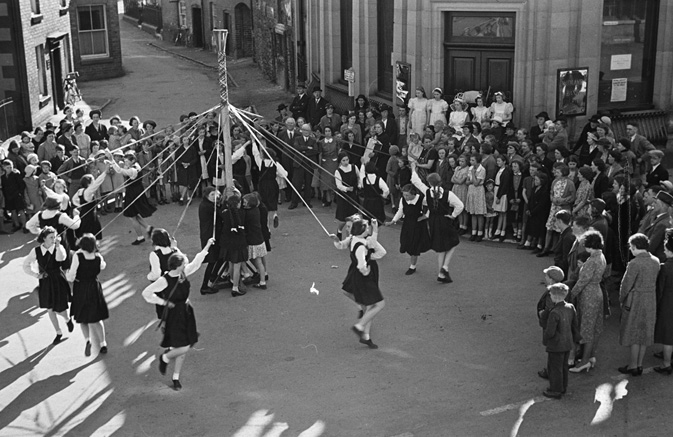
Fig. 14.1 Maypole dancing at a carnival in Llanfyllin, Wales, 1941; https://en.wikipedia.org/wiki/Maypole#/media/File:Llanfyllin_carnival_and_maypole_(7131389767)
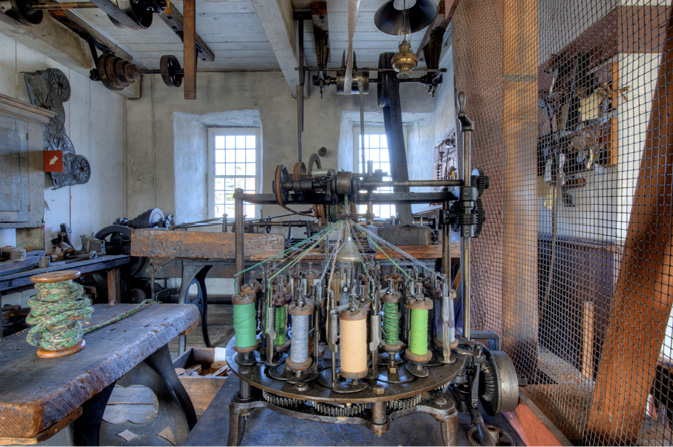
Fig. 14.2 Braiding machine, late nineteenth century, Wilkinson Machine Shop, Rhode Island; https://commons.wikimedia.org/wiki/File:Braiding_machine_in_Wilkinson_Machine_Shop.jpg

Inspired both by hand braiding and the Maypole braider, techniques of braiding have most recently been the subject of investigation by Flora Robotica, an EU-funded project (2015–19) for ‘Future and Emerging Technologies’ in which braid is understood as a ‘universal organizational structure’.6 Although the Flora Robotica braid research is envisaged in terms of emerging future technology, traditional hand-braiding techniques form a crucial early stage of investigation, (figure 14.3) enabling connections between non-human fibres in plants and synthetic fibres to be cognitively generated and embodied. Having first been explored through manipulation, threads or filaments are then processed via algorithms, sensors, agents (and so on), to become autonomous and self-organising cognitive systems, functioning like artificial (robotically-generated) plants which not only support the biological plants but are in turn supported and controlled by the growth of the plants, such that plants and robots grow together. From simple beginnings braid emerges as having the potential to grow like a plant and to demonstrate discriminating behaviour.
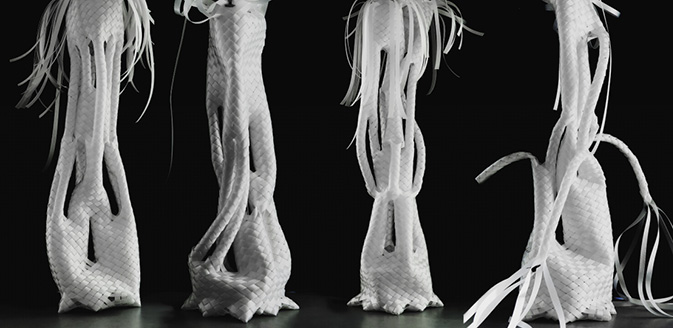
Fig. 14.3 Experiments to explore complexity of braid morphologies; Flora Robotica; Courtesy Phil Ayres, Centre for Information Technology and Architecture, The Royal Danish Academy of Fine Arts Schools of Architecture, Design and Conservation
Key advantages of braid in enabling robots and biological organisms to talk to one another are noted in terms of a combination of flexure and stiffness and an ability to ‘rotate at intersections’, thus:
Braid, as a typology, is a group of three or more continuous filaments interlacing so that they are functionally similar and span the length of the braid… The interlacing organization and continuity of filaments allows braided elements to be self-structuring if filaments are sufficiently stiff. Because individual filaments are not mechanically affixed to one another, they are also able to translate and rotate at intersections. They are mechanically flexible, able to contract and elongate without change to organization of filaments, and able to form a variety of complex shapes (Heinrich and others 2016: 154).
In one configuration, exemplifying swarm braiding, Thymio robots perform and form a maypole-type braid, influenced by a traditional maypole dance, in which ‘[r]obots braid, one strip each by a simple line-following behavior and a collision avoidance behaviour’ (Hanmann 2018: 75). Braiding emerges through a reciprocity which enables strands to be held apart while also remaining together.
In 2017 Cathrine Hasse, a Danish anthropologist with an interest in robotic engineering, brought robotics engineers, including those working with Flora Robotica, together with Danish basketmakers, for a seminar on weaving robots and basketry. The objective was to see to what extent basketry skills can inform a shift in robot-making from hard materials to human-friendly soft materials, made for instance, of silicone or other bendable materials, together with wires necessary to conduct current. Hasse notes that ‘[b]asketry, knitting and weaving are embodied processes which often function without any conscious awareness by the human of all the bodily processes involved. When working with robots, humans have to learn to apply all the intuitive movements and at the same time become aware of their own embodied being by learning from robots’ (Hasse and Treusch 2021). In the making of robots as cognitive, embodied systems we are thus led to reflect upon our own subconscious and intuitive braiding-type processes.
From hand movements to dancing hands
Even within the futuristic ambitions of Flora Robotica, techniques originating in the body are understood as primary and instrumental in understanding the effective generation of braid. The body actively generates braiding motions which in turn generate technique, arguably through a bipedal more-or-less-symmetrical formation of interwoven or intersecting interior physiological structures and operational crossings from one side or one end of the body to the other and through interior-exterior interaction, especially through the hands in their manipulation of material. Techniques are not the preserve of individual bodies, however, but are also distributed within social and cultural contexts. For Marcel Mauss, ‘techniques of the body’ are coordinated bodily actions, learned or acquired, like those of a craft, so that they form part of a skill set for any given culture. They can be as seemingly innocuous as walking or perhaps more culturally marked, such as in dancing or caring for the body (Mauss 2006: 85–91). The braiding of hair may be one such technique of the body, an act of caring-for-one-another or grooming which has a relational role to play within the development of culture.
Hair is a textile medium, of the body at the same time as being an extension to it, which lends itself to braiding, activating the hands and fingers to work as combs, so that ‘hair and hands work together’ (Tarlo 2016: 149). Long hair, if it is not cared for, easily becomes dishevelled, but it is flexible and directional, easily divided into bundles of strands which can be shaped into an orderly pattern (figure 14.4). This serves not only practical but also aesthetic and symbolic ends. As increasingly suggested by the archaeological record, the patterning of hair braids in prehistoric contexts may be indicative of skill and enhanced status (Tomaž 2017: 355–56; Tassie 2009); in many cultures dishevelled or ungroomed hair (particularly of females) is or was associated with wanton behaviour, whereas braided hair denotes order and propriety (Barber 2014: 23). Perhaps coincidentally, braided hair is often worn by females in traditional social dance contexts; lively movement of the hair requires control and decorative effect is especially valued. In a way that is not dissimilar to loose strands of hair, the warp ends which are left when woven cloth is cut from the loom are sometimes tied and tidied through a braided fringe, thus mitigating against fraying and also adding a decorative element. In considering a cross-over between hair braiding and braiding with other materials, an etymological crossover between hair braiding and rope may be indicative; thus the Greek word trikhia (τριχιά), meaning rope or tether, is derived from the word for hair thrix (θρίξ), with both combined in the Vulgar Latin cognate trichia, meaning both braid and rope. In contemporary Italian, braid is treccia and in French it is tresse (from which English derives ‘tresses’, to describe hair, especially when it is long).7 The French word for knitting, tricot, is related, and more recently also used in English to describe a form of warp knitting in which the yarn zigzags vertically, following a single column or wale.
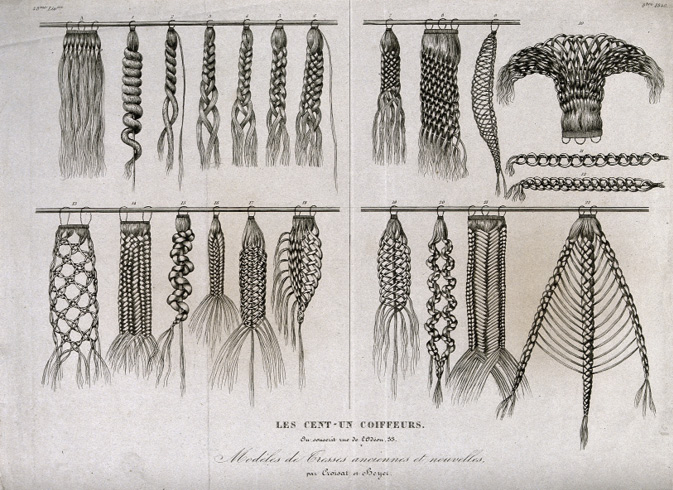
Fig. 14.4 Modèles de Tresses anciennes et nouvelles; twenty-two illustrations showing different plaited hair pieces. Etching. Croisat et Heyer, 1840. Wellcome Collection.
The reticulate patterning of braiding actions as formed through the manipulation of appropriate materials is characterised by branching and linking, dividing and uniting, opening and closing, interweaving or interlinking, all together forming a planar surface or a distinctively patterned length (figure 14.5). The quasi-geometrical patterns that typically result appear to be formed of small but dynamically poised squares, although each strand (or bundle of strands) can also be followed through with the eye, under and over other strands, criss-crossing and zigzagging from one end or side to the other. Each strand is ‘active’ in formation of the pattern, and there is typically an equivalence in the ordering of strands, with each strand alternating in being warp or weft as the braiding proceeds. In this ‘active’ capacity, braiding strands are distinct from the stronger-weaker effect of the fixed warp and active weft such as in weaving on a loom. Directional reciprocity is one of the salient characteristics of the alternating actions; thus, as the braid proceeds, one set of actions follows mimetically from another and the reticulation of the pattern is generated through mirroring, rotation, balance and repetition. Each strand has a role to play in forming an orderly, repeated arrangement. Pattern and skill form interweaving strands of action, as if always in close correspondence and ‘in-forming’ an intimate network.
The braider’s hands are especially significant in this respect. Archaeologist Lambros Malafouris, considering the working processes of potters, remarks that ‘their hands often have reasons of which their mind is not aware’ (Malafouris 2008: 20). Within traditional textile and basketry contexts a well-made braid depends on artful manipulation, with fingers and hands, separately and together, holding down, lifting, hooking up, tensioning, drawing together, teasing apart or disentangling, twisting, folding, smoothing and ensuring even density; The hands may perhaps also, as in the case of working with plant fibres, add more material of the appropriate dampness, density, pliability or colour. As braiding proceeds, strands are continuously and numerically divided by the fingers and (re)arranged according to the established order of the pattern-in-process. The two hands mirror each other yet are continually shifting, as if in rotation. In Noémi Speiser’s explanation ‘the distinct movements depend to a certain degree on the proportions of your hands, especially on the relative lengths of index, middle and ring fingers, which are particularly involved in these processes’. All the fingers are employed and ‘a lazy finger must not be allowed to rest, it must on the contrary, be trained to participate’ (Speiser 2014 (1988): 16).
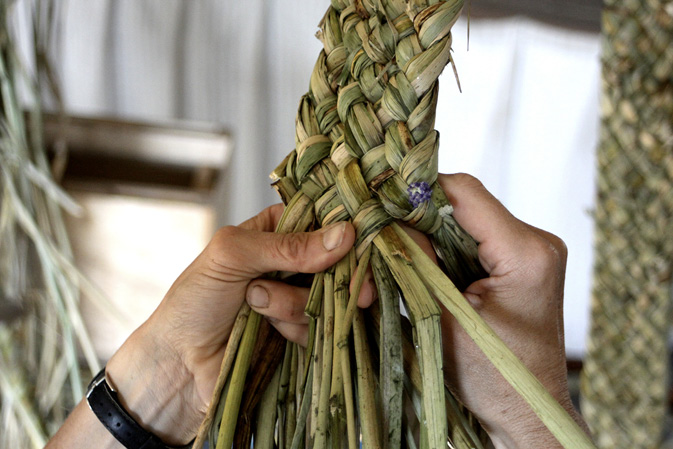
Fig. 14.5 Felicity Irons, braiding with English freshwater bulrush, scirpus lacustris (photo courtesy of F. Irons)
In loop braiding (also known as finger-loop braiding) the strands are kept under tension by being looped around the fingers (figure 14.6), and sometimes the hands (Boutrop 2012: 52). Effectively, the fingers function as a mobile loom, forming an intrinsic relation with the braid. Globally widespread as well as historically extensive, even considered to be the technique used in an Iron Age braid from the Halstatt salt mine (Grömer, Kania, and Boutrup 2015), such braiding may have been the most common method of production for braided items such as laces during the later Middle Ages and Renaissance, and it was also the means to create kumihimo before use of the Marudai.8 Ingrid Crickmore, a contemporary loop braider and historian of the art, describes how her hands and fingers activate the braiding and suggests a parallel to dancing in the way that the two hands interact with one another:
All the fingers are constantly cooperating and reacting to each other’s movements in passing the loops back and forth, without my really feeling that I am consciously controlling each separate movement. Of course, I am broadly in control, but not at the level of telling each finger what to do. It feels as if they all know what the overall goal is, and how to achieve it, and that they enjoy doing it smoothly, efficiently, and rhythmically. The two hands and all the fingers have to constantly cooperate and anticipate each other’s movements, like pairs of dancers adjusting to each other, or jugglers throwing balls to each other. … The bundle of loops is integral to the hand movements – I am totally unable to reproduce or mime the confluence of movements in the absence of the loops and the resistance of the loop bundle attached to its fixed position.9
The hands and fingers might thus be said to be dancing as they work to engage the rhythms as indicated through the succession of actions; Crickmore notes also that braiding while music is playing can provoke an added sense of dance movement for the actions.10 When two or more people braid together (enabling more loops to be worked) and the vibrancy and rhythm of actions are experienced socially, parallels with dance may be further accentuated. A three-person, seventeenth century, openwork ‘Katheren Wheel’ braid is even suggestive of processional paths that dancers might have taken at the time.11
Other examples of dancing hands have been noted. The braid techniques used by Miao women in Guizhou are described by Jacqui Carey as actions which flow together in a ‘rhythmic hand dance’ (Carey 2012: 11), while Stephen Lonsdale, discussing hand gestures in the dancing practices of fourth-century BCE Greece, draws attention to cheironomia as denoting ‘dancing with the hands’, a widespread association at the time (Lonsdale 1993: 30). For the anthropologist Alfred Gell, ‘the dancer-like nimbleness of the hands’ is not only indicative of ‘cognitive linkages’ between dancing and drawing in the art of the Trobriand islanders, but ‘even more, it indicates the synergy between art forms and modalities of expression which conventional aesthetics tries to deal with separately’ (Gell 1998, 94–95).
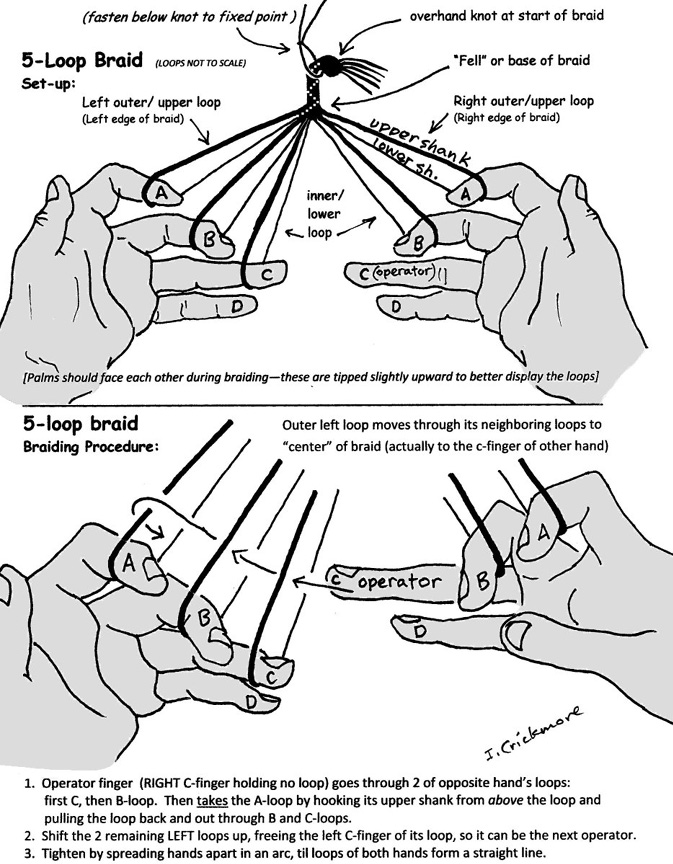
Fig. 14.6 Ingrid Crickmore, diagram to demonstrate the making of a 5-loop braid (Image courtesy of I. Crickmore)
When the fingers of one hand fit snugly between the fingers of the other hand there is already a suggestion of braided form. As they work to braid with materials, these fingers and hands form a relation with the rest of the body which imparts a sense of rhythm. In her comprehensive archaeological and ethno-archaeological analysis of Egyptian basketry, Willeke Wendrich identifies the ‘body as instrument’ and, as in Mauss’ techniques of the body, she finds that each body depends upon and finds its own rhythm within the social context in which it is embedded (Wendrich 1999: 341–49). Wendrich notes that skilled basket-makers (including those making baskets of plaited coils) adopt ‘a very steady working rhythm’ dictated by the pattern of the actions, so that each technique results in a different rhythm (Wendrich 1999: 391). It is not just the fingers and the hands that are active, however; rather, it is the whole body that is engaged. The actions of braiding give rise to heightened awareness of bodily rhythm and of the body’s capacity for and need to be attuned to rhythmic experience. Dance functions in a parallel way; indeed, Wendrich likens the making of the baskets to a kind of choreography for which the dance is the basket as a whole. It is not until watching the dance as a whole, she concludes ‘that the meaning [of the basket] can be sensed’ (Wendrich 1999: 389–91; Wendrich’s italics).
Braiding patterns of thought
As well as being activated and articulated in the production and construction of a braided length of fibre, braiding’s sequential reciprocity parallels an ordering propensity in respect of perception, conception and cognition. As Suzanne Küchler has suggested, patterns are ‘good to think with’ (Küchler and Were 2005: 172): they both reflect and are formative of patterns of thought. Coherence to the eye and heightened visual perception are conveyed as strands which begin as loose and separate become interlocked in conjunction with one another in a form that imparts and inspires order and coherence. Patterning can be perceived and operate as ontological as well as morphological action. It is something that happens to us and that we make happen in forming intelligible connectivity between matter and meaning. From the knowing action of the hands as they work the material(s) an inherently aesthetic length of braid gradually emerges, as if giving shape to the actions.
In theory at least, André Leroi-Gourhan’s physiological aesthetics is at work here, as a satisfying operational rhythm effects the formation of an equally satisfying visual rhythm in the pattern that results. Reticulate braided patterns, and the braided lengths themselves, may have been absorbed through visual or tactile experience of something in the environment (such as snakes and their patterned scales) which conjoin with the symmetry and pattern inherent in the evolutionary physiology of the body and enable the articulation and externalisation of the movements and patterns of braiding. A parallel with dancing is clear. Such physiology is as if braided in itself, not only in the interconnectivity of muscles, tendons, joints and nervous system but also through the agency of bilateral symmetry and bipedal evolution. Within this physiological para-braiding, the senses, notably in the kinesthetic relationship between haptic and optic, are especially and acutely active in the coming-into-being of braided form. In return, the formation of the braid activates the coming-into-being of maker, or dancer, and also, through affordance, of the braid’s beholder.
This braiding of optic-haptic twists and turns reflects Edmund Husserl’s idea of ‘intertwining’ (Verflechtung), which Maurice Merleau-Ponty draws attention to with reference to the optic chiasma or chiasmus. This is the term used to denote the crossing point or intertwining (entrelacs) whereby, as if between the flesh of the body and the reflections of the mind, ‘[t]here is double and crossed situating of the visible in the tangible and of the tangible in the visible’ (Merleau-Ponty 1969: 134). The partial crossing of nerve fibres or ligaments at the optic chiasma enables the left cerebral hemisphere to process the right hemispheric vision and vice versa, effecting a ‘crucial’ (cross-shaped) balance between the two sides of the body as well as between the senses and other cerebral processes. Ted Toedvine notes that chiasma is typically used in relation to anatomical structure whereas chiasmus references rhetoric, as when opposing phrases are used to convey the same thing. Toedvine further remarks that although each word has a distinct etymological root in Greek, khiasma and khiasmos, they share a common root, khiazein, to mark with an χ (khı-) (Toadvine 2011: 336). Merleau-Ponty elegantly effaces these differences in his haptic-optic mind-body cross-over, as if marking with a cross (χ) the reciprocity and balancing of the diagonal intertwining and distinctive patterns which are so typical of movements in braiding.
The materials also assume an aspect of the embodied action and reflection. The stuff from which we make objects informs how we operate and the way in which our lives become knowingly structured. Materials carry memory of their having come-into-being (Trewavas 2014: 222, 229) and can be considered as co-respondents in the making process through the mobility, structure and detail of the responses that they generate and stimulate. They are formative of the emerging braid, such that it is as if we are intra-actively both embodied and embraided in and through the intricate and sometimes irregular patterning of the material strands. Lars Spuybroeck has argued that the characteristics of braiding are shaped by the infinitesimal detail which structures both pattern and matter, and that braid is paradigmatic in its contribution to conceptual frameworks within consciousness (Spuybroeck 2016: 92). These characteristics are considered as embedded within materials, with technology ‘acting on the inside of matter’ and pattern being an effect of the ‘self-crafting of matter’ (Spuybroeck 2016: 102). Successive crisscrossing, whether of nerve-muscle fibres, material fibres or dancing feet, effects interaction and relational coherence. Patterning and rhythm, as active in braiding, or dancing, are intrinsic to the (bio)morphology of connectivity as it infiltrates tissues of knowing; for physicist Donna Haraway, ‘the tissues of one’s knowings’ extend beyond the human and engage common biological ground, with weaving, string figures and interlacing as especially potent manifestations of the ‘relational action’ between human and nonhuman fibres and as formations through which kinship and behaviour are sustained (Haraway 2016: 91–93).
In a similar vein, but from the perspective of archaeology, Lambros Malafouris proposes ‘a ‘hylonoetic’ (from the Greek hyle for matter and nous for mind) ontology of thinking through and with matter’ (Malafouris 2013: 236 Malfouris’ italics). In How Things Shape the Mind he traces the active or enactive coming-into-being of thought in tandem with the coming-into-being of objects, and while recognising that neural networks and DNA evolution are significant in this process he holds that cultural and environmental factors also affect the way in which brains are formed and thoughts are shaped. Above all, making and engaging with material is formative of cognition rather than a reflection of it, providing ‘a scaffolding device that enabled human perception gradually to become aware of itself’, enabling humans to think about thinking (Malafouris 2013: 204). Within a now well-established discourse detailing the embodiment of the cognitive apparatus,12 Spuybroeck and Malafouris both emphasise ways in which knowing emerges through engagement with materials, thus considering materials as a primary conduit for the consequent forms. For braiding, therefore, pattern formation reflects and exhibits a continuously active and emergent phenomenon that is as much internally formed as it is externally fashioned.
Dancing as braiding
Braid and braiding carry notions of side-to-side movement but also an implied sense of conjoining, confluence and bringing together. Dancing can be paralleled, especially in effecting the mesmerising tempo of experienced braiding. Dances often convey or mimic movements associated with repetitive activities, as sometimes reflected in the names by which they are known. In the Orcadian ‘Strip the Willow’ line dance, for example, the movement conveys a loose figuring of willow being stripped while also enabling the turning-and-interlinking-with-one-another passage of the leading couple as they ‘strip’ along the lines from head to foot (or tip to butt) to the rhythm of musical accompaniment.
Establishing a conducive rhythm is fundamental to proficient braiding, and the origins of the English word braid indicate that rhythmic movement is intrinsic to its meaning. Rooted in the proto-Germanic *bregdanan from which Old English and Old Saxon bregdan, middle English breiden, then braid, evolved, the term indicates darting, jerky, zigzag movements from side to side or off to one side (as in brandishing a sword), movements so nimble as to be associated with a cunning sleight of hand. It is not until the sixteenth century that the sense of braiding as a distinctive hither-thither action gives way to textile-related actions; the ‘broid’ of embroidery, perhaps drawing attention to the in-and-out of a needle, is noted as a borrowing from braid dating from this time. The Oxford English Dictionary also includes a ‘transferred’ meaning, noted in nineteenth century examples, of braid (v.) ‘to ‘thread the mazes’ of the dance; to cross and recross’, and definition of the adjective braided includes ‘as a dance’ in a figurative sense.
The word braid thus emerges as referring to patterns of movement and exchange which carry a pronounced sense of a vibrant action and which involves centred but sharp twists and/or turns. Perhaps it was in response to the dexterity, virtuoso speed and characteristic criss-crossing of skilled braiders, as outlying strands were turned and interwoven to form a reticular pattern, that the word shifted towards its now familiar use in textile and hair-braiding contexts. Braiding is the preferred nomenclature for this paper (rather than plaiting) in part because zigzagging references the body that produces the pattern as well as the pattern that is produced, whether as braid or dance.
When people interact with one another through dance, sharing the stimulus of rhythmic music, they form movements and patterns in negotiation with one another, as if each moving body is a strand, forming stronger strands through formation with others. Relationships (especially between partners) are articulated and can be fostered, braiding social coherence through the patterns and rhythms, perhaps even entwining as a prelude to ‘tying the knot’ in marriage. The concept of braiding is thus extended, here, to substantiate the premise that the patterned actions of braiding, whether identified through manipulation, mechanical agency or social dance, constitute an embodied semiosis (Violi 2008: 241–64), formative of individual and social cognition (and of the reciprocity between these). Braid, by this measure, is but a material form of social dancing, with both informed by the harmonious, repeating, criss-crossing, in-and-out, close-fitting togetherness of lines or figures and brought about through well-tuned actions. Elaborations of braided patterning (and the speed with which these can be accomplished) can capture the radiance and variegation (ποικιλία, poikilía) discussed by Giovanni Fanfani in the context of ancient Greek weaving and the chorality of song and dance (Fanfani 2018: 9).
We use our whole body to dance, and especially we work with our feet, embodying ‘the rhythmic pattern of lived time and space’ as Tim Ingold puts it (Ingold 2004: 332). Through the familiar dynamics of waltzing, for example, Maxine Sheets-Johnstone suggests that the actions ‘are woven into our bodies and played out along the lines of our bodies’, so that we become attuned to the ‘kinesthetic melodies’ of bodily coordination (Sheets-Johnstone 2012: 390). The actions thus enable that which is inside the body and that which is exterior to the body to be understood as a continuum. For Sheets-Johnstone,
[o]ur visual sensing of movement dynamics is grounded in our awareness that our own movement has an inside and an outside, not simply in terms of the fact that it is both personally experienced and publicly visible, but in terms of the fact that, through kinesthesia, we experience directly our ability both to feel and to perceive our own movement. (Sheets-Johnstone 2012: 396; Sheets-Johnstone’s italics)
In Patricia Daugherty’s consideration of the production of Turkish-Yörük flatweaves, the weavers’ sense of balancing inside and outside through centering, containing and separating invokes and expresses ‘patterns of physical bodily experience’ that are also evidenced in their dance (Daugherty 2004: 306). These patterns are reminiscent of braiding, at least in principle; thus one of the most distinctive patterns for the weavers is that of repeated diagonal squares or diamonds forming lines which are seen as separating (ayirir) and coming together (kavuşur) as they zigzag through the weave (and for which there is always a balancing mirror reflection which is central to their cultural aesthetic). That which is inside the lines is associated with the inside of the body, and the diamond opening which the lines create is considered as an interior-exterior point of entry and exit. Carrying this example over to braiding, the effect of bringing outlying, separate strands into a cohesive geometry reflects the internal workings of the body and its spatial awareness, indicating a form of patterning, also expressed through dance.
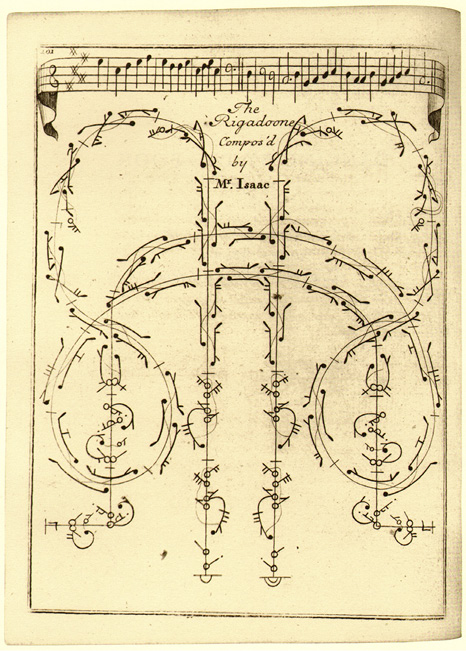
Fig. 14.7 Raoul Auger Feuillet’s dance notation for a Rigadoon by Isaac, first published in Orchesography or the Art of Dancing … an Exact and Just Translation from the French of Monsieur Feuillet. By John Weaver, Dancing Master. Second edition. London, ca. 1721 (https://upload.wikimedia.org/wikipedia/commons/1/1e/Feuillet_notation.jpg)
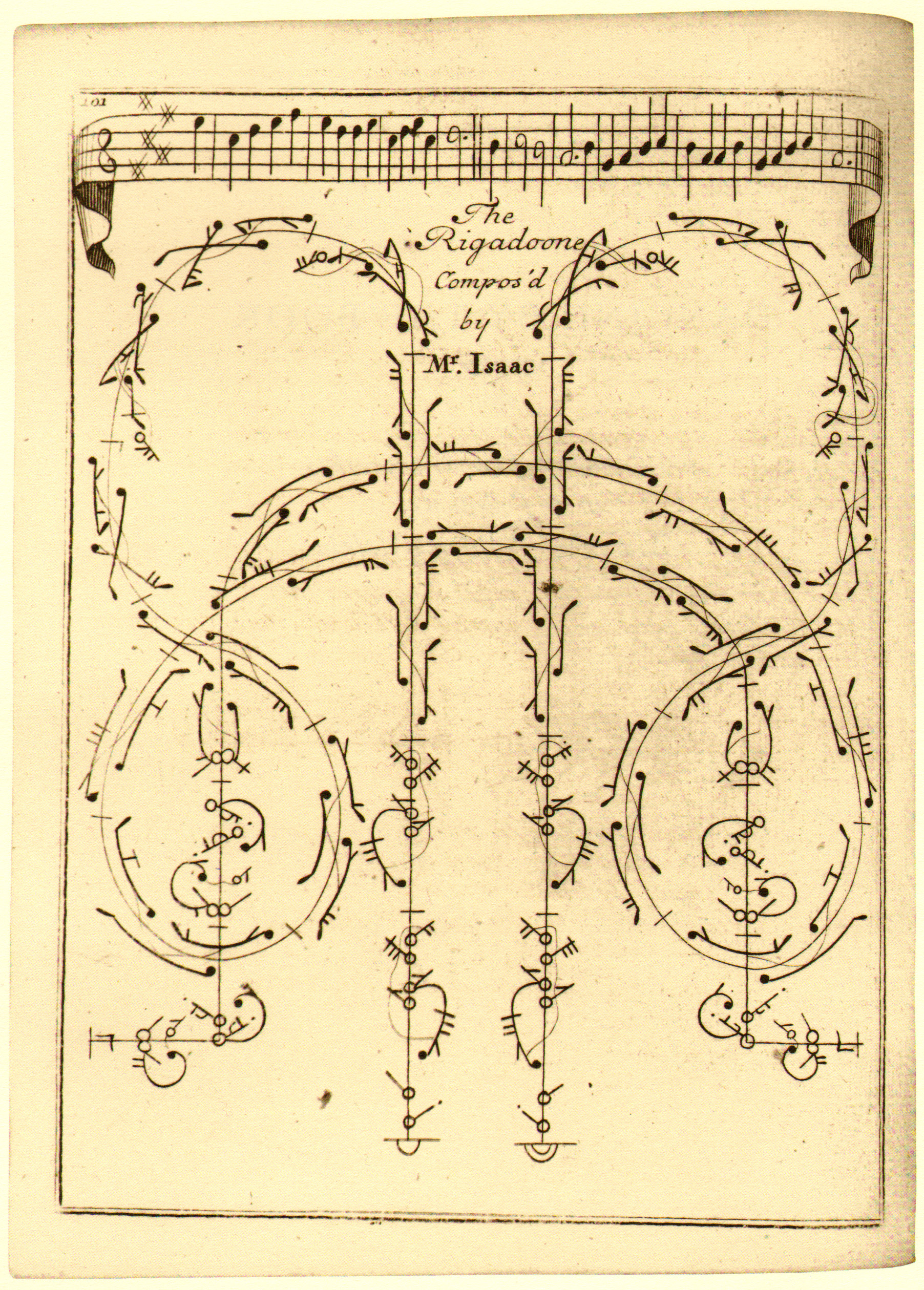
Although even the simplest braiding is not exactly mirror-symmetrical, symmetry is nevertheless a characteristic of the process and typical of resulting braids as a form of ‘glide reflection’ symmetry. Donald W. Crowe provides an image of walking feet (right foot ahead of left foot, left foot ahead of right, either side of a line indicating the centre of the body) to illustrate glide reflection; dancing figures could be substituted with similar effect (Crowe 2004: 6; figure 1.5). The feet also indicate a forward-moving trajectory, paralleling the generative direction of braiding as it extends outwards from the body as a kind of prosthesis. In eighteenth-century notation for dance, as illustrated in Raoul Auger Feuillet’s dance notation for a Rigadoon (figure 14.7), lines for foot movements and arm gestures in the manner of braid-like glide reflection are described. The Rigadoon was a fast dance, requiring much practice to grasp the subtleties of movement.
Social dances such as country or folk dancing and processional dances such as were common in Renaissance Europe are particularly rich in actions akin to interlacing and braiding. This can be recognised in contemporary descriptions, as in the poem ‘A Farewell to Town’ of 1577 in which the poet Nicholas Breton evokes braiding through his poetic description of dancing, thus
And to it then; with set, and turn about,
Change sides, and cross, and mince it like a hawk;
Backwards and Forwards, take hands then, in and out; … (Baskerville 1929: 351)
In the Renaissance processional dance known as the galliard there was an enchaînement of five steps (the cinquepace) which corresponded to six musical beats; thus in four movements ‘the dancer…raises one foot in front of or behind or across the other’ then performs a leap (a petit saulte or cadence) with the foot that bears the weight, followed by a ‘posture’ (Baskerville 1929: 341). This was a set of units around which repetition and variation were possible, including more steps, leaps, spins and turns and on occasion the close holding of a partner. The final posture might be likened to the final pulling or easing into shape that ensures that the tension of a just-worked interwoven strand is in keeping with the braid form.
The relationship between process and processional – moving forward and transforming, in and through time – reflects the embodied agencies of making and pattern formation in shaping culture, as well as in shaping the body within social and cultural contexts. There is evidence of braiding not only in the movements of the dancing but also in the forming of social bonds; thus, depending on the social context, a succession of dances might begin with those that were relatively formal and become livelier and more inclusive as a dance event proceeded. Towards the end, the simplicity and familiarity of country dances, in which ‘in a word, a group of dancers kaleidoscopically advance[e] and retreat[…], swinging each other about, crossing from one side to the other, moving up or down inside the lines or outside, weaving in and out, passing under an arch of hands…’ might provide a fitting finale to an evening’s entertainment.13
Scottish country dances were generically known as reels, perhaps from the whirling and turning associated with the reeling or unreeling of a spool. In the sixteenth century, ‘reel’ also had the meaning of a zigzag path, as if in the manner of ‘hither and thither’.14 The reel figure was also associated with a serpentine or ‘round’ country dance known as the ‘hay’ or ‘heydegues’, praised by William Hogarth in his Analysis of Beauty of 1753: ‘One of the most pleasing movements in country dancing, and which answers to all the principles of varying at once, is what they call ‘the hay’: the figure of it, altogether, is a cypher of S’s, or a number of serpentine lines interlacing or intervolving one another’.15 While this raises complexities regarding the softness of a serpentine line of thread or movement in relation to the zigzag line, it’s worth noting that ‘hay’ was also a term used to describe a net for catching fish, thus indicating a more pronounced geometrical reticulation. The ‘intervolving’ may be serpentine but the cross-over point is angular; the familiar phrase ‘figure of eight’ not only indicates the shape of the number 8 or describes a knot but also describes a motif in Scottish dancing in which one or more dancers follows the path of a figure of eight, moving around either standing figures or one-another, crossing one another’s path and creating a figural, braid-like reticulation through succession. In Scottish dancing a set of repeated movements is known as a figure,16 a word rooted in the Latin figura, meaning a form or shape, which was in turn a translation of the Greek skhêma, (σχῆμᾰ, schema), which referred not only to shape and form but also to dance. A ‘figure’ in dancing, conceived thus as a formation, or a shaping, creates a pattern of movements that are repeated.
For the contemporary British basketry artist Joanna Gilmour, who was a classical ballet dancer before she turned to the making of braided structures, the rhythms and symmetries of movement as experienced in dance are closely paralleled with braiding, as exemplified in practice work at the barre in which exercises on one side of the body would be repeated on the other side, with the body turned around. She suggests that ‘maybe legs and feet in dance could be compared to arms and hands in basketry’ and that in forming a figure of eight through the interlacing of two lines ‘a group of dancers can make a whole, in a similar way that making a basket can bring many elements together’.17
Conclusion
As with so many textile-related actions, braiding lends itself to extension through association, across and between phenomena. These associations are conveyed as much by the conduit of the body’s experience of the actions as by the way in which braid functions in relating one thing to another, as through metaphor, which can itself be perceived as braid-like, bringing together disparate strands of reference into a single concept while still distinguishing one from another. While the parallel between braiding and dancing which is outlined here began as an almost instinctive analogy, albeit with metaphorical reference, it is through attention to the patterned actions and motions of braiding, whether in the making of braids or social dancing, that a more substantial semblance between the two has been identified. As techniques of the body, shaped by patterns (both visible and invisible, external and internal), merge with skill, an element of performativity might be considered as appropriate to both.
Maypole dancing, although not considered in detail in this paper, is perhaps the most obvious example of braiding and social dancing in combination (Mitchell 2020: 250). However, an example such as that of multi-person finger loop braiding, where the strands are intricately manipulated to form detailed patterns, might be seen alongside a dance such as a Rigadoon or a Scottish reel in such a way as to suggest that as well as a close intertwining of braid and dance, there are further significant parallels to be drawn, or crossing points to be identified, the implications of which are instructive.
Endnotes
1 The subject of this paper was first outlined at the 2017 Woven Communities symposium, University of St. Andrews (UK). I am grateful to Dr Stephanie Bunn for her invitation.
2 Bishop and Neumann in Spuybroeck ed. 2011: 142.
3 Sprang is also sometimes considered in relation to braid (as well as to weave). Elizabeth J. W. Barber cites Elizabeth van Reesma (1926) in describing it as ‘plaiting with stretched threads’ but also likens it to cat’s cradle. Barber 1991: 122.
4 Felicity Irons, Rush Matters, Bedfordshire, UK., in conversation with the author, 27.11.2018.
5 As a related example, Caroline Radcliffe, in ‘The Machinery – Challenging the Automaton: Creative Resistance and the Nineteenth Century Cotton Worker’ given at the Homo Textor conference, Munich, 2019, performed and described a heel-and-toe type clog dance (discussed also in chapter 13) which she traced back to Lancashire cotton mill machine loom contexts, where the loud and rhythmic sound of the machines provided a kind of musical backing.
6 Heinrich and others 2016: 154. Flora Robotica project, https://www.florarobotica.eu.
7 Barber 1991: 136–7. The example here given by Barber (dating from 3000 B.C., from Lüscherz, Switzerland) also incorporates supplementary weft threads. The same example is also discussed in Grömer, Kania, and Boutrup 2015.
8 Nutz 2014: 118; Crickmore, https://loopbraider.com/category/loop-braiding/history/.
9 Crickmore, email correspondence with the author, 22 April 2020. I am very grateful for Ingrid Crickmore’s apposite responses, her encouraging consideration of historical examples and for allowing the use of her diagram demonstrating the making of a 5-loop braid (figure 14.4).
10 Crickmore, ibid.
11 Crickmore 2012: 59; Sibthorpe 2016: 234. The dance related suggestion is mine, the pavane for example, or the Rigadoon (for which see below, figure 14.5).
12 Varela, Thompson and Rosch 1991; Noland 2009; Malafouris 2013.
13 Baskerville 1929: 371 (with reference to John Playford’s The Dancing Master of 1651).
14 Emmerson 1972: 151.
15 Hogarth 1753: 150. In the same volume Hogarth also discusses the braiding of hair, ‘an artful way of preserving as much of intricacy, as is beautiful’, 28–29.
16 Scottish Country Dancing Dictionary (online, n.p).
17 Gilmour 2019, (online, n.p).
References
Barber, E. W., Prehistoric Textiles (Princeton, New Jersey: Princeton University Press, 1991).
Barber, E. W., The Dancing Goddesses: Folklore, Archaeology and the Origins of European Dance (New York: W. W. Norton and Company, 2014).
Barthes, R., S/Z. Trans. by Richard Miller (New York: Hill and Wang, 1974).
Baskerville C. R., The Elizabethan Jig (Chicago: University of Chicago Press, 1929).
Bateson, G., Steps to an Ecology of Mind (Chicago: University of Chicago Press, 1972).
Boivin, N., Material Cultures, Material Minds (Cambridge: Cambridge University Press, 2010).
Boutrop, J., ‘Loop Manipulation Braiding’, in S. Berlin and R. MacGregor, eds, Threads That Move: Proceedings of the Second International Conference on Braiding (The Braid Society, 2012), pp. 52–57.
Carey, J., ‘Chinese Braid Embroidery’, in S. Berlin and R. MacGregor, eds, Threads That Move: Proceedings of the Second International Conference on Braiding (The Braid Society, 2012), pp. 7–13.
Crickmore, I., ‘Loop Braided “Double Braids”’, in S. Berlin and R. MacGregor, eds., Threads That Move: Proceedings of the Second International Conference on Braiding (The Braid Society, 2012), pp. 57–71
Crickmore, I., https://loopbraider.com/category/loop-braiding/history/ (accessed 10 May 2020).
Crowe, D. W., ‘Introduction to the Plane Symmetries’, in D. K. Washburn and D. W. Crowe, eds, Symmetry Comes of Age (Seattle: University of Washington Press, 2004), pp. 3–17.
Daugherty, P., ‘Cognitive Structures and Body Metaphors in the Aesthetic and Everyday Discourse of Turkish-Yörük Weavers’, in D. K. Washburn and D. W. Crowe, eds, Symmetry Comes of Age (Seattle: University of Washington Press, 2004), pp. 304–46.
Emmerson, G. S., A Social History of Scottish Dance (Montreal: McGill-Queen’s University Press, 1972).
Emery, I., The Primary Structures of Fabrics (Washington DC: The Textile Museum and Watson Guptill Publications, 1966).
Fanfani, G., ‘Craftsmanship and Technology as Chorality: The Case of Weaving Imagery in Archaic and Classical Choral Lyric’, Dionysus ex machina, IX (2018): 6–40.
Flora Robotica, https://www.florarobotica.eu (accessed 10 December 2019).
Gell, A., Art and Agency: An Anthropological Theory (Oxford: Clarendon Press, 1998).
Gerofsky, S., J. Forren, and E. Knoll, ‘Dancing Rope and Braid into Being: Whole-Body Learning in Creating Mathematical/ Architectural Structures’, Bridges Conference Proceedings, 2017. https://archive.bridgesmathart.org/2017/bridges2017-523.pdf (accessed 13 January 2022).
Gilmour, J., ‘Symmetries of Movement, Symmetries of Making’, extracts from a conversation for Forces in Translation: Basketry, Maths, Anthropology. https://forcesintranslation.org/conversation-with-joanna-gilmour/, 2019 (accessed 26 May 2023).
Grömer, K., K. Kania, and J. Boutrup, ‘Iron Age Finger-Loop Braiding Finds from the Hallstatt Salt Mine’, Archaeological Textiles Review, 57 (2015): 39–46.
Hamann, H., Swarm Robotics: A Formal Approach (New York: Springer, 2018).
Haraway, D. J., Staying with the Trouble: Making Kin in the Chthulucene (Durham: Duke University Press, 2016).
Hasse, C., and P. Treusch, ‘Weaving Together: Human-Robot-Relations of Basketry and Knitting’, in S. Bunn and V. Mitchell, eds, The Material Culture of Basketry (London: Bloomsbury, 2021), pp. 255–63.
Heinrich, M. K., M. Wahby, M. D. Soorati, D. N. Hofstadler, and others, ‘Self-Organized Construction with Continuous Building Material: Higher Flexibility Based on Braided Structures’, IEEE 1st International Workshops on Foundations and Applications of Self Systems (FASW), (Augsburg, Germany, IEEE 2016): 154–59. https://doi.org/10.1109/FAS-W.2016.43 [accessed 15 November 2023].
Hogarth, W., The Analysis of Beauty (London: Printed by J. Reeves for the Author, 1753).
Ingold, T., The Perception of the Environment (London: Routledge, 2000).
Ingold, T., ‘Culture on the Ground: The World Perceived Through the Feet’, Journal of Material Culture 9(3), (2004): 319–40.
Küchler, S., and G. Were, Pacific Pattern (London: Thames and Hudson, 2005).
Larsen, J. L., Interlacing: The Elemental Fabric (New York: Kodansha USA Inc., 1987).
Leroi-Gourhan, A., Gesture and Speech (Cambridge, Massachusetts: Massachusetts Institute of Technology, 1993).
Lonsdale, S. H., Dance and Ritual Play in Greek Religion (Baltimore: Johns Hopkins University Press, 1993).
Malafouris, L., ‘At the Potter’s Wheel: An Argument for Material Agency’, in C. Knappett and L. Malafouris, eds, Material Agency: Towards a Non-Anthropocentric Approach (Boston, MA: Springer, 2008), pp. 19–36.
Malafouris, L., How Things Shape the Mind: A Theory of Material Engagement (Cambridge Massachusetts: Massachusetts Institute of Technology, 2013).
Mauss, M., ‘Techniques of the Body’, 1935, in N. Schlanger, ed., Techniques, Technology and Civilization (Oxford, New York: Berghahn Books, 2006), pp. 77–97.
Merleau-Ponty, M., ‘The Intertwining – The Chiasm’, in M. Merleau-Ponty and A. Lingis, eds, The Visible and the Invisible (Evanston, Illinois: Northwestern University Press, 1969), pp. 130–55.
Mitchell, V., ‘Braiding and Dancing: Rhythmic Interlacing and Patterns of Interaction’, in S. Bunn and V. Mitchell, eds, The Material Culture of Basketry (London: Bloomsbury, 2020), pp. 245–53.
Noland, C., Agency & Embodiment: Performing Gestures / Producing Culture (Cambridge, MA: Harvard University Press, 2009).
Nutz, B., ‘Drgens sn wir vs nvt schame – No Shame in Braiding: 15th Century Fingerloop Braids from Lengberg Castle’, Estonian Journal of Archaeology, 18.2 (2014): 116–34.
OED online. Oxford University Press: http://www.oed.com (accessed 10 December 2019).
Robinson, C., ‘Imports, Mechanisation and the Decline of the English Plaiting Industry: The View from the Hatters’ Gazette, Luton 1873–1900’, MA Thesis, University of Hertfordshire, 2016. https://uhra.herts.ac.uk/handle/2299/17623?show=full (accessed April 2020).
Scottish Country Dancing Dictionary. https://www.scottish-country-dancing-dictionary.com (accessed 10 December 2019).
Sheets-Johnstone, M., ‘Movement and Mirror Neurons: A Challenging and Choice Conversation’, Phenomenology and the Cognitive Sciences, 11.3 (2012): 385–401.
Sibthorpe, J., ‘Manuscript Directions for Weaving Braids’, in C. Richardson, T. Hamling, and D. Gaimster, eds, The Routledge Handbook of Material Culture in Early Modern Europe (Abingdon: Routledge, 2016), pp. 234–35.
Spencer, P., Society and the Dance (Cambridge: Cambridge University Press. 1986).
Speiser, N., A Manual of Braiding (Bern: Haupt Verlag, 1988, reprinted 2018).
Spuybroeck, L., ed., Textile Tectonics (Rotterdam: NAi Publishers, 2011).
Spuybroeck, L., The Sympathy of Things: Ruskin and the Ecology of Design (London: Bloomsbury, 2016).
Tarlo, E., Entanglement: The Secret Lives of Hair (London: Bloomsbury, 2016).
Tassie, G. J., ‘The Hairstyles Represented on the Salakhana Stelae’, in T. DuQuesne with S. Abdel Razak, E. S. Meltzer, J. M. Johnstone, and G. J. Tassie, eds, The Salakhana Trove: Votive Stelae and Other Objects from Asyut (London: Oxfordshire Publications in Egyptology 7, 2009), pp. 459–536.
Toadvine, T., ‘The Chiasm’, in S. Luft and S. Overgaard, eds, The Routledge Companion to Phenomenology (Abingdon: Routledge, 2011), pp. 336–47.
Tomaž, A., ‘Depiction of Hairstyle, Reflection of Identity: Some Considerations Concerning Neolithic Depictions of Hairstyles in the Anzabegovo – Vršnik and Velušina – Porodin Cultural Milieu’, Documenta Praehistorica XLIV (2017): 346–58.
Trewavas, A., Plant Behaviour and Intelligence (Oxford: Oxford University Press, 2014).
Varela, F. J., E. Thompson, and E. Rosch, The Embodied Mind: Cognitive Science and Human Experience (Cambridge Massachusetts: Massachusetts Institute of Technology, 1991).
Violi, P., ‘Beyond the Body: Towards a Full Embodied Semiosis’, in R. Frank, R. Dirven, T. Ziemke, and E. Bernardez, eds, Body, Language and Mind, Vol. 2 (Berlin: Mouton de Gruyter, 2008), pp. 241–64.
Wendrich, W., The World According to Basketry: An Ethnoarcheological Interpretation of Basketry Production in Egypt, CNWS publications no. 83 (University of Leiden: Research School of Asian, African and Amerindian Studies, 1999).