2
The technical mode of existence of weaving:
Introducing histomorphism
Ellen Harlizius-Klück
This chapter concentrates on crucial notions of ancient weaving as a technology establishing order far beyond the borders of a fabric, thus claiming weaving to be a technological basis for a whole culture, integrated into its mode to calculate, to explain stunning patterns in nature and to understand the order of the cosmos. The chapter introduces the technical mode of order and generation in pattern weaving (which I call histomorphism) and explicates how that ordering principle and process travels into other domains like painting (on pottery and frescoes), natural history (bird feather and snake skin patterns), arithmetic (how number features behave when numbers are combined) and atomism (how elements constitute the cosmos).
In this contribution, I strongly distinguish between the travel or transfer of form (which can be described by hylemorphism) and the transfer of its principle of production or creation in weaving (which asks for histomorphism). This does not mean that the principles are opposed to each other. However, while hylemorphism splits idea or form from matter, this is not possible in histomorphism where they are cognates in the process of making.
Because of the back and forth as well as up and down movements of the weft and shuttle in weaving, histomorphism partakes in a major feature listed by Bruno Latour for any technology, namely that the technical mode of existence1 is characterised by a specific deviation: the technical or technological labyrinth (Latour 2013: 223). Latour employs several terms to indicate this defining feature: ‘ingenious detour’ (2013: 223), ‘technical folding’ (2013: 227; emphasis by Latour), ‘technical zigzag’ (2013: 216–18, 227). This detour is also addressed as mêtis, a Greek term for a specific type of intelligence that seizes opportunities and does not follow pre-established plans. It is often attributed to Odysseus or Penelope, both capable of technical ruses. In undoing her weave by night, in undoing the patterned fictions created the day before, Penelope insists on weaving as a mode of existence rather than a design practice: she persists in weaving as a zigzag path between doing and undoing, and retains the social order that textiles establish in Archaic Greece. 2
Also, the productive way of ordering in weaving itself – for example, the repeated introduction of the weft by a shuttle – includes a zigzag movement that is, however, commonly understood as futile labour replaced in the course of the history of technology by machines. The productive order of the zigzag movement thus no longer contains the creative aspect of fabric making which is nowadays located in the design process.3 It is exactly the ‘ancient’ zigzag of production and its intellectual implications that I want to put (back) into the heart of the technological mode of weaving by explicating it along the paradigmatic case of the meander pattern (figure 2.9). With reference to this mode, the term ‘ancient’ has two meanings; first, it indicates the zigzag that contemporary weavers still do with their hands all over the world,4 a movement that genealogically predates loom developments that speed up the production process at the cost of the possibilities of fabric and pattern construction for the weavers.5 Secondly, it literally indicates the weaving of ancient Greece, which is based on a warp-weighted loom and for which the meander poses specific problems, as we shall see. But why do I go back as far as ancient Greece?
To Latour, it is a key question why our type of science, which had its advent in ancient Greece, makes it so difficult to grasp modes of thinking that differ from objective knowledge (Latour 2013: XXV). That arguably new type of reasoning in ancient Greece is a stumbling block for scholarship, in constant need of explanation.6 Jean-Pierre Vernant describes the innovative change in the following way: ‘a new thought sought to base the order of the world on relations of symmetry, equilibrium, and equality among the various elements that made up the cosmos’ (Vernant 1982: 11). With regard to the Greek city-states, Vernant asks, further, how a community can be founded on contradictory elements, or, ‘to apply the Orphics’ formula, how, on the social level, could one emerge from many and many from one?’ (Vernant 1982: 45). It is here that histomorphism, the concept of entangling elements by the zigzagging and dialectical movement of weaving that is based on a binary order of up and down, can provide a unique model of explanation. This idea of entangling elements in the dialectical movement of weaving is demonstrated not only by the Panathenaic festival – which celebrated a fabric woven by girls and women of the city of Athens and was dedicated to the city-patron and mythical founder Athena (see chapter 1) – but also the Orphics’ text corpus, brought up by Vernant himself. The Orphic cosmogonist Pherecydes7 introduced the cosmos as an intricate fabric woven by the God Zas (Zeus). Here, weaving is able to present a clear idea of how order comes into the world from many single elements.8
Some Pre-Socratic philosophers described the cosmos as an entanglement of uncut elements (atoms) and void, ordered by weight and movement – just like threads on a warp-weighted loom. I contend that Aristotle, in opposing his concept of hylemorphism to the atomistic idea of the order of the cosmos, especially rejected a mode of existence that was strongly connected to the technical mode of weaving on a warp-weighted-loom. Aristotle criticises atomistic ideas as materialistic while claiming that only ideas and forms are universal and eternal and should therefore be regarded as primary ‘elements’ of the cosmos.9 In the course of this text we will see how investigations of textile concepts will fall prey to this dichotomy of materialism and idealism in which geometry, as an inscription of universal ideas of order, plays a key role – a role that Latour reassessed (and actually reinforced) as a practice establishing ‘immutable mobiles’ (1990).
This investigation will proceed in four steps:
A) I first revisit the debate among art historians as to whether textile art was the beginning of art itself, an argument initiated by the art theorist and architect Gottfried Semper. This discussion reveals a fundamental misunderstanding of woven forms as geometric and establishes the value of art with reference to geometry, thereby connecting the beginning of art to the scientific revolution in ancient Greece where geometry was established as science. Although this seems to be a scholarly discussion, political conditions of the perception of textile work inflect it as a battle between materialism and idealism in a German context in times of revolution, a battle in which weaving played a crucial role.
B) To clarify the role of geometry for textiles, I then look at how patterns are transferred to other surfaces, and how they shed light on the discretisation of planes by geometrical grids. Here, we not only encounter ways to reproduce patterns, but also stunning ways to express meaning through patterns that exceed their decorative function and raise the riddle of their construction.
C) By looking into ancient descriptions of patterns – especially the Greek term poikilos (multi-coloured, variegated) in its various forms – it is possible to show how weaving presents cosmic generation. Discussed as a technology of enchantment, we encounter some explanations of how weaving prefigures atomism in the description of colour mixtures. Here, we revisit Aristotle and the earliest conflict between materialism and idealism that gave rise to the hylemorphic scheme in which principles of construction are not relevant.
D) Finally, I will look at practices of weaving in ancient Greece, clarifying features that are specific for weaving on a warp-weighted loom, but also presenting some basic principles of pattern weaving in general. We will not only encounter the loom, but also its ‘arithmetic’ or visual algebra at work, and the concept of mixing threads to ‘forms’ and ‘fictions’10 like the meander, including the constructive aspect. From here, we can finally delineate histomorphism as the mode of existence that travels across the archaic world.
Weaving will be presented here as a technê in its ancient meaning, where nature and technology are not opposed but able to explain each other.11 The ancient mode of existence of weaving is not only technical12 but extends into the realms and fields of religion, cosmology and natural philosophy, thus being an encompassing mode of existence that bridges technology, culture and nature.
Misunderstanding woven forms: The role of geometry
‘In the beginning was the textile art’ – with these words, Gottfried Semper (1803–1879), the famous German architect and art theorist, liked to introduce his lectures on ornamentation.13 The phrasing provocatively alludes to the Gospel of John, where the word functions as a principle of cosmic genesis.14 Semper triggered a fierce discussion among art historians as to whether art is founded on such a technological basis.
Semper claimed technological features to be responsible for the first principles of style in art, and he lists four technical classes to consider: textiles, ceramics, tectonics (carpentry) and stereotomy (masonry etc.). Addressing the question of which technique was primary, he goes on to say:
It is hard to establish which of the technical branches listed in the previous chapter was practiced first in the natural course of human development, and ultimately there is little point in knowing this. But there can be no doubt that in the first two branches – textiles and ceramics – we find the first efforts to embellish functional objects through a conscious choice of form and decoration. Of these two arts, textiles should undoubtedly take precedence because they can be seen, as it were, as the primeval art form from which all other arts – not excepting ceramics – borrowed their types and symbols, whereas it itself seems quite independent in this respect. Textile types evolved within the art itself or were borrowed directly from nature. (Semper 2004: 113; emphasis by Semper).
Semper concludes: ‘There can be no doubt that the first principles of style are bound up with this earliest of artistic techniques’”
Semper was obviously aware that ceramics would have been favoured as the first technology by most of his colleagues. And indeed, his idea was taken up by the archaeologist Alexander Conze (1831–1914) who placed geometric pottery at the beginning of style development:
Semper correctly says that the details of forms and the whole characteristics of the ornaments of these vases are of technical origin and point to the technique of weaving, possibly also to plaiting and embroidery; the rectangular crossing of threads is responsible for the linear character and the straight and angular forms. The fact that even the execution with brushes constrains itself to these forms that are rooted in a completely different technique seems to prove that a time and population where weaving, embroidery, plaiting, particularly executed by women and above all being the most important branch of art, left its traces here. (Conze 1870: 522; my translation)
Opposed to both Semper and Conze, the Austrian art historian Alois Riegl (1858–1905) fervently rejected this idea as ‘materialistic’, instead introducing the ‘will to art’ (Kunstwollen). Riegl held this to be an aesthetic disposition, innate to human beings by nature,15 that is the main driver of style development. He then founded modern art history as the history of such style.16 Riegl especially objected to the idea that the characteristics of geometric vase decoration were grounded in textile patterns (Riegl 1985: 9). To Riegl, not the specific constraints of textile technology were responsible for the geometric style, but rather artistic laws that were universally true and independent of technique and material – like the laws of geometry (Riegl 1985: 3).
Riegl’s objection became the standard argument against any effort to give textile technology a paradigmatic position for the beginning of art.17 In 1969, the archaeologist Bernhard Schweitzer (1892–1966) described ornamentation on Archaic pottery as a grammar18 operating on the elements of point, line, straight line and angular line, and observed:
[I]t is not by accident that these are the axioms of geometry: the point that generates the one-dimensional line when it moves; the straight line that leads to the area of a rectangle when crossed, and the angle that in the end leads to the image of the triangle and lozenge by crossing.
And he summarises: ‘Here we have, for the very first time, an inquiry into the essence of geometry – what it is by its very nature – and from the elements of geometry a great and abstract artistic language is built up with mathematical precision’ (Schweitzer, 1969: 15; my translation). Schweitzer thus aligns with Riegl regarding the independence of geometric ornaments from technical or material origins:
In relation to nature, these beginnings of Greek art are not sensual, but eminently intellectual. Intuitive foreboding of a geometric-mathematical structure of the cosmos – cosmos in the not accidental threefold meaning of decoration, ornament and universe – seeks and finds its purest reflection in the first ornamentation that the Greeks produced: the geometric.19
The attempt to value textile techniques by connecting them to geometry (though well-intended by Conze), ended up in subordinating them to the intellectual pre-conception of geometry as a universal mathematical subject by early pottery painters. While it could be then claimed for painters that they employ an intellectual activity in transposing geometric shapes to surfaces, weavers remain the slaves of a geometric grid that produces geometry as a natural result of technology with no participation of the intellect. Their ‘design’ is a matter of technical constraints, not an artistic invention or disegno.
Revisited from the twenty-first century, this might appear a marginal discussion. However, it reflects not only the unease of intellectuals with the decoration of new industrial products, but also the uproar induced by industrialisation all over Europe.20 The German revolution of 1848 followed on a series of weaver revolts, the most famous being the revolt of Silesian linen weavers in 1844. The Prussian officials did not fear the workers but saw great danger in the intellectuals (in those days called Literaten21) taking up the case and giving momentum to the debates following the revolt (Beck 1992). Semper, professor at the University of Dresden since 1834, took part in the fighting in Dresden in early May 1849 (together with the composer Richard Wagner), even enhancing the construction of the barricades. From that month on, Semper was wanted by the Silesian police on a warrant, and was forced to flee from Saxony.
He went to London, where he worked on the Great Exhibition in the Crystal Palace in 1851 and taught at the Government School of Design (today the Royal College of Art) together with Owen Jones. The Crystal Palace was a technical building of steel and glass, exposing a transparency that emphasised the rich decoration of the exposed Western objects that exhibited ornaments copied from the past. The Great Exhibition induced a long discussion of the role of ornaments for industrial production. While Jones explored the inner laws of ornamentation, published as Grammar of Ornament in 1856, Semper went to Switzerland where he got a lifetime professorship in Zurich in 1855, and wrote and published Style (1860), which included his ‘materialistic’ thesis of textile techniques being the origin of art (while still being wanted by the Saxony police until 1863).
Meanwhile, Karl Marx developed his concept of (historical) materialism: the way in which people organise material production (and reproduction) is the basis of all social organisation. Marx offered materialism as an explanation better suited to describe the social and economic situation than idealism. However, one idealist scholar compared the harm that materialistic ideas would do to society with the breakdown of cosmic order due to the loss of the force by which planets are bound to the sun.22 Playing out the opposition of cosmic/universal ideas and technological matter is a repeating motif in the discussion between materialism and idealism. Connecting the beginning of art to geometric pottery (and not textiles) as an intellectual and intuitive notion of a pure mathematics ordering the universe should be seen within this wider political and social situation where ‘textiles’ would have called to mind the weavers’ uprisings and the revolution that followed in its footsteps.23 Another consequence was the discussion on ornamentation which found its fever pitch in the essay ‘Ornament and Crime’ by the architect Adolf Loos.24
At the end of the discussions between art historians and archaeologists, the beginning of art is connected to the beginning of science in ancient Greece: the axiomatic foundation of geometry and the birth of pure mathematics in Euclid’s Elements, written around the turn of the fourth century BCE (and thus much younger than any geometric pottery or textile patterns). As a result, for art theorists such as Schweitzer and Riegl, it is clear that only abstract geometry can provide a reference for a work of art to the order of the world or the cosmos, but never the interweaving of threads in textile ornamentation.
In the words of Latour, the scholarly debate is decided by the possibility of inscription: the immutable mobile (geometry) wins over the technical mode of weaving that no one in the debate actually ever tried to investigate.
Transferring textile patterns
At first glance, it indeed looks like weavers work with geometry. In addition, the connections between geometry and textile production extend right into the names of the materials and equipment: both, the English ‘line’ and Latin linea, derive from the same Latin word linum for linen. On the ancient loom, the rod used to create patterns is called kanôn (Greek) and regula (Latin), both denoting the ruler or straight-edge. The linguistic relationship is not surprising considering that threads and cords were essential tools of early field measurement. However, at the loom, the parallel thread lines and right-angled thread crossings are not the result of applied geometry. They follow the laws of physics (gravitation, tension), which exert their effect on the loom and its elements within an order that is determined by rhythms and numbers, not by measurements.25 Neither a trace of the movement of the hand26 nor the line of the thread generates the line of the pattern: it emerges through a technically complex operation, the zigzag, the technical labyrinth of weaving, or histomorphism, executed on and with ‘linear’ threads.
Still, painters of a vase or fresco who transfer textile patterns onto other surfaces indeed need to grasp the pattern by geometry. They need to identify its form and symmetries, and need to transform it into shapes and areas. To this degree it is correct to say that the geometry of such depictions of textile patterns does not derive from textile techniques as such; however, it is exactly the case of textile pattern depiction, where geometry becomes important and sometimes indispensable.
Let us look at an example of such textile pattern transfer onto a vase-like surface, namely the marble leg of the sculpture of Paris from the west tympanon of the Aphaia temple at Aegina, dated to the fifth century BCE and executed as a reconstruction by the team of Vinzenz Brinkmann (figure 2.1; see also Brinkmann 2003, Brinkmann and Koch-Brinkmann 2003).
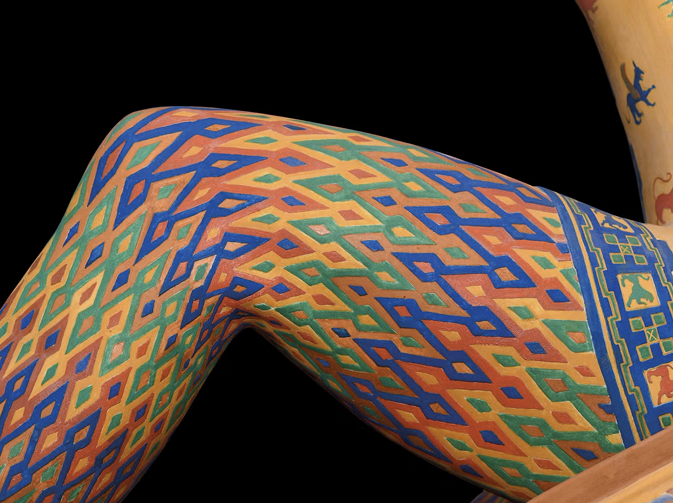
Fig. 2.1 Reconstruction of painting on the leg of the Paris statue of the Aphaia Temple by Vinzenz Brinkmann and his team (photo by Ellen Harlizius-Klück in September 2019)
As photographs with sidelight showed, the marble legs had a complex zigzag pattern that the Brinkmann team first tried to paint freehand on the marble-reconstruction – yielding an unsatisfying result (see Brinkmann 2003: 91–92). In another attempt, they applied a rectangular grid to the surface into which the pattern was then filled, yielding the result presented in the final reconstruction. Such grids are employed by artists to transfer and enlarge motifs between surfaces, e.g. from draft to canvas. Such regular perpendicular grids connected to Euclidean geometry and Renaissance perspective27 are, however, not the best choice for a transformation of the visible forms of an original three-dimensional curved fabric to the similarly curved sculpture. Depending on the form of the motif to be transferred, the grids sometimes have a lozenge form and thus diagonal lines. As the zigzag pattern suggests, and a textile reconstruction of the trousers by Dagmar Drinkler confirms, a diagonal grid would have helped to represent the pattern perfectly28 (figure 2.2). The insistence on a rectangular grid as standard seems particularly inappropriate for reconstructing the pattern on the arms of the sculpture, where a skewed or oblique grid as would have been provided by the plaited fabric already presents the perfect lozenge grid by itself.29
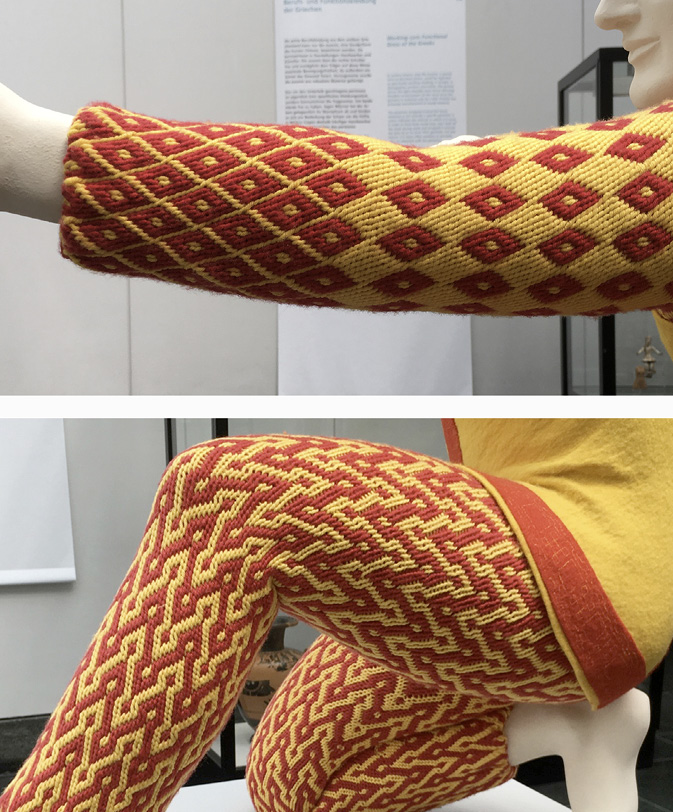
Fig. 2.2 Plaster cast of Paris sculpture with reconstruction in sprang-technique by Dagmar Drinkler (photo by Ellen Harlizius-Klück in 2019)
The original marble sculpture from the Aphaia Temple shows no physical traces of such a grid, although such supports for depicting textile patterns had been in use in Archaic times and are known from frescoes of Knossos and Mycenae (ca. 1,500 BCE), i.e. already one millennium earlier. Sometimes, this grid is termed ‘incised’, and some call it ‘impressed’.30 On the occasion of a description of the frescoes of Mycenae in 1919, Gerhart Rodenwaldt explains that a net was pressed into the plaster (Rodenwaldt 1919: 96, note 1, see figure 2.3).
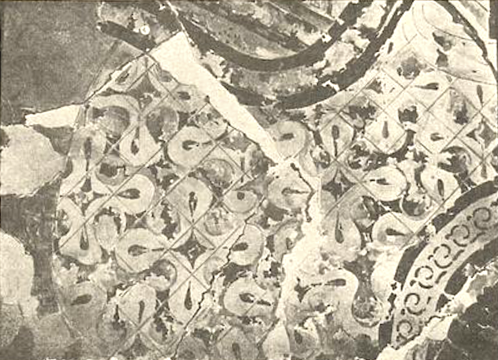
Fig. 2.3 Detail of pattern with artist grid from the skirt of a goddess at the Villa in Ayia Triada, Rodenwaldt 1919: 10431
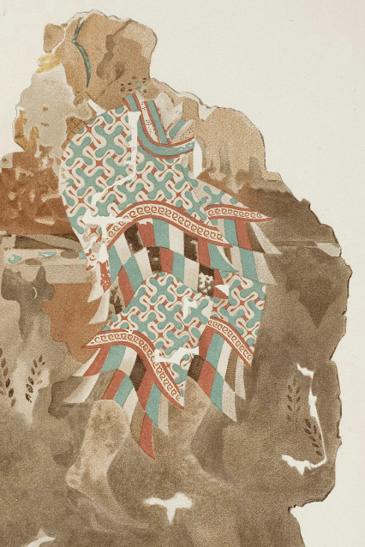
Fig. 2.4 Detail of fresco from Aya Triada with patterned skirt, Halbherr 1903, p. 10, https://doi.org/10.11588/diglit.9310#0216
The earliest evidence of this method, called ‘artist’s grid’ by Maria Shaw, stems from Crete, namely from the island of Pseira and the site Aya Triada, where the pattern of a women skirt has been constructed in such a way (figures 2.3 and 2.4; Shaw 2010: 316). The textile pattern appears almost identical to a ceiling ornament in Egypt, prompting Rodenwaldt to argue that textiles were traded across borders and that such a pattern was imitated here (see figures 10 and 11 in Rodenwaldt 1919: 104).
Shaw and Murray present several such pattern depictions from Mycenaean frescoes. It is striking that they do not reflect the body of the wearer at all (see figure 2.5). About the scale pattern of the cupbearers on the fresco at Ayia Triada, Murray writes: ‘It would appear that maintaining the integrity and clarity of the rapport design was a greater priority than visual naturalism’ (Murray 2016: 55). She continues: ‘The fact that the dress has a fancy weave is more important to record than how it fits and moves as clothing. It is as if the artist conceived of the fabric as the original bolt straight from the loom.’
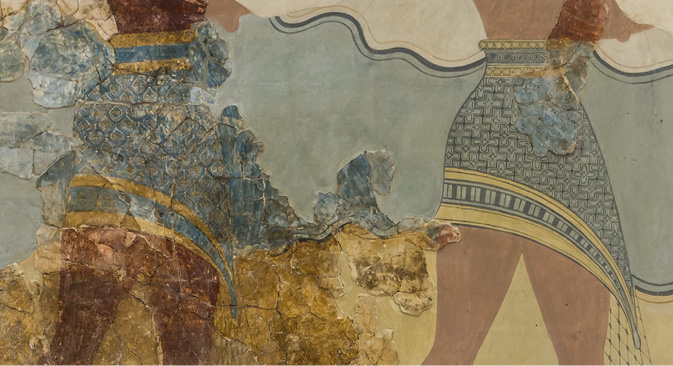
Fig. 2.5 Two examples of textiles worn by cupbearers, depicted with the help of rectangular artist grids. Palace of Minos in Knossos, details from procession fresco, Archaeological museum of Heraklion, Crete, Greece (Photo made in 2015, Public Domain)
According to Shaw, only grids made by vertical and horizontal lines are ‘the true artist’s grid’ (Shaw 2010: 318, note 10). She sharply distinguishes such grids from the ones that go diagonally, correspond to the pattern repeat (Shaw 2016: 194), and are applied to the depiction of wall-hangings.32
But why did the painter depict the textile pattern, that is usually always stretched and squeezed by the body, in such an unrealistic way? Why did they aim at this high pattern precision? Such minutely constructed patterns, when presented flat and not depicted as bending through the body of the wearer, are even irritating for the eye and claim an attention that works against the overall composition; perfection in textile pattern geometry does not appear as realistic or natural, but stands out: ‘The visual effect of this room must have been stunning’, says Murray (Murray 2016: 55). There are reasons to assume that this was exactly the aim of the artist.
Rodenwaldt avers that the rooms in which the patterns were discovered ‘must have had a very special meaning. However, any further clue is missing to determine more precisely what this meaning was, whether we have to recognise a room of similar purpose as the smaller Tirynther Megaron or perhaps the chapel of the palace’ (Rodenwaldt 1919: 106; my translation). Shaw and Murray also point to such a cultic meaning of the rooms where artist’s grids are employed to depict textiles:
In cases where a sufficient amount of a fresco composition is preserved to suggest a context, scenes in which elaborately patterned textiles or decorated garments are worn often have a ritual context, as they depict richly dressed goddesses, priestesses, or other ministrants engaged in activities of epiphany, adoration, offering, or initiation. (Murray 2016: 44; see also Shaw 2010: 316)
However, the fact that elaborate patterns may indicate a cultic meaning is not considered in the discussion of the textiles that are denoted as ‘examples of luxury clothing’, ‘haute couture’, ‘striking fashions’, or ‘extravagant textiles ‘and thus considered part of a luxury discourse and not as part of major social, political or religious events (see Murray 2016: 44, 46, 47, and 516) like the Panathenaic festival or the funeral of Penelope’s father-in-law, Laertes.
On the form of the cosmos: Weaving as cosmic mode of being?
Let us go back to the trousers of Paris to get a better understanding of the perception of textile patterns in ancient times. In a satyr play of Euripides, Helen’s head was turned by the prince’s trousers:
She saw the parti-colored breeches on the man’s legs and the gold necklace around his neck and went all aflutter after them, leaving behind that fine little man Menelaus33
What is of interest here is the problem of understanding the core term poikilos within the phrase tous thylákous tous poikílous (τοὺς θυλάκους τοὺς ποικίλους) as expressing the specific attraction and seductive power of the patterned textile, badly translated as ‘parti-colored’ (or ‘embroidered breeches’ by Coleridge34). Adeline Grand-Clément, in trying to get to the specific meaning of this term and the pattern it denotes, describes the poikilia pattern effect as ‘an entrapment of the eye caused by the interplay of chromatic contrasts animating the patterns’ (Grand-Clément 2015: 413). Such effects appear especially when ornaments show strict symmetries and strong colour contrasts.
This visual trick is what gives the observer an impression of animation, what intrigues and fascinates him. The captive gaze tries to unravel the mathematical and geometrical rules of the design’s construction. But the search is endless … (Grand-Clément 2015: 412).
Grand-Clément, referring to Alfred Gell’s discussion of the ‘technology of enchantment’, states that the attraction is a result of the aim to unravel the secret of its production, as the viewer knows well that there is order and rule behind the complexity.35 In the case of depicted textiles, this attraction is indeed stronger: even when we understand the geometric transfer by the painter, we still do not know how the real fabric pattern was composed. Grand-Clément summarises thus:
[T]he poikilia are the result of perfectly mastered craftsmanship, based on the inlaying and juxtaposition of varied materials, the organizing of patterns, or the meshing of colored threads. Poikilia thus refers to several techniques that share a common objective: to obtain a varied, glistening, and durable radiance – that is, to turn out what the Greeks called agalmata, valuables fit to delight the gods and men (Grand-Clément 2015: 410).
I suggest that this is what the precise pattern depictions in the ritual spaces are meant to achieve: they seem to illustrate a cosmic order that is best represented by textiles.36 However, this representation of order is not achieved by a sort of depiction like in the cosmic textiles, mentioned for example by Plutarch, Euripides or Pherecydes, that depict golden stars, the moon or the signs of the zodiac.37 What the term poikillô emphasises is the technical mode of generation: the elements that are combined do not actually merge. Grand-Clément quotes an observation made by Anne Wersinger that: ‘the effect is not one of mixing that would immediately neutralize the diversity but rather one of juxtaposition, as for weaving with coloured thread, to which the painters’ brushstrokes or the mosaic tesserae correspond’.38 This is said to be characteristic of Archaic aesthetics and implies order, beauty and harmony, concepts that come together in the term kosmos (Grand-Clément 2015: 410). As for the production/construction of poikilia, Grand-Clément states that, ‘it lies in bringing heterogeneous elements together, as a unified whole, while they retain their own nature and keep interacting in a dynamic fashion.’ (Grand-Clément 2015: 415)
The decisive point in this description is the mode of blending that is typical for textiles: not a homogenous physical mixture39 but a sort of optical mixture that Democritus is said to have described first.40Alexander of Aphrodisias writes:
Democritus, then, thinks that what is termed blending occurs by juxtaposition of bodies, with the constituents being divided into corpuscules and forming themselves into a mixture by their positioning beside one another; he says that they are not at all blended in reality, but that the apparent blend is a juxtaposition of bodies with one another where each preserves in corpuscular form its own nature, which they had even before the mixture. These bodies seem to be blended since perception is unable to grasp a single one of them because of the minuteness of the juxtaposed bodies. A lover of truth and a philosopher, he did not shrink from stating the consequence for those who say that blends occur in this way.41
In the Metamorphoses, Ovid describes how the famous weaver Arachne employs this type of mixing colours for weaving. He compares it with the rainbow, in which a thousand colours seem to shine.42 Grand-Clément quotes the fragments of Pherecydes, one of the earliest (if not the earliest) prose texts in Greek literature, dealing with cosmological questions, as an example of the meaning of poikillô as cosmogonic activity. Here, cosmic order indeed comes into existence as a fabric on a loom.43 The order of the world is generated by Zas as a weave that shows not only the signs of the zodiac, but also ôkeanos, the river that surrounds the world like the meander surrounds a cloak. The fragment says: ‘And on the third day of the wedding Zas makes a great and fair cloth and on it he decorates (poikillei) Ge and Ogenos and the halls of Ogenos …’ (Kirk/Raven/Schofield 1983: 61)
As before, the word poikillei in the original fragment is translated as decoration and therefore alludes to a hylemorphic scheme where the fabric is made first and then decorated by some sort of surface design. Robert Eisler, investigating the motif of the cosmic mantle,44 argues that, ‘Because weaving is a uniform type of work that gives no room for creative freedom, the greater magic of δαιδάλεον ποίκιλμα [daidaleon poikilma], the figure building multicoloured embroidery, needs to be added.’ (Eisler 1910: 248; my translation)
We are back, again, among the representatives of the primacy of form putting forward the prejudice of the simplicity of weaving that calls for additional techniques of surface design. Instead, in the term poikilos as we can reconstruct it from the sources with respect to textile technology, we see nature, craft and mathematics intertwined. Although the order of the pattern is mostly addressed as geometric, the importance of the concept of mixture without blending points to a calculated order by composition that, as in the Pythagorean idea of the cosmos,45 depends on the arithmetical relation of elements that do not change in themselves but, when put into relation, generate a third instance by in(ter)ference. While the result of merging two different fluids cannot usually be reversed, the poikilos mixture of weaving can be undone and presents a view where one can still tell apart each element, just by looking close enough to detect where elements shift in and out – as Ingold did in the case of the Navajo blanket; when writing the chapter Traces, Threads and Surfaces for his book on Lines Ingold gives an account of his looking at a blanket made by a Navajo weaver:
What is most striking about the Navajo blanket, however, is that, while the colored designs on its surface are strongly linear, these lines are not themselves threads. Nor are they really traces. Indeed when we look for the line in the blanket, however closely, we find only differences – namely, variations in the colour of the threads, and row-by-row displacements in the locking position of the weft for each colour. We could say that the line on the blanket exists not as a composite of the threads of which it is made, but as an ordered system of differences among them (Ingold 2007: 63–64).
We need to have a closer look at the composition of such patterns.
Patterning textiles, or, form as number and song
To weave means to order. Nothing messes up more easily than threads, which have a natural tendency to entangle. Because of this predisposition, a huge part of textile art is to prepare the necessary arrangement of threads for work, and to decide on the correct form for transport from one stage of production to the next in order to keep this arrangement. It therefore comes as no surprise that the word ‘order’ relates to a Latin verb ordior, denoting the action of setting up the warp threads on the loom. Let us consider the ancient weavers’ practice to understand this specific mode of production.
The most significant difference between present day and ancient weaving is the way in which weaving begins. Fabrics from the warp-weighted loom in use in Greek times (see figure 2.6) employ a starting-border: a band that carries the warp threads for the fabric and later remains attached to it. Due to this border, the warp is not connected to the loom but only to the fabric, and no cut into the warp is required to take the fabric from the loom.
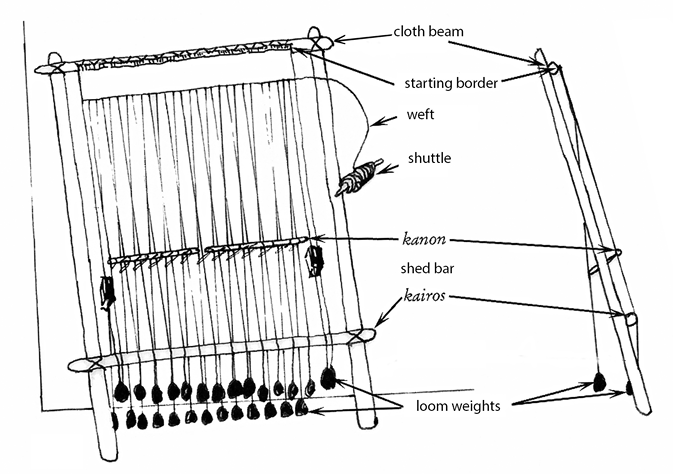
Fig. 2.6 Diagram of warp-weighted loom with side view of natural and artificial shed (drawing by Ellen Harlizius-Klück in 2020)
Furthermore, due to this type of beginning, whatever pattern the weaver wants to establish on their fabric needs to fit into the arrangement of threads provided by this pre-woven border. For a pattern like the meander displayed by the famous painter Exekias as a fabric pattern on a funerary plate (figure 2.9, detail on the right) and reconstructed in the Penelope laboratory, the number of warp threads needs to be a multiple of the number of threads in the pattern unit (twelve in my example); or to put it another way, the thread-count of the pattern needs to be a factor of the number of warp ends. If this were a prime number, no repeat would ever fit, because a prime has no factors beyond one and itself.
When the weaver sets up her loom, the threads coming from the starting border are distributed evenly across the shed bar or kaîros;46 every thread with even numbers goes behind the bar and the odd ones in front (or vice versa). This provides a natural shed that is always open for inserting the horizontal weft. In order to make the countershed to insert the next weft, all the threads behind the kaîros will then be knitted onto a heddle rod (called a kanôn) which allows half of the warp to be pulled in front of the other half.47 Thus kaîros and kanôn open the shed (void) that allows insertion of the weft and composes the elements to make a fabric.
The weaver starts in front of those perpendicular threads that are kept in order by the starting border and by the weights attached to the lower end of the threads. She then gradually inserts weft threads perpendicular to these lines.48 The fabric and its patterns are generated by rhythmical and algorithmic picks of selected warp threads. When every second thread is picked up and this system is set off by one in the next row,49 a tabby is produced: the simplest type of weave. If both thread systems have the same colour, a uniform colour shows on the fabric. When all warp threads are black and the weft threads white, a tiny check pattern shows but the fabric appears grey from a distance. This effect of white and black threads intertwining into optical grey is employed in the case of check patterns that generate squares of three colours from two different thread colours: the third colour is an optical mixture or merge of the other two (figure 2.7) – like the ‘grey’ in the previous example.50 When groups of colours, like black and white, alternate in warp and weft direction, there will be a black square where the black threads cross, a white square where white threads cross, and ‘grey’ squares where black and white threads cross. The number of ‘grey’ squares equals the sum of black and white squares. All three examples have the same algorithm of weaving, namely just up and down; it is only the change in thread colour that produces the different visual patterns.
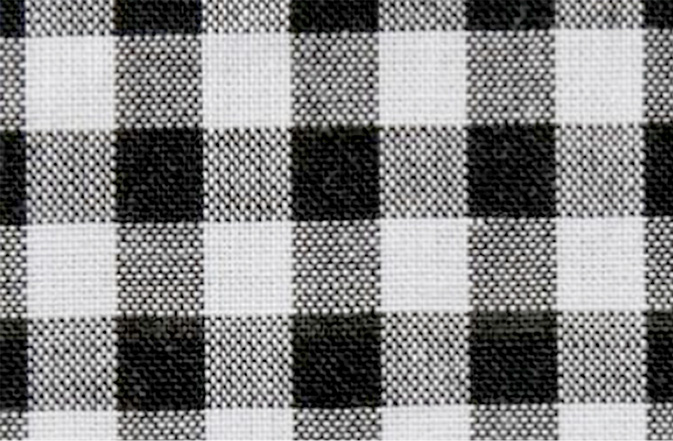
Fig. 2.7 Fabric made by interlacing groups of black and white threads alternating in warp and weft and producing a check pattern (photo by Ellen Harlizius-Klück)
Depending on the weave structure, the field of mixed or ‘entangled’ colour (‘grey’ in the examples above) can show pattern elements that add up with the plain-coloured parts to a bigger pattern unit and often generate the form of a swastika-like cross. A lot of pattern depictions from Crete, Mycenae and Egypt show such interlock patterns, where the ornament seems to be the result of interlocking forms (see figure 2.8).
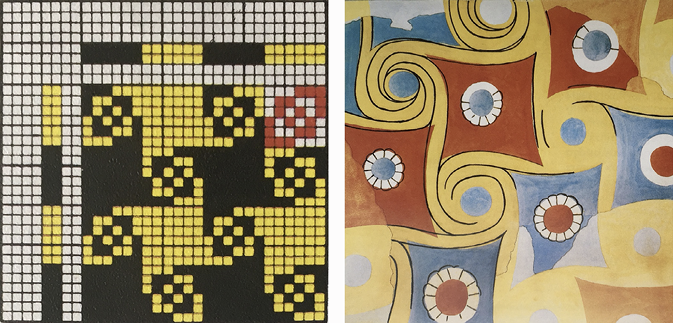
Fig. 2.8 Draft for colour-effect pattern with picking scheme in black and white (hand draft from weaving student, private archive Ellen Harlizius-Klück), and detail of fresco from Knossos (Karetsu 2000: 242)
There are more possibilities to pattern a textile, like inserting a coloured supplementary weft that runs along the whole width of the fabric. Complex weave structures have not been found in ancient Greece so far, and most textile finds show tabby, i.e. the basic up and down structure we know from canvasses, often with higher density of the weft, resulting in hidden warp threads.51 This also applies to tapestries, where the colour sometimes only runs as far as the motif and thus is closer to the principles of executing forms in drawing or painting than other weaving techniques. To weave geometric patterns in tapestry (like on a Navajo blanket) is not easier or more difficult than, for example, weaving birds or fishes, horses or human beings. The freedom here is not a result of the freedom of depicting a shape or a form being filled, but of stacking layers of zigzagging weft threads that finally present a visible result: a form or an image.
But aside from tapestry and similar techniques, patterns in weaving, including floral motifs, are subject to technical constraints and rules that contradict the hylemorphic concept of design where one proceeds from drafting a motif to its execution. The meander, for example, escapes the idea that all geometric pottery paintings are based on geometry, because an elementary geometric construction is not at hand. Schweitzer, having explained why ornaments on geometric vases were independent of technical origins, was nevertheless forced to conclude that, ‘The prehistory of the meander in the 10th century can probably not be explained without the hypothesis of a textile origin.’52
Likewise, Elisabeth Barber argues for a textile origin of the meander, in this case based on her own weaving experiments. When trying to weave the spiral ornament frequently encountered in Greek art, she tried as many techniques as possible, and finally realised that most of them force the weaver to create angular spirals and thus meanders. The technique that worked best was double weave, whereas the running spiral was easiest to weave with a supplementary weft (Barber 1991: 370, Note 10).
Based on practical experiments, I explored variations of the weaving techniques described above – known as colour-and-weave effect patterning – to achieve an all over meander pattern as depicted on a funerary plaque by Exekias (5th century BCE). Figure 2.9 presents the respective fragment on the right-hand side, the motif that is repeated in the middle, and the instruction for lifting the warp threads to the left. Juxtaposed like this, the difference to usual sketching techniques in art is obvious and the difficulty in understanding the process lies open: How could a non-weaver understand how the labyrinthine outcome, the meander, arises from such an instruction (the red-white scheme of lifting threads to the left) that does not present any maze-like feature?
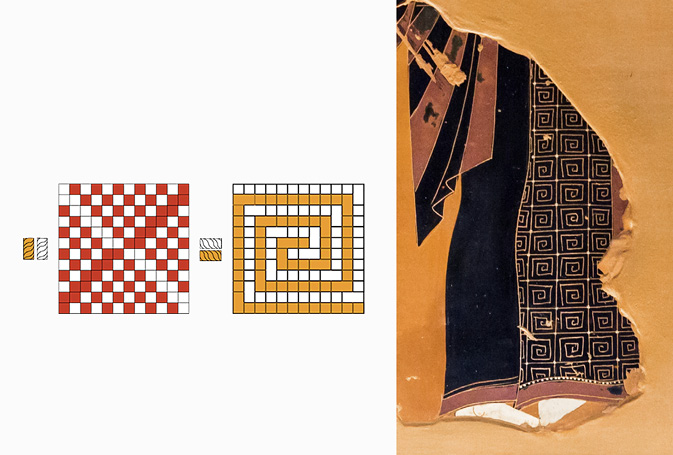
Fig. 2.9 Left: draft, or instruction scheme for lifting warp-threads (part of patron or draft); centre: sketch of result; right: fragment of funerary plate by Exekias. Diagram by Ellen Harlizius-Klück
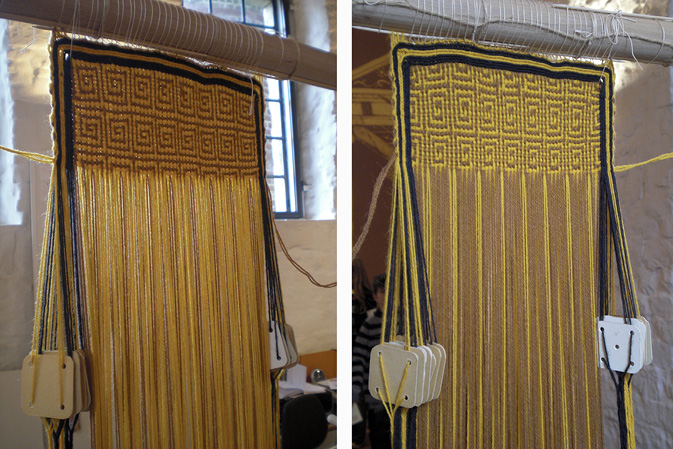
Fig. 2.10 Meander fabric reconstructed by Ellen Harlizius-Klück on the warp-weighed loom, recto and verso side. Photo by Ellen Harlizius-Klück in 2009
What happens is that the red-white binary scheme is executed as an algorithm on two systems of continuous threads, vertical warp and horizontal weft, in alternating colours of ochre and white. However, the relation between binary action and outcome remains unpredictable for non-weavers.
Such drafts are not known from ancient times and are associated with modern looms with shafts and treadles. Still, they can help to understand the principles of patterning that every weaver has to follow, especially because they show the pattern as a result of two interfering structures. These structures are, first, the system of crossings denoted as a binary grid of red or white squares indicating the up and down of the warp (that we refer to as ‘binding’ or ‘weave’, and that are of many kinds) and, second, the arrangement of threads of specific colour that make the meander motif appear to the eyes of beholders. It is this stunning generation process, zigzagging across the loom by following a binary logic imposed on two independent systems (thread order and colour order) that I address as histomorphism: a scheme of composition indicating how a form (morphê) is produced in a weave (histos) or on a loom (histos).
Within the rival concept of hylemorphism, the squared spiral of the meander would be the initial form in the mind of the weaver, being only then imposed on the fabric as its material. This would only work as a concept for embroidery or painting on textiles where the form we see indicates the movement that the hand of the craftsperson has to follow. The line of the woven meander, however, is not such a trace of a movement.
Armed with some insight into the complexity that the weaver needs to master when s/he generates a pattern emerging from structured elements, we can now see why the hylemorphic scheme fails for understanding the genesis of patterns. Aristotle, to whom Simondon and Ingold refer as the origin of the hylemorphic scheme,53 did not aim to establish a theory of making, but to reject the ideas of atomists like Democritus, for whom change is a rearrangement of tiny material elements (atoms or stoicheia). Both Plato and Aristotle discarded such concepts as materialistic, a qualification that did not exist in Pre-Socratic times. The opposition of materialism and idealism, which we saw already as a driving and splitting force in the discussion of textiles as origin of art, does not only refer to the question of what reality really consists in, but also how it originated. To atomists like Leucippus and Democritus, all that exists is an entanglement of matter and void. To speak of matter as an entanglement of elements is opposed to the idea that matter is a continuous substance capable of taking many forms.
It is here that the similarity of the rejected atomism to the construction of fabrics by weaving is most striking. We can easily read the claims of the atomists as saying: all that exists is an entanglement of elements or threads (matter) with interstitches: the void opened by kaîros and kanôn allows the filaments to compose a three-dimensional structure. The ordered arrangement of discrete elements, namely the threads, is also what generates optical mixtures of colour in a fabric: not a merging of different colours as in painting, but a particular mixture where each component retains its nature, and the optical effect is the result of a pattern, its emergence on the fabric collapsing the distinction between form (design) and material that nevertheless persists in the perception of the pattern as (fictive) ‘form’. The interaction of connection and separation with the alternation of order and position as we see it in the histomorphic principle precisely reflects how Democritus, quoted (and rejected) by Aristotle, describes the generation of colour ‘by virtue of turning’ as understood by the atomists:
But Democritus and Leucippus, by positing shapes (ta schemata), explain alteration and generation on the basis of these: generation and destruction by dissociation (diakrisis) and association (sunkrisis), alteration by order and position. […] And that is why he [Democritus] says that colour does not exist: for coloration happens by virtue of turning (tropê gar chrōmatizesthai).54
Aristotle’s concept of hylemorphism deserves a detailed analysis which we cannot deliver here.55 It seems that the current idea of hylemorphism is a misrepresentation of his initial notion, which does not refer to man-made objects at all. His scheme is clearly brought up against atomistic ideas that were gaining popularity in Aristotle’s times. Considering the frequent use that atomists make of textile and weaving terms for explaining how elements organise into bigger wholes, it is no surprise that any rejection of atomism also affects the concept of weaving that travels with those theories of cosmic order and their textile terms and concepts. A glimpse of this important role of weaving as a mediator of atomistic principles is perceivable when the late atomist Lucretius, who frequently employs weaving metaphors, feels obliged to claim that weaving originates from male hands in concert with the invention of iron. In his view, weaving was only later passed to female hands because male hands had more important things to do.56
. . .
As this chapter has demonstrated, the operation of pattern weaving itself does not employ geometry, but rather arithmetic, even when the fabric shows squares and triangles. When we see a geometric form on a woven fabric, a weaver who wants to imitate such a pattern does not need knowledge of geometry. Instead, s/he needs to identify (1) the technique (weaving, plaiting, double weave, supplementary weft etc.), (2) the colours of the threads (not the colours of the pattern!) and (3) the distribution and the relation or ratio of numbers/bundles of the coloured threads. Concerning the numbers, it is not so much their amount that is important but rather the relation, ratio or proportion contained in the pattern. This ratio was called logos in antiquity and points to ‘the group or bundle of numbers that are contained in a thing and by which this thing can be described as well as reproduced.’57 A traditional weaver from Afghanistan, asked how she translates an image into patterns, responded: ‘I don’t see it as a picture. I see it as numbers and I make it a song.’58
The woven order best explains the atomistic concept of mixture without blending, a calculated order that, as in the Pythagorean idea of numbers constituting the cosmos,59 depends on the arithmetical relation of elements that do not change in themselves but generate a third instance by a sort of interference. Such a process of generation (here described as histomorphism) where the weaver, as Homo textor, is capable of ordering elements into balanced structures bearing forms as emergent compositions of entanglements, can indeed function as a cosmogonic principle and extend to elements in nature, like the scales of a snake or the cross-breeding of plants, or extend to elements of social communities, like husband and wife or citizens and guests, and their relation.
With regard to the question of what it is that travels with the technical mode of weaving, neither the poetic answer given by the weaver from Afghanistan nor the concept of histomorphism presented here are easily accessible for non-weavers. One can argue that people in antiquity knew the technology well enough to understand how it orchestrates all those seemingly diverse ideas like number, rhythm, entanglement, colour mixture or the quality of being poikillô. Changes in the loom during history, especially when they constrain the possibilities of the weaver in orchestrating the entanglement at the loom, make this work appear to be labour only. These changes will finally make the transfer of the technical mode inaccessible and turn textile terminology into mere metaphor.
Endnotes
1 The phrase ‘technical mode of existence’ goes back to Gilbert Simondon (2017), who takes up a concept presented by Etienne Souriau (2015, 1943), related to modes of things like being tough, tender, imaginary, virtual and so on. Bruno Latour in his Inquiry refers to both Souriau and Simondon in building up a network of such modes including technology, religion, fiction and reference. In this chapter, I loosely refer to Simondon and Latour (2013). To determine exactly how the technical mode of weaving relates to those endeavors would require a longer philosophical investigation.
2 Homer, Odyssey 2.85–2.105, see also chapter 1 ‘Introducing Homo textor’, of this book.
3 Our contemporary term ‘design’ derives from It. disegno, in which art history has its own notion of hylemorphism: of an idea applied to matter. Disegno is one of the major concepts of the Renaissance theory of art, where it means both design and project, outline and intention, idea in the speculative sense as well as in the sense of invention (Cassin et al. 2014: 224). Where this concept of art-making rules, textile ornaments are conceived of as a design on a sort of canvas, a material surface on which an idea takes form by painting, printing, drawing or embroidery.
4 More common in areas like Bolivia, Guatemala, India, Indonesia for example, but also still alive as craft in the United States and Europe.
5 The development of looms instead has advantages for designers who begin with an idea or form, since looms increase the possibilities for drafting methods that are not concerned with the technical details of fabric construction.
6 For a recent discussion, including an overview of former explanations of the beginning of science, see Makarov 2023; see also Snell 1982 (1953).
7 Pherecydes of Syros was born around 584–581 BCE. Further details of his life are unknown.
8 However, when Vernant refers to the work of Pherecydes, he resumes: ‘The myth does not ask how an ordered world could arise out of chaos…’ (Vernant 1982: 113). Indeed, Vernant in his investigation focuses on the seemingly typical techno-materials iron, stone and wood. His accounts of economic transformations (71–72), lists of traded products (72), and of transformations in the areas of agriculture and craft (73) illustrate a fundamental neglect of textiles: wool, flax, clothes and textile production are absent from these accounts.
9 Simondon explicates this opposition of atomism and hylemorphism in his thesis (Simondon 1995: 21–22).
10 In the meaning those terms have in Latour’s Inquiry, especially 2013: chapter 9, 233–57.
11 For the relation of metaphor and technology, as well as nature and culture, as presented in the ancient term technê see Harlizius-Klück and Fanfani (2016): 62–64. See also Blumenberg (2015); Schadewaldt (2014) makes a strong case for the peculiar kind of integration between nature, technê and culture in Archaic Greek thought by exploring the terms/concepts physis and technê.
12 The concept of a technical mode of existence as introduced by Simondon was meant as an alternative to the idea of hylemorphism that reduces the process of making to the execution of an idea in matter. Into this bilateral but monodirectional concept, Simondon introduces energy as an important condition (Simondon 1995: 43–44) while Tim Ingold, who was the first to describe the process of making as a modality of weaving, aims to establish a field of forces (Ingold 2010: 91–92, 97, 100) as a condition of making, especially in art and craft.
13 Fischbach 1883: VII. My translation.
14 See ‘In the beginning was the word …’ John 1.1.
15 Riegl 1985: 20. Similarly, the art critic George Kubler refers to the individual who creates art as an artisan with a calling: he ‘belongs to a distinct human grouping as homo faber, whose calling is to evoke a perpetual renewal of form in matter’ (Kubler 1962: 10).
16 Riegl 1985. On the history of the beginning of art history, see Vasold 2015.
17 Semper’s claim was taken up by two exhibitions in the year 2013 in Germany. Textiles Open Letter in Mönchengladbach aimed at presenting a comprehensive reconsideration of the textile medium (Frank and Watson 2015). Kunst & Textil in Wolfsburg promised to present textile patterns and structures as a new paradigm for the development of art (Arlt 2014). Both approaches have been criticised by Regine Prange (2015) as the ‘Renaissance of the carpet-paradigm’ a term borrowed from Joseph Masheck who takes the carpet as a flat, patterned surface directed against the Renaissance ideal of the painting as window on to the world (Masheck 2010). The Department for Art History and Visual Studies of the University of Lund announced in 2012 a publication entitled ‘Reconsidering the Carpet Paradigm’. This was published in 2014 as a special issue of the Konsthistorisk Tidskrift (3/83) and explicitly referred to Masheck’s concept as an attempt at a new foundation of modern art and art theory.
18 The term ‘grammar’ in this discussion points to the famous and influential Grammar of Ornament, published by Owen Jones in 1856.
19 Schweitzer 1969: 28; my translation. Indeed, the Greek word kosmos has a wide range of meanings that are difficult for us today to hold together: it can refer to patterned textiles and elaborate bracelets as well as to the order of the stars or of patterns in nature.
20 Germany as a nation state did not even exist. The Prussia-led confederation of northern German regions turned into the German Empire only in 1871.
21 The term could be translated as ‘men of letters.’ It was used in the late nineteenth and early twentieth centuries to denote what we today would call ‘intellectuals.’
22 ‘Wenn die Lehren des Materialismus in der modernen Gesellschaft zur Herrschaft kommen würden, so würde etwas Aehnliches mit ihr geschehen, wie wenn aus dem Himmel jene geheimnisvolle Kraft verschwinden würde, durch welche die Planeten and die Sonne gebunden sind und ihre Elemente in ihrem Mittelpunkt zusammengefaßt werden’. Haffner 1865: 3–4.
23 Vasold, who concentrates his account of the discussion of Semper’s idea on Riegl and Vienna (Austria), does not mention this background. Vasold 2015.
24 There is some confusion about the date of the essay. Probably written in late 1909, it was first published in French in 1913, but the usual publication date is rendered as 1908. See Long 2009.
25 On concepts of order in antiquity and their connection to specific properties of the warp-weighted loom see Harlizius-Klück and Fanfani 2016. For a more detailed analysis of the arithmetical parts of Euclid’s elements and their possible relation to ancient patterns and their calculation see Fanfani and Harlizius-Klück, forthcoming.
26 … as later claimed by modern artists like Paul Klee in ‘Beiträge zur Bildnerischen Formlehre’: the pictorial form in general begins with the point that sets itself in motion and creates a line, see http://www.kleegestaltungslehre.zpk.org/ee/ZPK/BF/ pages 5–6.
27 The most famous demonstration of the use of a grid of threads for constructing perspective is Albrecht Dürer’s woodcut depicting the drawing of a woman. Instruction on Measurement from 1525.
28 See Drinkler 2009. The team around Brinkmann did not ask for a possible textile construction of the original fabric (apart from some knitting experiments for publicity). Drinkler is textile conservator at the Bayerisches Nationalmuseum and felt challenged by this neglect. She made an example of a textile reconstruction of the trousers in a braiding technique called ‘sprang’. Her reconstruction has two colours instead of the five assumed by Brinkmann and his team. Indeed, the available data point to no more than two colours. (Oral information provided by the conservator of the State Collections of Antiquities, Catharina Blänsdorf, during an interview at the Deutsches Museum, Munich on 22 February 2018).
29 See Brinkmann and Wünsche 2003: 23–30 for the development of the rectangular grid. The authors claim that this grid is an indispensable condition for both the original painting and the reconstruction (23). They give no reason why the grid needs to be rectangular. In fact, the grid-like structure of the textiles probably supported the transfer of form as a discretisation tool before geometry.
30 Murray 2016: 50. Maria Shaw, investigating a fragment of plaster in Pseira, Crete, says that a thin thread is stretched and snapped against the wet plaster where it leaves an impression. See Shaw 2010: 315, note 3; see also Lang 1969: 10 and 11.
31 University Library Heidelberg, https://doi.org/10.11588/diglit.44573#0125 (accessed 9 November 2023).
32 It remains unclear why this distinction should be important as it does not make any difference for the rest of her investigation. In this context it is interesting to see that Shaw, in order to represent the pattern on the skirt of the goddess from the royal villa of Ayia Triada, rotates the drawing by 45° so that the formerly oblique grid becomes a perpendicular one. Obviously, she assumes that the pattern was rotated for depiction and speaks of an ‘obliquely placed pattern’ (Shaw 2016: 191). As a result, the grid now belongs to her category of artist’s grids (and no longer to the repeating patterns) and can be treated in the respective section (see Shaw 2016: 189–198).
33 Euripides, Cyclops, 182–85; after Kovacs, http://data.perseus.org/citations/urn:cts:greekLit:tlg0006.tlg001.perseus-eng1:175–202.
34 Euripides, Cyclops, 182–85; after Coleridge, http://classics.mit.edu/Euripides/cyclops.html.
35 See Grand-Clément 2015: 413; Gell 1992.
36 There are icons in the orthodox church where the patterns of the clothes of the presented saints are depicted in just the same flat manner. Looking at the icon, the viewer or person in devotion is mesmerised as by a picture puzzle.
37 Plutarch describes the cosmic mantle of Demetrius Poliorketes (Plut. Dem. 41.4); Euripides describes the tent of Xerxes (Eurip. Ion 1143); Pherecydes presents Zas/Zeus as weaving a fabric for Ge/Gaia (Kirk/Raven/Schofield 1983: 61).
38 Wersinger 2001: 38; quoted after Grand-Clément 2015: 409.
39 Aristotle, peri geneseôs kai phthoras, 328a. On the problem of mixing colours see Gage 1993: 30–32.
40 Gage 1993: 31. The idea of a mixture as an interlacement of elements that do not lose their properties when mixed, is the reason why Plato says the statesman should be a weaver who weaves the brave and the tempered citizens as strong warp and soft weft together to achieve a harmonic state (Politikos 311c).
41 Alexander of Aphrodisias, On Mixture and Growth, 214.18, after Todd 1976: 111.
42 Ovid, Metamorphoses, 6.61–67. See also Harich-Schwarzbauer 2016: 150–56.
43 See Grand-Clément 2015: 408. On the interpretation of the fragments of Pherecydes and weaving as comogenesis see Harlizius-Klück 2004: 155–64.
44 The idea of the heaven or cosmos as weave or mantle recurs through ancient times. Euripides presents the priest Ion setting up a tent consisting of fabrics with cosmic motifs (Euripides, Ion, 1143–58), Plato presents the idea of a band, keeping the cosmos together (Politeia, X, 616c). The statue of the Roman Emperor Trajan wears a mantle with rosettes meant as stars (Brinkmann 2003: 121–215).
45 For a detailed investigation of the Pythagorean idea of numbers constituting order in the cosmos, see Harlizius-Klück and Fanfani, forthcoming.
46 For the meanings of the word kaîros see Fanfani, Chapter 4.
47 It is important to be aware that the ‘halves’ of the warp distribute across the whole width of the loom. There is no split in the middle.
48 There is no focusing on the right angle between warp and weft while weaving, contrary to the suggestion by Richard Sennett (2008: 278). Instead, because the weft needs to go up and down along the warp, the inserted thread needs to be longer than the fabric width, and it needs leeway to pass into the third dimension. Therefore, it is either inlaid diagonally or in the form of a curve.
49 This is the rhythm considered from the perspective of the one picking. Thought along the perspective of the thread itself, there is a constant up-down rhythm that extends beyond the borders and turning points of the weft: a stable double zigzag.
50 A checked pattern, a Madras or Tartan, is a simple colour effect pattern. Variants that are more complex are shepherd’s check or Glencheck and similar patterns that are the result of an interference of structure and colour that is not easy to understand for laymen. A true checkerboard pattern is impossible to weave in simple tabby. It affords complex weave structures like double cloth or Taqueté.
51 Spantidaki writes: ‘Every extant textile dated from the seventeenth century BCE up to the tapestry of Vergina in the fourth century BC is a tabby’ (Spantidaki 2016: 55).
52 Schweitzer 1996: 31; my translation. Schweitzer refers to the 10th century BCE.
53 Simondon 2017: 184; Ingold 2010: 92. However, without detailed reference. The main source for the concept is Aristotle, Physics i 7, but several other works refer to the same idea.
54 Aristotle’s On Generation and Corruption, 315a34–b9 and 315b33–316a2. I thank Giovanni Fanfani for pointing me to this source.
55 For a detailed discussion see Kelsey 2010; see also Fratzl et al. 2021: 7.
56 ‘Clothing made from materials tied together / came before woven garments, woven clothes / came after iron, for cloth is made with iron – / that is the only way men can turn out / such fine, smooth heddles and spindles, shuttles, / and rattling yard-beams. Nature forced the males / to work with the wool before the females, / for the male sex far excels in skill and is / much more inventive, until tough farmers / scorned weaving, and then the men were willing / to let the women do that kind of work / and to share equally among themselves / in hard labour, strengthening hands and limbs / with heavy tasks.’ Lucretius, De Rerum Natura / On the Nature of Things, V.1350–60. Lucretius is a Roman author who lived in the first century BCE while the Greek atomists, of whom we only have fragmentary texts, were active in the second half of the fifth century BCE.
57 See von Fritz 1971: 83. For a more detailed investigation of numbers and weaving in Archaic Greece see Fanfani and Harlizius-Klück, forthcoming.
58 Postrel 2020: 84. See also chapter Five by Anthony Tuck et al.
59 For a detailed investigation of the Pythagorean idea of numbers constituting order in the cosmos, see Harlizius-Klück and Fanfani, forthcoming.
References
Arlt, P., ‘Ikonologie der Textilmuster in der Kunst’, Ossietzky: Zweiwochenschrift für Politik / Kultur / Wirtschaft 3 (2014). http://www.ossietzky.net/3-2014&textfile=2559 (accessed 3 January 2021).
Barber, E. J. W., Prehistoric Textiles: The Development of Cloth in the Neolithic and Bronze Ages (Princeton: Princeton University Press, 1991).
Beck, H., ‘State and Society in Pre-March Prussia: The Weavers’ Uprising, the Bureaucracy, and the Association for the Welfare of Workers’, Central European History, 25.3 (1992): 303–31.
Blumenberg, H., Schriften zur Technik, ed. by A. Schmitz and B. Stiegler (Frankfurt: Suhrkamp, 2015).
Brinkmann, V., ‘Der Prinz und die Göttin: Die wiederentdeckte Farbigkeit der Giebelskulpturen des Aphaia-Tempels’, in V. Brinkmann and R. Wünsche, eds, Bunte Götter: Die Farbigkeit antiker Skulptur (Munich: Glyptothek, 2003), pp. 84–113.
Brinkmann, V., and U. Koch-Brinkmann, Der prächtige Prinz (Munich: Biering & Brinkmann, 2003).
Brinkmann, V. and Wünsche, R., eds, Bunte Götter: Die Farbigkeit antiker Skulptur, München: Glyptothek, 2003.
Cassin, B., and others, eds, Dictionary of Untranslatables: A Philosophical Lexikon (Princeton: Princeton University Press, 2014) https://www.jstor.org/stable/j.ctt5hhntn (accessed 5 November 2023).
Conze, A., ‘Zur Geschichte der Anfänge griechischer Kunst’, Sitzungsberichte der Akademie Wien, philosophisch-historische Klasse (1870): 505–38.
Drinkler, D., ‘Tight-Fitting Clothes in Antiquity: Experimental Reconstruction’, Archaeological Textiles Newsletter 49 (2009): 11–15.
Eisler, R., Weltenmantel und Himmelszelt: Religionsgeschichtliche Untersuchungen zur Urgeschichte des antiken Weltbildes. Vol. I. (München: Beck, 1910).
Fanfani, G., E. Harlizius-Klück, and A. Mamidipudi, ‘Anchoring in tekhnê. Weaving and Plato’s Distinction of Pure and Applied Knowledge’, in M. Flohr, S. Mols, and T. Tieleman, eds, Anchoring Technology in Greco-Roman World (Leiden: Brill, 2025), pp. 257–283.
Fanfani, G., and E. Harlizius-Klück, ‘Pattern Weaving as Knowledge in Early Greek Thought’, in R. Hahn, and A. Herda, eds, Knowledge in Archaic Greece: What Counted as ‘Knowledge’ Both Before and During the Origins of Philosophy in the 6th century BCE Ionia? (forthcoming).
Fischbach, F., Geschichte der Textilkunst nebst Text zu den 160 Tafeln des Werkes Ornamente der Gewebe (Hanau: Alberti, 1883).
Frank, R., and G. Watson, eds, Textiles Open Letter (Vienna: Sternberg, 2015).
von Fritz, K., ‘Die ΑΡΧΑΙ in der griechischen Mathematik’, in K. von Fritz, ed., Grundprobleme der Geschichte der antiken Wissenschaft (Berlin: de Gruyter, 1971), pp. 334–429.
Fratzl, P., M. Friedman, K. Krauthausen, and W. Schäffner, eds, Active Materials, Berlin/Boston: de Gruyter, 2021.
Gage, J., Color and Culture: Practice and Meaning from Antiquity to Abstraction (London: Thames and Hudson, 1993).
Gell, A., ‘The Technology of Enchantment and the Enchantment of Technology’, in J. Coote and A. Shelton, eds., Anthropology, Arts and Aesthetics (Oxford: Clarendon Press, 1992), pp. 40–67.
Grand-Clément, A., ‘Poikilia’, in P. Destrée and P. Murray, eds, A Companion to Ancient Aesthetics (Oxford, MA 2015), pp. 406–21.
Haffner, P. L., Der moderne Materialismus (Frankfurt: Verlag für Kunst und Wissenschaft: 1865).
Halbherr, F., Resti dell’età micenea: scoperti ad haghia triada presso phaestos (Roma: Accademia dei Lincei, 1903).
Harich-Schwarzbauer, H., ‘Over the Rainbow’‘: Arachne und Araneola – Figuren der Transgression’, in H. Harich-Schwarzbauer, ed., Weben und Gewebe in der Antike: Materialität – Repräsentation – Episteme – Metapoetik. Text and Textiles in the Ancient World: Materiality – Representation – Episteme – Metapoetics (Oxford: Oxbow, 2016), pp. 147–163.
Harlizius-Klück, E., Weberei als episteme und die Genese der deduktiven Mathematik (Berlin: Ebersbach, 2004).
Harlizius-Klück, E., and G. Fanfani, ‘(B)orders in Ancient Weaving and Archaic Greek Poetry’, in G. Fanfani, M. Harlow, and M.-L. Nosch, eds, Spinning Fates and Song of the Loom: The Use of Textiles, Clothing and Cloth Production as Metaphor, Symbol and Narrative Device in Greek and Latin Literature (Oxford: Oxbow 2016), pp. 61–99.
Harlizius-Klück, E., and G. Fanfani, ‘Weaving the Double Square: An (Im-)material Contribution to early Greek Mathematics’, in W. and R. Hahn, eds, Materia Philosophiae: Material Dimensions of Ancient Philosophy (Leiden: Brill 2025), pp. 267–309.
Ingold, T., Making. Anthropology, Archaeology, Art and Architecture (London and New York: Routledge, 2013).
Ingold, T., The Perception of the Environment: Essays in Livelihood, Dwelling and Skill (London and New York: Routledge, 2000).
Ingold, T., Lines: A Brief History (London and New York: Routledge, 2007).
Ingold, T., ‘The Textility of Making’, Cambridge Journal of Economics, 34 (2010): 91–102. doi:10.1093/cje/bep042 (accessed 20 November 2023).
Jones, O., The Grammar of Ornament: A Visual Reference of Form and Colour in Architecture and the Decorative Arts (Princeton: Princeton University Press, 2016 (1856)).
Kader, I., Penelope rekonstruiert: Geschichte und Deutung einer Frauenfigur (Munich: Museum für Abgüsse Klassischer Bildwerke, 2006).
Karetsu, A., ed., ΚΡΗΤΗ-ΑΙΓΥΠΤΟΣ. Πολιτισμικοί δεσμοί τριών χιλιετιών. Cataloque Archaeological Museum Heraklion 21 November 1999 – 21 September 2000; (Heraklion: Hellenic Ministry of Culture, 2000).
Kelsey, S., ‘Hylomorphism in Aristotle’s Physics’, Ancient Philosophy 30 (2010): 107–24.
Kirk, G. S., J.E. Raven and M. Schofield, eds, The Presocratic Philosophers (Cambridge University Press, 1983).
Kubler, G., The Shape of Time: On the History of Things (New Haven: Yale University Press, 1962).
Kunstmuseum Wolfsburg, ed., Kunst & Textil. Stoff als Idee und Material in der Moderne von Klimt bis heute (Ostfildern 2013).
Lang, M. L., ed., The Palace of Nestor at Pylos in Western Messenia, Vol. II: The Frescoes, (Princeton University Press, 1969).
Latour, B., An Inquiry into Modes of Existence: An Anthropology of the Moderns (Cambridge MA: Harvard University Press, 2013).
Latour, B., ‘Reflections on Etienne Souriau’s Les différents modes d’existence’, in G. Harman, L. Bryant, and N. Srnicek, eds., The Speculative Turn: Continental Materialism and Realism (re.press, 2011), pp. 304–33, https://hal-sciencespo.archives-ouvertes.fr/hal-01054002 (accessed 19 February 224).
Latour, B., ‘Drawing Things Together’, in M. Lynch and S. Woolgar, eds, Representation in Scientific Practice (Cambridge, MA, and London: MIT Press), pp. 19–68.
Long, C., ‘The Origins and Context of Adolf Loos’s “Ornament and Crime”’, Journal of the Society of Architectural Historians, 68.2 (June 2009): 200–23. https://www.jstor.org/stable/10.1525/jsah.2009.68.2.200.
Loos, A., Ornament and Crime (London: Penguin, 2019).
Makarov, Z., and T. Radzyniak, ‘On the Problem of Origin of Science: The Antiquity Context’, Filosofija. Sociologija, 34.3 (2023): 300–9. https://doi.org/10.6001/fil-soc.2023.34.3.10
Masheck, J., The Carpet Paradigm: Integral Flatness from Decorative to Fine Art (New York: Edgewise 2010).
Murray, S. P., ‘Patterned Textiles as Costume in Aegean Art’, in M. C. Shaw and A. P. Chapin, eds, Woven Threads: Patterned Textiles of the Aegean Bronze Age (Oxford & Philadelphia: Oxbow 2016), pp. 43–103.
Postrel, V., The Fabric of Civilization: How Textiles Made the World (New York: Basic Books 2020).
Prange, R., ‘Die Wiederkehr des Teppichparadigmas: Anmerkungen zur zeitgenössischen „Welt-Kunstgeschichte“’, in A. Tietenberg, ed., Muster im Transfer: Ein Modell transkultureller Verflechtung? (Cologne and Vienna: Böhlau, 2015), pp. 21–36.
Riegl, A., Stilfragen: Grundlegungen zu einer Geschichte der Ornamentik (Darmstadt: Wissenschaftliche Buchgesellschaft, 1985) (Reprint of first edition 1893).
Rodenwaldt, G., ‘Mykenische Studien I’, Jahrbuch des Deutschen Archäologischen Instituts 34 (1919): 87–106.
Schadewaldt, W., ‘The Concepts of “Nature” and “Technique” according to the Greeks’, in R. Scharff and V. Dusek, eds, Philosophy of Technology. The Technological Condition: An Anthology (Hoboken NJ: Wiley-Blackwell, 2014), pp. 25–32.
Schweitzer, Bernhard. Die geometrische Kunst Griechenlands: Frühe Formenwelt im Zeitalter Homers, Köln: DuMont Schauberg, 1969.
Semper, G., Style in the Technical and Tectonic Arts: Or, Practical Aesthetics (Los Angeles: Getty Publications, 2004).
Semper, G., Der Stil in den technischen und tektonischen Künsten. Vol. 1: Die Textile Kunst (Frankfurt: Verlag für Kunst und Wissenschaft, 1860).
Sennett, R., The Craftsman (New Haven: Yale University Press, 2008).
Shaw, M. C., ‘A Fresco of a Textile Pattern at Pylos: the Importation of a Minoan Artistic Technique’, British School at Athens Studies 18, Cretan Offerings: Studies in honour of Peter Warren (2010): 315–320.
Shaw, M. C., ‘String Lines, the Artist’s Grid, and the Representation of Textiles in Fresco’, in M. C. Shaw and A. P. Chapin, eds, Woven Threads: Patterned Textiles of the Aegean Bronze Age (Oxford & Philadelphia: Oxbow 2016): 183–204.
Shaw, M. C. and Chapin, A. P., eds., Woven Threads: Patterned Textiles of the Aegean Bronze Age (Oxford & Philadelphia: Oxbow 2016).
Sigaut, François. ‘Die Homo faber-Kontroverse’, Zeitschrift für Kulturwissenschaften 2 (2018): 17–33.
Simondon, G., L’individu et sa genèse physico-biologique (Grenoble: Millon, 1995).
Simondon, G., On the Mode of Existence of Technical Objects (Minneapolis: Univocal, 2017).
Snell, B., The Discovery of the Mind: The Greek Origins of European Thought (New York: Dover, 1982) (1953).
Souriau, É., Les différents modes d’existence (Paris: PUF, 1943).
Souriau, É., The Different Modes of Existence (Minneapolis: Univocal Publishing LLC, 2015).
Spantidaki, S., Textile Production in Classical Athens (Oxford & Philadelphia: Oxbow, 2016).
Todd, R. B., ed., Alexander of Aphrodisias on Stoic Physics (Leiden: Brill, 1976).
Vasold, G., ‘Woven Thinking: Textile Art and the Advent of Modern Art Scholarship’, in R. Frank and G. Watson, eds, Textiles Open Letter (Vienna: Sternberg, 2015), pp. 166–79.
Vernant, J.-P., The Origins of Greek Thought (Ithaka and New York: Cornell University Press, 1982).
Wersinger, A. G., Platon et la dysharmonie: Recherches sur la forme musicale (Paris: Librairie philosophique, 2001).