3
Merge, weave, house, trap: First steps towards a reverse palaeoanthropology of identity concepts
Julian Rohrhuber
A palaeoanthropology of concepts
Perhaps a palaeoanthropology of concepts is a lost cause – how should we learn, even barely conjecture, how people thought many thousands of years ago, even before they could have left traces of written artefacts? It would be a very narrow understanding of reasoning, however, to reduce thought to language. Nonverbal traces may testify agency and thinking (Gell 1998: 13f), and technology may coordinate practice just as language does (Newen and others 2018). Material conditions determine what is thinkable. But it is not always easy to see how cognition is embedded in material artefacts and bodies. Do concepts exist in other media than language, and may therefore predate language? There are various theories which unfold such an idea (Gamble 2007: 87; Renfrew and Scarre 1998). But even though it is necessary for archaeologists to infer cognitive processes from prehistoric artefacts, a properly synchronic (pre)historiography is a speculative activity nonetheless.
While no less speculative, this chapter reverses the perspective. Its objective is not to reconstruct palaeolithic thought, but to question contemporary ‘primitive’ intuitions, which are embodied in low-tech and high-tech in much the same way. Because computers occupy an intersection between formal and material culture, we pay special attention to programming as a field for a ‘reverse palaeoanthropology’. Taking intuitions seriously, and taking them as shadows of material practices like weaving or merging, will allow us to displace and open them to alternative readings. Thus, the perspective of this chapter is neither synchronic (suspending the present in favour of the past) nor anachronic (searching for the present in the past), but it follows an ideal of what may be called ‘heterochronic description’ (doubly offset, both from past and present) (Rohrhuber and Kamensky 2015). If in doubt, we will pretend to have just met, an old palaeolithic philosopher friend and I, and we’ll live up to the occasion to embark on a heterochronic analysis of concepts together. We have decided that our focus will be on the concept of identity.
Merge and weave
After a sunny day, the heat sleeps in the stone. A cold hand feels warm. The mouth’s fog joins the hazy air, just like rain that falls onto the stream, which in turn joins the lake. A yellow and a grey piece of clay completely merge when kneaded together, while the new pale colour still bears the traces of its constituents. Similarly does dough preserve some of the flavours of its ingredients, so that we can taste the sweetness of honey in it as well as the bitterness of powdered seeds. It is in speech that one most distinctly hears the tiredness of the speaker.
While not all, much of matter invites merging. It is a process that can be easily observed and many things can be reasonably explained as being its outcome. It seems to occur naturally where aspects mingle, in breeding plants and animals, in cooking and singing. In painting (body or rock), the contours of the surface and the contours of the pigments may become inseparable in the image. Family resemblances are possible because the related members are mixes. Even if something is identical to itself and carries its identity with it in space and time, we can explain it as a merging of all its aspects with each other, and their merging into locatable permanence. These aspects sometimes stand out from the mixture, making it their backdrop; sometimes they disappear in it, leaving only the assurance that they have entered, not left.
Arising with and engrained in these processes is a particular concept of identity. In many cases, thinking about identity and thinking through identity takes recourse to the explanatory power of merging.
. . .
Without looking back, we jump as far as possible. Another concept of identity is just as credible, but is of a very different character. It arises with the processes of loose combination and gains its stability from the impact of its texture. A trace in sand depends on it. A collection of berries, roots, bones, or branches may gain a collective identity through its amount alone. But moreover, collections may be arranged – they may attain a function through the mutual order of what they bring together. This mutual relation makes up the thing. As we all know, a small house may be built from large bones by interlocking them, a fence from bamboo twigs, hair may be plaited and wattled. Who we are changes depending on whether we walk with our parents, or with a group of friends.
Such identity is not merged into the parts, it is a structural identity that arises from the relations parts have with each other. The identity of a fabric is its pattern, which arises out of an interaction between the materiality of the threads, their mutual tension and order. It is impossible to oversee the variety of possible paths of threads and the placing of members. Again, our reference to weaving is not meant metaphorically, but functionally. Because the constitution of a fabric works the way it does, interweaving becomes a reason for something to be as it is. This type of intuition of identity is predicated upon the explanatory power of weaving.
Identity concepts in programming
Merging and weaving are two concepts of identity that have a strong anchor in material culture. Let’s reconsider them in programming languages, where materiality is confronted less directly, or in a different way. Our computer programs are an intermediary between a symbolic expression (usually written strings of characters) and a physical process (usually electric currents). Here, what functions as one form of identity in one system may function differently in another. The bit representations and operations are a good example: as electric states, they implement computations on the machine level, but on the level of the programming language, they appear as very different computational entities, such as numbers, symbols, objects and processes. On the one hand, bit patterns are mere constellations of possible states whose identity arises extrinsically from context alone. On the other hand, for a given program, an entity implemented in such a bit pattern is a primitive element. It has properties intrinsically bound to it, irrespective of how it is implemented. But again, at this level in turn, such primitive entities can be used in contexts where nothing counts but their mutual relation, and so on.
Despite this relativity, we find concepts of identity at each level of such a system; they determine the situation at this level; they determine compatibility; and despite differences between languages, it is possible (accepting a bit of distortion) to talk about them quite generally. So let’s look at some examples.
The idea of different attributes densely merged in an entity is ubiquitous in computer programming where specific values are at play, and in particular numerical values. Computing enacts number concepts, unrolls and situates them. A test if a number is larger than a limit, a test if a number is divisible by another one, the incrementally growing sum of an account, operations like doubling, tripling, negation. Even though they relate several numbers, these operations tacitly assume a number to have intrinsic properties. And while a name is just a name given through convention, when used to address a value, name and value practically share identity: the only way to have one is to have the other. We found all kinds of strategies for passing values around a system that maintain their connection. Searching a string for a pattern takes this pattern to be an intrinsic attribute of the string. Searching a dataset for certain values takes this dataset to have these values, it owns them as personal property, so to say. Assigning types to variables or values not only stabilises their identity, but also builds on the intrinsic identity of the types themselves. Similarly, internal attributes of objects (such as coordinates in points) identify the object as that which has them, and affiliate it with all those which have similar ones. There are many such ways of identification, which we may generally call intrinsic identifications.
The opposite mode of identification is just as important, however. A number can be just taken for a Boolean truth value, for a letter, an integer for a real, a large number for two smaller numbers; many programming languages reinterpret one datum for one thing or another, dependent on the situation. The same number may play the role both of a counter and an index, for example. More generally, the result of applying an operator depends on its arguments. Even the actual operation behind the operator is often chosen to match the arguments. One function relies on a network of other functions, and even the function call itself may be completely defined in terms of function calls, recursively. Where variables can be reassigned to a new value over the course of the calculation, the variable names are provisional, so that their identity is established only some time later. And of course, a language is interpreted by an algorithm and therefore its meaning depends on it. In such a way, programming languages identify their subject matter extrinsically – a program is woven from elements, insofar as they gain identity only through their relation to and interaction with each other.
Dissociation of concepts
The two concepts of identity are as common as they are simple. When considered in the context of contemporary programming, we see how readily they fall into place with the opposition of structure (or form) against essence (or substance) – a historically notorious theme, which became particularly dominant through twentieth-century structuralism. In particular, with the rise of computer science, programming has been treated en par with formal logic, which has helped to cultivate the idea of a purely structural mode of identification – more or less in line with the idea that ‘everything is merely zeroes and ones’. And arguably, this move has left a sediment of equally pure essentialist identifications, in line with an idea of a universal horizon of concrete elementary operations or basic elements.
Despite all this, something seems a little forced about the characterisation of purely intrinsic merge and purely extrinsic weave. They combine in ways not compatible with this picture: we find that entities travel around and may claim their changing identities as their own as they enter new constellations. In programming, the subject matter is rarely up to a free combination; not everything is compatible with everything else; there is resistance against recasting of identity. The nomadic is not purely combinatorial. On the other hand, it is not always possible to completely fix identity. As we watch systems grow over time, to provide compatibility, identity has to be contextually negotiated again and again. We encounter tricksters, character changes, double lives. As it seems, the pure merge and the pure weave are particular moments rather than exhaustive concepts.
Again, we use these concepts of identity not as analogies or conventional metaphors, where for instance we would speak of a structure as something ‘like a texture’, or ‘as if woven’. Intuitions are stabilised by situations, which thereby enact a conceptual force. Reconsidering merging and weaving as material practices may help to clarify what is wrong with the use of these concepts as we try to divide and cover a terrain. At least it could be that how the divide between form and substance is usually envisioned limits our understanding, and that taking the intuitions seriously may open a shift in their use.
In the beginning, we saw that to identify something as the result of a merging process is a way of accounting for a differentiated but intrinsic identity. To identify something as a result of weaving is to attribute its identity extrinsically to a mode of interaction. There are implicit assumptions in these two pictures which we can now make explicit. A structure, once put together, can be undone again, recovering the original unrelated elements from the outside. Structures are taken to be somehow loose and reversible. And what has been completely merged cannot be taken apart again, its parts having become essential aspects of the autonomous mixture. It is irreversible. Due to our familiarity with a number of typical material situations in which texture is reversible and mixture is not, we have pairwise identified two dimensions with each other, a time-like and a space-like one.
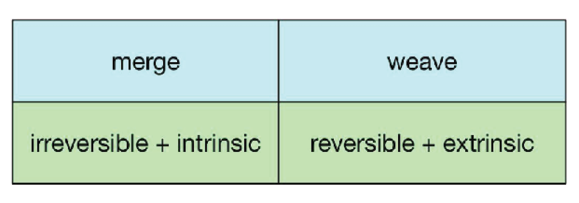
Fig. 3.1
This identification seems to be a good explanation for the common intuitive understanding of the multiple as loose, light and contingent, and unity as solid, heavy and necessary. Structure is accidental and essence is necessary. As far as a foundational ontology goes, adherents and opponents of the respective paradigm seem to share this intuition. Arguments for intrinsic identity are criticised as dogmatic and eternalist (‘conservative’), arguments for extrinsic identity as shallow and opportunist (‘liberal’). But all this notwithstanding, we would like to note that reversibility and irreversibility are both dimensions of contingency. This is easy to overlook, so we need to explain what we mean. It is because it is irreversible that one has to accept something as a contingent given: nothing is harder to unravel than a pure coincidence. It determines our situation without accessible reason. But also, the reversible is contingent in the sense that, in order for something to be reversible, it must be possible that it could have been different than it is. So, it has no inherent necessity. Technology fixes rationality in a particular way, so that it works reliably within reason, but this setup is artificial or contingent: it always could have been fixed differently (Deuber-Mankowski 2013).
With this in mind, let’s return to the world of artefacts and primitive technologies. Do we know of other practices that constitute a different intuition? Yes, these practices exist and their relevance is easy to see. But first, let’s disentangle the two dimensions and make space for an extended concept of identity.
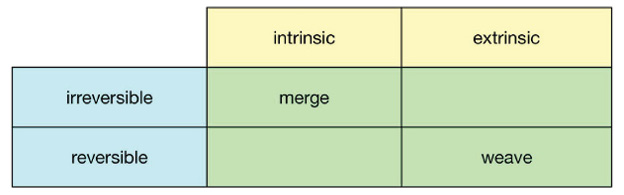
Fig. 3.2
The reversibly intrinsic
This table opens two new fields of enquiry. The first concerns those kinds of identity which are intrinsic, but do not have the irreversibility of a mixture. What are such things, that can carry their identity within themselves, but reversibly so? It helps us to remember that the intuition about the intrinsic-extrinsic distinction has a spatial or at least space-like quality. That is, something is merged, insofar as it shares the very same place, and something is woven, insofar as its parts meet while running past each other. Extrinsic identity is heteronomous. It is secured from the outside of what is identified. Intrinsic identity, by contrast, is insulated from its outside, it is autonomous and stays the same over travel.
So, what is in fact missing in this quadrant seems to be some kind of reversible inclusion, an autonomy that is closed, but can be disassembled. It is easy to see that vessels, covers and containers precisely fulfil this function. A filled vessel or a covered body have autonomy, but can be emptied or uncovered. A mask is such a cover; it is an exemplary technology of exchangeable and temporary identity. Spirits exist as masks, but masks can be taken on and off like any other hat. Perhaps in this group we should also include more diverse artefacts that bestow a specific role to their users. All kinds of instruments have this transformative potential (Gamble 2007; Latour 1999; Schüttpelz 2021). The capacity to enclose is fundamental in the form of bodily, material and social situations (Gell 1998; Strathern 2004). Perhaps the richest technologies of this kind are dwellings like caves, houses and tents. This is why we propose here to use the concept of house (as a verb, like merge and weave) to name the concept of identity that is reversibly intrinsic.
Within programming, housing is ubiquitous. Don’t we enter a program like a room or a tent? Export data from one, so we can import it to the other? Programs, and their parts, recursively, seem to be internally populated and to be animated from the inside. Many of the cases of intrinsic identification (merge) that we have already touched upon, turn out to be structured like containers as soon as they become mutable. For example, the intrinsic characterisation of an entity like a point by its dimensions becomes reversible when its coordinates can be replaced, or when they can be left unknown until later. Then such an entity becomes hollow, and something else can live in it and inspire its identity. This is why a point object acts like a container of its coordinates.
Or a very different case: deduction is a process that rests on logical ‘inclusion’, and types can be inferred from other types in such a way. This inclusion is reversible in so far as the types automatically change as the program is rewritten with different presuppositions. More generally, variables have a strong architectural role to play. Not only do variables enclose values, but also there are values that play the role of variables, traveling through a system as a movable indirection. As such objects enter new contexts, their identity stays the same. Pointers or references may pass around the point of access to a specific memory location, for example. Above, we discussed those instruments that bestow identity in use. In programming, we find them as specific operations: operations which may combine with other operations to form new composed operations that subsequently enclose their functionality, like a skilled person and a tool, when joined, that become a professional. From a functional point of view, this modularity is an enclosing. So it is no accident that those structures which keep variables accessible that were accessible in the context where they were defined have been named closures.
The irreversibly extrinsic
As it has been so easy to fill the first gap of the reversibly intrinsic, we are looking forward to finding cases for the structural opposite, the irreversibly extrinsic. Again, we have to brush intuition against the fur just a little bit; the usual cases of an extrinsic identity seem to be reversible, if simply for the fact that what is external may be replaced. But just as what is internal may be replaced (e.g. in a container), that which is external may be structured in such a way that it doesn’t provide for disassembly. As it happens, in computing, we didn’t have to search long for cases of irreversible procedures. Algorithms that have an inverse are indeed very rare, and for a given algorithm the so called ‘adjoint code’, which reverses it, is difficult to construct (Bennett 1973; Landauer 1961). While in some way closures are containers, which carry with them their enclosed state, this state is usually no longer accessible, and remains irreversibly hidden. Closures function by irreversibility. So a container is often a one-way street. But in what way are these irreversible processes extrinsic and not intrinsic?
In fact, extrinsic identity is just as common as its irreversibility. Algorithms, while irreversible, are radically ‘generous’ (Staal 2007): they are hackable, amenable to be used in ways they were not intended to be used, intentionally or not. Operations are often implemented so as to make them completely dependent on the context in which they are called, or on the arguments passed. In such a way, all the most mundane entities of computing turn out to be of our last kind, identified as irreversibly extrinsic. They cannot be disentangled, but are not self-determined nevertheless. Is the irreversibility of a program part and parcel of its generality or merely the result of our lack of knowledge? At least there is one case where programs function through irreversibility, not despite it. In encryption procedures, identity is completely extrinsic (all that matters is the matching of key and lock), while their trustworthiness is a function of their irreversibility. For the more general case, we will leave open the question whether every rule-based process is reversible in principle.
. . .
A house that identifies irreversibly is a prison. We capture with knots that cannot be undone. Too dense to be reversible, but still extrinsic and structural, the irreversibly extrinsic identification is both a ubiquitous technology and a constant challenge to our alertness, as potential prey and of responsibility, as potential agent. The technology of traps is probably as old as most other technologies, and probably one of the most varied. Traps are models of the prey’s body and behaviour, ‘lethal parodies of the animal’s Umwelt’ (Gell 1999: 200–1). But they are also models of the hunter, automata left behind in well hidden places, their prime mover being their first victim. And perhaps nothing is more extrinsic and plainly irreversible than death. But it is too quick a conclusion to be carried away with danger, with the destructive transformation initiated by those traps that kill. The focus on danger may blind us to the numerous traps that we have to fall prey to in order to transform, and those we have to set in order to permit transformation. If we look at how traps work, they are a kind of palaeolithic program, a reified future process (Rohrhuber 2008). A trap is a physical prophecy. Hans Blumenberg wrote in his posthumously published manuscripts:
The trap is an action in absence of the prey, as well as, shifted temporally, of the hunter. The trap acts for the hunter in the moment in which he is absent, while the construction of the trap shows the opposite state of affairs. It is expectation that has become a thing. In so far, the trap is the first triumph of the concept. (Blumenberg 2007: 13f, our translation)
Traps function as material concepts because they enable and require us to account for what is absent. They are extrinsic in a temporal sense, and doubly so, because the prey is absent when the hunter is present and vice versa. They are also extrinsic to the prey’s cognition. And finally, the close relation between concept and trap alerts us to the irreversible and extrinsic character of the process of learning. In the moment of learning, we cannot know what it is that we will have learned. Once we have understood, it is hard to even imagine why it may have been difficult to decipher. Try and search for some orientation in a seemingly random pattern; before any specific order is detected, the pattern is perceivable in many different ways. Once found, there is no way back. Again, paradise lost. Once we have conceptually understood something, the conditions of experience have become separated from experience. Here we find both function and limitation of concepts condensed: they capture mutually extrinsic aspects, but once in place are hard to escape. We can now be content to have filled in the missing entries of our little diagram.
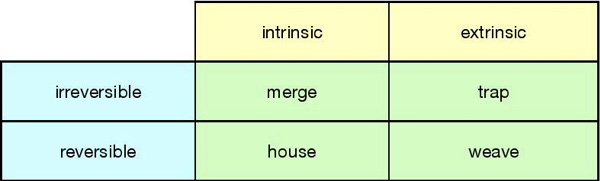
Fig. 3.3
Recovery
This could have been a good ending. After all, we have exhausted the space of possibilities opened by the crossing between the reversible and intrinsic together with their respective opposites, the irreversible and the extrinsic. The bounds of the classical opposition between substance and structure now seem much less severe than expected. And while the conceptual system dissects the intuition of identity, giving way to a much wider space of what is thinkable as identity, it also reframes it in a fresh conceptual trap. Is there anything in the centre of the diagram, or is it absolutely uninhabitable? We’ve had some serious discussions about this last point.
References
Bennett, C. H., ‘Logical Reversibility of Computation’, Computer Science, 17.6 (1973): 525–32.
Blumenberg, H., Theorie der Unbegrifflichkeit (Frankfurt/M.: Suhrkamp, 2007).
Deuber-Mankowski, A., ‘Der geistige Automat: Das Technische und das Lebendige als Problem einer möglichen Medienphilosophie’, in L. Engell, F. Hartmann, and C. Voss, eds, Körper des Denkens: Neue Positionen in der Medienphilosophie (Munich: Fink, 2013), pp. 49–68.
Gamble, C., Origins and Revolutions: Human Identity in Earliest Prehistory (Cambridge: Cambridge University Press, 2007).
Gell, A., Art and Agency: An Anthropological Theory (New York: Oxford University Press, 1998).
Gell, A., ‘Vogel’s Net’, The Art of Anthropology: Essays and Diagrams (LSE Monographs on Social Anthropology) (London: Berg Publishers, 1999): 187–214.
Landauer, R., ‘Irreversibility and Heat Generation in the Computing Process’, IBM Journal of Research and Development, 3.5 (1961): 183–91.
Latour, B., Pandora’s Hope (Cambridge, MA: Harvard University Press, 1999).
Newen, A., L. de Bruin, and S. Gallagher, eds, The Oxford Handbook of 4E Cognition (Oxford: Oxford University Press, 2018) (4th ed.).
Renfrew, C., and C. Scarre, eds, Cognition and Material Culture: The Archaeology of Symbolic Storage (Oxford: Oxbow, 1998).
Rohrhuber, J., ‘Implications of Unfolding’, in U. Seifert, J. Hyun Kim, and A. Moore, eds, Paradoxes of Interactivity: Perspectives for Media Theory, Human-Computer Interaction, and Artistic Investigations (Bielefeld: Transcript, 2008), pp. 174–91.
Rohrhuber, J., and V. Kamensky, ‘Heterochrone Töne: Zur Frage der Historiographie im Dokuentarfilm ALLES WAS WIR HABEN’, Nach dem Film: Audio History 14 (2015), online: https://www.nachdemfilm.de/index.php/issues/text/heterochrone-toene [accessed 30 October 2023].
Schüttpelz, E., ‘Vom Werkzeug zum Behälter, vom Behälter zum Medium: Die Ausweitungen des Körpers’, in N. Engelhardt, and J. F. M. Schick, eds, Erfinden, Schöpfen, Machen (Bielefeld: Transcript, 2021), pp. 25–72.
Staal, F., ‘The Generosity of Artificial Languages.’ IIAS 44 (2007). Online: https://hdl.handle.net/1887/12527 [accessed 27 October 2023].
Strathern, M., Partial Connections (Walnut Creek, Lanham, New York, Toronto, Oxford: AltaMira Press, 2004).