7
Modular patterns: A survey of the textile origin of Neolithic design and its calculational implications
Kalliope Sarri
Ancient textile production appears to be closely linked to the human intellect and wisdom. Through the archaeological evidence and literary sources, we recognise that weaving, even in early antiquity, relates to notions of order and that it might have been one of the primary forces that motived humans to create sophisticated technologies and eventually to embark on scientific thought. The sophisticated textile industries of the Greco-Roman world (Harlow and Nosch 2014; Mee 2015; Spantidaki 2016) interacted with other high technologies not merely to fulfil basic everyday needs but to reveal a systematic engagement with the concept of nature (Harlizius-Klück 2014: 49). Moreover, fine arts, poetry and philosophy were occasionally associated – conceptually and metaphorically – with the manufacture of cloth, showing that weaving was an essential driving force to the understanding of structural space (Harlizius-Klück and Fanfani 2016).
But how far back in the past does this relation go? How could the invention and the early practising of weaving have influenced the human mind to such an extent that it could better understand natural laws and move to more advanced technological stages? Such questions can be approached through the study of prehistory, by observing weaving, if not from the earliest stages of textile technology, at least from the Neolithic period, for which we have adequate evidence (Barber 1991: 133–44; Siennicka, Rahmstorf, and Ulanowska 2018: 3–5). In this paper, I address the question of conceptual weaving by focusing on the cognitive environment where we can first discern the relation between weaving and empirical mathematics and their visual expressions on forms of material culture and art. Our guide to this survey will be the decorative patterns of the Neolithic era, with particular reference to the Aegean.
Textile-evidence in the Neolithic
We know that people began to weave nets, textiles and baskets during the Upper Palaeolithic period, but there is no adequate information about the weaving activities of the mostly nomadic populations of this long era (Soffer, Adovasio and Hyland 2000). Some scarce and indirect evidence shows us, however, that Palaeolithic artefacts were decorated with typical, sometimes even intricate ‘textile’ patterns known to us from later times.1 The vague picture of the earliest textile crafts alters with the permanent settlements of the Neolithic period when people had more time to accomplish laborious household tasks and to proceed to create sophisticated artefacts. By exploring permanent or temporary Neolithic settlements, archaeologists were able to collect plentiful data and better examine the prime technologies of the era. Tools for hunting, fishing, agricultural work and house construction, as well as remarkable pieces of figurative art, were found at many sites of the known world. Tools connected to textile craft were discovered in all Neolithic cultures of Mesopotamia, the Aegean, the Balkans and in Central and Western Europe.2 Certain kinds of these tools, such as bone sewing needles and weaving beaters do not look much different from those used until recently or still in use in some areas.3 The evidence, however, that first and foremost confirms the existence of Neolithic textile production is the rich assemblage of spindle whorls for making thread, sets of bone tools for connecting pieces of textiles or as auxiliary weaving implements, and later, when the warp-weighted loom was invented, the loom weights.4
Textile patterns in Neolithic iconography
The elements that best reflect the aesthetic and decorative technologies of Neolithic textile art are the so-called ‘textile patterns’ – that is, patterns imitating woven structures, which are commonly seen on Neolithic pottery. We will focus on this evidence to explore whether, how early and for how long pottery decoration was linked to textile craft and how valuable is the information it offers, not only from a technological perspective but also within the field of the cognitive environment of the Neolithic weavers.5
While naturalistic figurative art has existed since the Palaeolithic era, straight-linear geometric shapes and compositions do not exist in the natural environment: thus Neolithic people must have copied them from another man-made craft that required working on pre-set axes, a process which would later give rise to the primary geometric shapes and compositions. Knowing the basic technologies of the Neolithic (stone knapping and polishing, bone curving, stone building, and so on) it is hard to imagine any other craft acting in a more structural framework than the textile craft, where the loom, of any kind, offers a three-dimensional canvas structure, the stretched threads play the role of guide lines and grids, and the patterns produced represent the basic two-dimensional geometrical shapes or even complex geometrical compositions. The same structural possibilities are offered by the craft of basketry which, without the aid of a loom, uses only the twisting, coiling, crossing and manipulating of threads made of the same or similar natural fibres to create woven artefacts.
Early rendering of weaving patterns
The earliest evidence of pattern weaving goes far back into the past, but we have been tracking it since the Early Neolithic (6500–6000 BCE) in the Aegean (Björk 1995: 128; Winn 1989: 96–100, 137, fig. 5.70; Pyke and Yiouni 1996: 86–88; Vitelli 1948: 190–92). During this period, simple symmetrical patterns, mainly arranged in zones, are commonly observed. They include solid motifs, based on triangles, bands and simple linear patterns such as zigzag lines, parallel chevrons and rows of triangles (figure 7.1). They are drawn with earthen colours on the surface of the pot, usually placed on the vase’s belly or on the shoulder zone.6 Around the end of the period, more complex patterns, such as checkerboard motifs and frames of small triangles are added, and at the same time black paint and slipped ground were introduced. (Phelps 2004: 39) There are certain variations of this style in the different geographical areas, but all the areas were moving along certain major axes of the decorative programme, in terms of painting techniques, syntax and hues. The ornaments of this period, at least of its earliest phase, do not yet reveal a clear connection to textile craft; they inform us, however, about the first conscious rendering of geometric shapes, which were repeated all over the vase’s perimeter and rendered with high precision, showing understanding and conscious use of symmetries perhaps derived from weaving.7
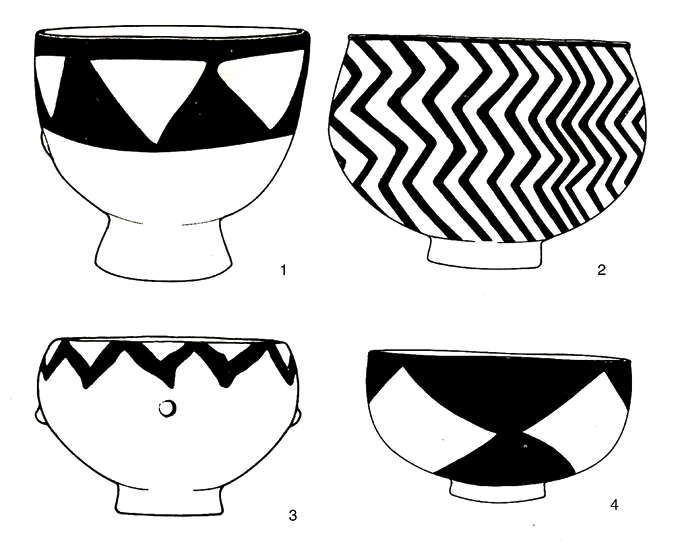
Fig. 7.1 Early Neolithic vases with simple geometric decoration (after Theocharis 1993, Plate IV)
Textile decoration as craft transfer
This simple geometric style of the Early Neolithic period showed a rapid development in the Middle Neolithic (6000–5500 BCE), when pottery decoration became complex, now showing more evident affinities with patterned textiles.8 At the same time, a greater variety in the use of colours can be discerned: large black, red and brown patterns are shaped on the plain surface of the vases but sometimes also on a thick creamy slip.9 We can observe entire ranges of connected or interlocking patterns such as networks, triangles, rhombuses, various kinds of grids, checkerboards and systems of zigzag lines (figure 7.2).
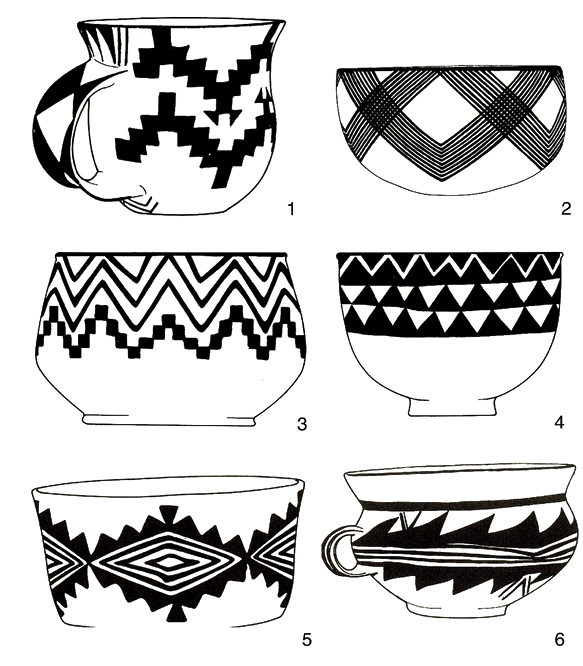
Fig. 7.2 Middle Neolithic vases with textile patterns (after Theocharis 1993, Plates IV and V)
Most of these geometric motifs are familiar tο us from fabrics, kilims and carpets of all periods and regions. A very common pattern of the so-called Urfirnis Middle Neolithic pottery10 is that composed of groups of crossed lines arranged in zones (figure 7.2, 2). Another very popular pattern of the same style features rhombuses framed by denticulated outlines commonly described as flame patterns (figure 7.2, 5–6). This particular motif is one of the most common textile patterns, occurring almost identically in the textile art of quite different areas and periods, presumably because of its highly decorative and easy to weave shape. During this period, rectilinear patterns are preferred, but simple curvilinear shapes, such as concentric circles and arc segments, are also occasionally included in the motif repertoire. Frequently, the decoration consists of stepped, diagonally arranged, square modules, bringing to mind the technical challenge of weaving curvilinear patterns or long vertical shapes without slits, a fact that provides an additional reason to see these decorations as representations of patterned textiles. The whole arrangement of the basic decorative elements is characterised by modularity (Jablan 2002 and 2020), strongly reminiscent of the syntax of traditional oriental kilims woven using the tapestry technique.11 The same decorative trends can also be seen in the contemporary Neolithic pottery styles of the Balkans. In the pottery styles of the Karanovo culture in Bulgaria and the Cucuteni culture in Romania such simple modular patterns, along with some other more complicated syntheses, also signify textile prototypes.12 Striking analogies can also be found in the Neolithic pottery of Anatolia. In the Hacilar culture, for example, the decorative mode shows the same choice of motifs and a clear similarity between its decorative syntax and the Aegean textile patterns (Mellaart 1970: 119, Figs. 309–27).
A particular category of the Aegean Middle Neolithic decoration is the canvas style, where the motifs have been placed as groups of stepped digitlike units upon a painted canvas.13 Through the filling of empty squares, the units shape large intricate patterns covering large parts, or the entire surface, of the vase (figure 7.3). Here we can discern not only a distant inspiration from woven products but also how the textile patterns were precisely executed based on a pre-planned graphic template. This almost naturalistic iconographic expression is so evident that it raises another question about how the original decoration was technically achieved on the textiles, in particular about whether the embellishment was woven, embroidered or even stamped.14 It is not, however, easy to settle on a particular textile technique, since both main options, weaving and embroidery, could have been used as inspiration by the potters. Besides, there are some composite techniques, such as in-woven embroidery, which is accomplished on the loom by adding colourful weft threads to create motifs. Nevertheless, both these textile techniques are ideally applied on a canvas structure and give a similar visual result. On the other hand, it is also possible that the grid-based designs do not represent a woven fabric but an ideal weaving or embroidery guide, or perhaps a net lace with empty and filled spaces. Several examples of this distinctive decoration come from the Sporades islands in the central-northern Aegean and have some distant similarities with particular styles of Thessaly and central Greece15 so that we can refer to it as a typical local production from the central Aegean.
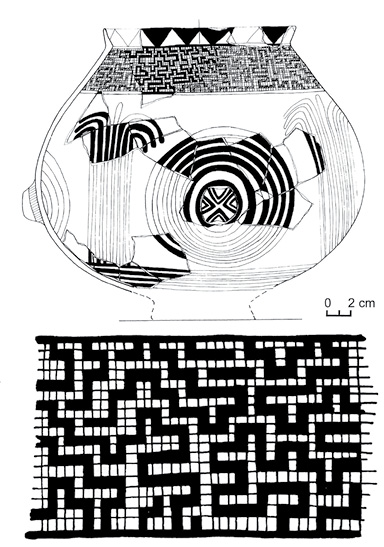
Fig. 7.3 Middle Neolithic jar with canvas decoration from the cave of the Cyclops (after Sampson 2008, Plate 3.4)
From geometric to pictorial design
The woven styles, which seem to copy elaborate textile designs, flourish remarkably in the Late Neolithic (5500–4500 BCE), when composite curvilinear shapes, such as spirals and wavy patterns, are added to the linear motifs, often shaping very complex compositions (figure 7.4, 1; 3; 5–7). During this period, pottery decoration seems not only to have been inspired by colourful fabrics, but it sometimes appears to have been purely figurative, depicting real textile objects such as fringed carpets or colourful woven bands. (Sarri 2018: 166) These new figurative elements supply an additional hint to the textile origin of the pottery decoration.
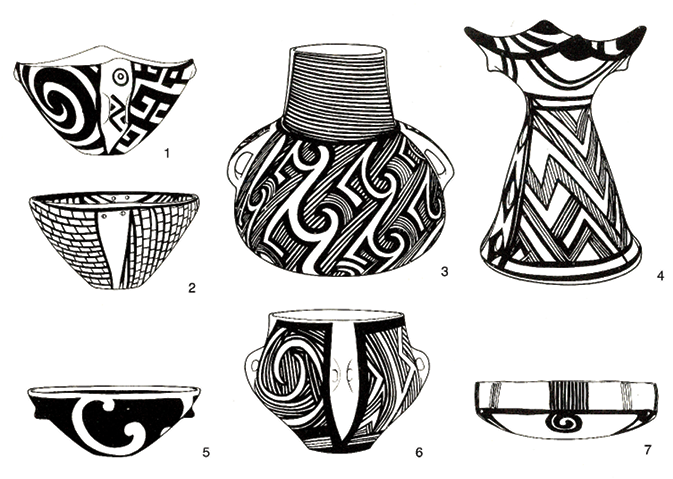
Fig. 7.4 Late Neolithic vases of the Dimini culture (after Theocharis 1993, Plate VIII)
The intricate Late Neolithic interlocking decoration that covers the entire body of the vase is reminiscent of the seamless patterns of stamped fabrics which are reproduced through square modules covering the whole surface of large pieces of cloth (figure 7.4, 3). This kind of tiled pattern can be used as an additional key for the recognition of textile prototypes.16 Sometimes the design consists of large panels that do not follow the usual horizontal arrangement, but they look like connected pieces of differently decorated fabrics (figure 7.4, 1). This style is very common on the large open bowls of the Dimini style, where panels with checkerboard patterns or spiral designs are combined, each covering almost a half of the pot.
Tracing further textile technologies
We are not able to accurately reconstruct either the textile technologies or the precise tool kit of the Early and Middle Neolithic, but we can assume that simple early loom types, such as the backstrap loom, the two-beam loom, small weaving frames, or the horizontal ground loom, might have been used but not yet the warp-weighted loom that seems to appear towards the later Neolithic. It does so, at least, in Southern Greece, while it might appear earlier in the Middle Neolithic in Northern Greece, perhaps following Balkan traditions.17 Moreover, certain decorative elements indicate that sophisticated techniques were used, such as band weaving, joining different fabrics with a patchwork technique or decorative joining stitches. (Sarri 2018: 165–67)
Basket weaves
Towards the end of the Late Neolithic period, during the Aegean Late Neolithic II or the Final Neolithic (4500–3200 BCE), painted decorations largely decline in central and southern Greece, and the patterns of vases now often resemble the products of basketry. They consist of incised, impressed or relief stripes that appear interwoven in horizontal, vertical or lateral arrangements and completely cover the surface of the vessels. The plastic rendering of the decoration reveals the original inspiration which seems to be the relief surface of baskets. A similar aesthetic effect is often achieved by so-called pattern-burnishing, in which the decoration is created by the contrast of polished and non-polished areas of the vase surface. However, it is not only monochrome and relief-decorated ceramics that show relationships with basketry: as many traditional and contemporary examples demonstrate, the alternation of colours on basketry could be achieved not only through the use of materials of different origins but also through painting. Thus, ceramics decorated in two or more colours can also represent basket weaves.
It is not always possible to distinguish which ceramic decoration is inspired by textile weaving and which by basketry. Some examples, however, are obviously influenced by basketry techniques, especially those that feature spiral or very open weaves, since they resemble similar traditional and contemporary basketry work. (Sentence 2007: 56–118) In particular, the rendering of such open weaves in basket style is sometimes combined with analogous shapes showing basket prototypes. A very characteristic example of this case is seen on a ceramic-handled lid from the Neolithic site of Sitagroi, phase III, which bears graphite-painted decoration with diagonally crossing bands, leaving ample space between them (figure 7.5). Here both the decoration and the shape of the pot seem to imitate an open basket lid.18 The materials used in basketry could have been straw lengths, various reeds, rushes, grasses, roots, leaves or pieces of bark.19 The fibres could be interwoven with each other but also with diverse other materials such as hair, bands of skin and hide. The basketry techniques could have included plaiting, twining, coiling, bundle coiling or twilling.20 This phenomenon of craft transfer seems logical and to be expected within the general concept of Neolithic pottery, since the ceramic repertoire often appears as an expression of skeuomorphism, including imitations of plant shapes such as pumpkins and leather objects such as flasks.21 It is quite plausible that basketry was invented earlier than weaving, since the material used was easy to find and did not required elaborate preparatory processes such as cleaning, retting, combing and spinning. This possibility leads us to believe that the whole invention of ceramic creation could have come from basketry, especially since we know that some of the first woven products were baskets covered with clay, lime, tar or resin to make them waterproof.
Representations of ropes
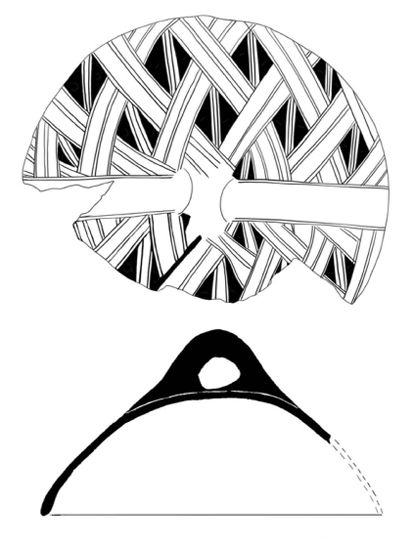
Fig. 7.5 Vase lid decorated with a basket-weave pattern from Sitagroi, phase III (after Bonga Fig. 63.1)
During the Late and especially during the Final Neolithic, the first ‘rope decoration’ appears; this is a style where one or more plastic strips are decorated with indents or incisions so as to resemble thick ropes tied onto the vase’s body (figure 7.6). This style, beside its decorative value, also had a utility function, since plastic strips helped to provide a solid grip when moving large vessels. Moreover, it might reflect a contemporary custom of tying large vases and pithoi with ropes during their transport, as many ethnological sources demonstrate. This kind of decoration later became a common trend and is often seen in the coarse household pottery of various Bronze Age sites of Central Greece, as well as in the pottery of Minoan Crete.22 Except for a sometimes clearly visible twist with an S or Z direction, the rope-imitating bands are rendered too abstractly to define the exact rope-making techniques; the presence of this pattern on the vases, however, provides evidence that potters were eager to transfer the idea of fibre artefacts to pottery. Sometimes, though, decoration details are more obvious: a distinctive group of Early Bronze Age pithoi from the site of Lerna displays braiding and net making techniques on its broad plastic bands. (Wiencke 1970: pl. 29, 102 and 116)
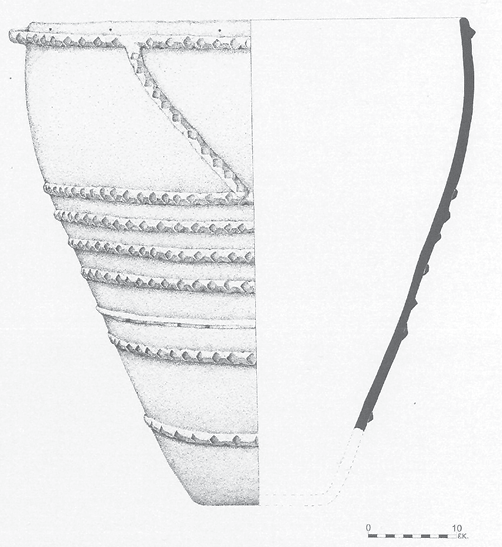
Fig. 7.6 Final Neolithic storage jar with rope decoration from the Alepotrypa Cave (after Papathanssopoulos and others 2011, Fig. 163)
Patterns and Symmetries
All painted decorative features show that textile patterns were highly standardised and that weavers were able to repeat them accurately, which in terms of the weaving procedure means precision in counting. Even if some simple free patterns could have been randomly created, the more complex ones, and certainly the tiled patterns, could not have been woven and certainly not repeated if the weavers had not been able to count the warp and weft threads. That is to say, we encounter the perception and manipulation of two and three-dimensional structural space as an early expression of visual mathematics.23 Crystallised concepts of shapes are shown by the deliberate rendering of abstract two-dimensional shapes in the three-dimensional textile structure and then in their return as two-dimensional linear shapes on the surface of the pottery.
Looking at early technologies, none of the other Neolithic crafts we know of could have reached this cognitive, artistic and technological level. The manufacture of pottery, stone, or bone artefacts, for example, requires strength, skills and kinetic precision but not counting and measuring.24 Neither does it require abstract thinking and accurate visual skills such as are needed to copy and transfer from a two-dimensional shape to a three-dimensional medium. Moreover, calculations would have been necessary at other stages of textile production. Estimation of raw materials and precise planning of the work would have been required, since fibres were not able to be purchased in finished form through trade but were collected from nature at certain times of the year. In all succeeding stages of the chaîne opératoire, estimation of quantities, weights, and values was needed in order to process certain quantities of fibres, to produce particular dyes, to divide warp threads and set series of loom weights, and to estimate the value of the textile products for offering or exchanging with other goods.25
Weaving and counting
The hypothesis that metrology, in the sense of a common understanding of units, originated in the textile arts is of great importance for understanding the knowledge background of the Neolithic people since, in the absence of known measurement systems from this era, it gives us an idea of how people may have started to develop complex manipulation and planning skills to improve their standard of living.26 The multiple possibilities that yarn offers for three-dimensional representations of objects and symbols, as well as counting and measuring concepts, is shown by a series of ancient applications, the most typical being the khipu devices of the Incas.27 These were threads which used combinations of loops and knots to encode words and numbers so precisely that they were used as administrative documents in official state archives.28 In other parts of the world, we can see a similar counting concept in the prayer beads of various religions, such as the various types of woven rosaries of the Catholic and Greek Orthodox Churches, and a similarly functioning device, the Buddhist ‘mala’. It is worth noting that these simple threaded measuring tools, in addition to being used in calculating, were also used for measuring time.
The arrangement of the decoration on axes and the counting of the warp threads to create colour changes and shapes brings to mind the concept of the abacus, which is also a three-dimensional binary system with a horizontal and a vertical axis.29 Moving back to the past, we can imagine that Neolithic weavers, by observing the textile structure they created, understood the loom’s principle and perhaps realised its value as a computational system. By lifting a certain number of warp threads as they wove to pass the wefts through them, a process similar to that used on an abacus, they were able to create the symmetrical coloured forms seen on pottery, and, through this creative experience they may have perceived the principal geometric shapes.
Archaeological implications
The ornamentation of Aegean Neolithic pottery with textile patterns is not a unique phenomenon, but it epitomises a case where craft transfer, particularly skeuomorphism, can be clearly seen.30 In the contemporary cultures of the Balkans, Anatolia and the Near East,31 we can see a parallel development, and since it is widely believed that the Neolithic lifestyle came to the Aegean from the east in the first half of the seventh millennium BCE,32 the pottery inspiration may have been part of this cultural movement. One of the classic examples of the connection of Neolithic ceramic ornamentation with Anatolian textile craft has been recognised by the interpretation of Neolithic ornaments as a rendering of coloured kilims by the British pioneer archaeologist James Mellaart.33 Similar decorative patterns observed in contemporary Stone Age cultures lead us to the tracing of population movements. Moreover, the possibility of a common origin of Neolithic motifs from the textile crafts also gives us an alternative explanation for why geometric ornaments are so similar in very remote areas.
If we aim to explore why these technical cross crafts and interrelations exist, we realise that when acts of imitation and mingling of techniques were carried out, art proceeded to new paths of creation, and remarkable innovations were observed; thus one can assume that the desire of the craftspeople and the textile consumers for new artistic expression brought to the fοreground the styles and techniques of other crafts.
Beyond the artistic creation of new styles, it is suggested that the decoration of Neolithic pottery, especially symmetrical modular patterns, opens a way for us to realise that prehistoric people conceived the mathematical notions of arithmetic and geometry through textile crafts and long experimentation on woven symmetries. The practice of weaving helped artisans to create precise shapes and symbols, and to use their knowledge of calculation in metric and weight systems, achievements that were implemented in a series of later technological applications developed in the ancient world.
Endnotes
1 On the Palaeolithic modular patterns from Mezin, see Jablan 2002: 284–85.
2 For the archaeological textile artefacts of the Cucuteni Culture, see Marian 2009: 112–17.
3 On Neolithic weaving bone tools, see Sarri 2020: 100.
4 Barber 1991: 91–113; Carington Smith 1975: 122–26; Perlès 1992: 246–54. On weaving tools made of bone, see, de Diego and others, 2018: 73–76; Sarri 2020: 95–102.
5 Textile decoration can also be seen on Neolithic seals, figurines and architectural features. Perlès 1992: 252–54; Türkcan 2006: 180; figurines: Sarri 2018: 168–69.
6 For a classification and analysis of the Early Neolithic patterns, see Washburn 1983.
7 On a definition of symmetry and different kinds of symmetry transformation, see Darvas 2007: 4–11.
8 Theocharis has noted the affinities with weaving and argued that the nature of the weaving material leads to geometric patterns. Theocharis 1993: 67. On the decoration of Neolithic pottery, see also Otto 1976 and 1985.
9 See the development of the decoration motifs from the Early to Middle Neolithic in the Achilleion site in Gimbutas, Winn and Shimabuku 1989, Fig. 5.31.
10 For the style and distribution of Urfirnis pottery, see French 1972: 8–11; Holmberg 1964: 35, and Phelps 2004: 44–47.
11 Mellaart has indicated the relation of Neolithic design to textile art: Mellaart 1989; 1970: 38–39.
12 See some examples of the decorative pottery of Karanovo in Hiller and Nikolov 1997: Fig. 66–67, 104; of Cucuteni A–B period in Lazarovici 2010: 144; of Donja Branjevina in Budja 2009: 128, fig. 3 right.
13 This type of decoration was interpreted as copied from the weaving craft by Katsarou-Tzeveleki (2008: 100–2). See some characteristic examples in Theocharis 1973: fig. 258; and Papathanasopoulos 1996: fig. 4 and 212, fig. 5.
14 For challenges of defining decorative textile techniques in antiquity, with a special emphasis on traditional tapestry, see Wace 1948: 53.
15 See the distribution of the fabric in Katsarou-Tzeveleki 2008: 101. The closest style in Thessaly is seen on the Tzani Magoula: Papathanasopoulos 1996: 255, fig. 101. In Central Greece, the red-on-white Chaeroneia style better represents this kind of weaving imagery, sometimes seen on figurine clothing (Papathanasopoulos 1996: 236, 315). On Chaeronea ware, see French 1972: 6–7.
16 On the syntax and variations of tiled modular patterns, see Jablan 2020 (no pages).
17 The earliest loom weights in Europe have been located in the Balkans; see Barber 1991: 93–98 and Mazăre 2014: 14–19. On warp-weighted loom, see Sarri in press (‘Ηorizontal Loom’). On spinning tools, see Vakirtzi 2018: 188–89.
18 Compare Fig.7.5 with Bonga 2013: 63.1 and Papathanasopoulos 1996: 250, fig. 87 with a basket made with coconut leaves in Sentance 2007: II, above right.
19 For possible fibres and other materials used in basketry, see Sentance 2007: 16–51.
20 On prehistoric basketry, see Belogianni 2004.
21 On skeuomorphic relations in prehistoric art, see Nakou 2000: 49. Diverse aspects of craft transfer are discussed in Rebay-Salisbury, Brysbaert, and Foxhall 2014. For skeuomorphism in the Neolithic of the Near East, see Wengrow 2001: 178.
22 For the early development of the Greek pithos, see Cullen and Keller 1990. On Early Helladic III pithoi with relief rope decoration, see Wiencke 1970: plate 19, L 752. On Minoan storage vessels with relief rope decoration, see Christakis 2005: 23–36. On Bronze Age to Iron Age pithoi, see Lis and Rückl 2011.
23 On visual mathematics, see Darvas 2007: 28–33; Jablan 2002.
24 On Neolithic artefact production, see Perlès 1992: 130–41.
25 On the stages of textile production, see Andersson Strand 2012.
26 We can define metrology in this early period as a common understanding of units and determining of measured values. The early measuring systems in Europe are discussed in Budja 1998 and 2003; possible interpretations of Neolithic artefacts as counting objects are suggested by Marangou 2001: 18–22. For the invention and development of counting, see Schmandt-Besserat 1992 and Malafouris 2010.
27 For information on khipu, see Ascher 1986 and 1991: 16–26; Conklin 2002; The Harvard Khipu Database Project; Day 1967; On a methodology of ethnomathematical research concerning basketry, see Adam 2010: 701–2. For mathematical concepts in early prehistoric societies, see Merzbach and Boyer 2010: 6–7.
28 For more on khipu principles, see Chapter 10 (pp. 183–85) of this volume.
29 For the relation of Neolithic textiles tools and counting, see Sarri 2020: 20–21.
30 For cases of skeuomorphism, see Brysbaert 2007: 336.
31 Breniquet and others 2017.
32 On the discussion of the Neolithicisation of the Aegean, see Perlès 2001: 58–63.
33 Mellaart 1989.
References
Adam, N. A., ‘Mutual Interrogation: A Methodological Process in the Ethnomathematical Research’, International Conference in Ethnomathematical Research. Procedia. Social and Behavioral Sciences, 8 (2010): 700–7.
Andersson Strand, E., ‘The Textile chaîne opératoire: Using a Multidisciplinary Approach to Textile Archaeology with a Focus on the Ancient Near East’, Paléorient, 38.1–2, (2012): 21–40.
Ascher, M., Ethnomathematics: A Multicultural View of Mathematical Ideas (Belmont, California: Wadsworth, 1991).
Ascher, M., ‘Mathematical Ideas of the Incas’, in M. P. Closs, ed., Native American Mathematics (Texas: University of Texas Press, 1986), pp. 261–89.
Barber, E. J. W., Prehistoric Textiles: The Development of Cloth in the Neolithic and Bronze Ages, with Special Reference to the Aegean (Princeton: Princeton University Press, 1991).
Belogianni, M., ‘Η καλαθοπλεκτική και τα προϊόντα της στην προϊστορική Ελλάδα’, in A. Kyriatsoulis, ed., Althellenische Technologie und Technik von der prähistorischen zur hellenistischen Zeit mit Schwerpunkt auf der prähistorischen Epoche, (Ohlstadt, Weilheim: Verein zur Förderung der Aufarbeitung der Hellenischen Geschichte, 2004), pp. 429–54.
Björk, C., Early Pottery in Greece: A Technological and Functional Analysis of the Evidence from Neolithic Achilleion, Thessaly, Studies in Mediterranean Archaeology 115 (Göteborg: P. Åström, 1995).
Bonga, L., ‘Late Neolithic Pottery from Mainland Greece, ca. 5300–4300 BC’, PhD diss., Temple University, 2013.
Breniquet, C., ‘Weaving and Potting during the Late Neolithic Period: Are There Textile Patterns in the Early Painted Pottery of Mesopotamia?’, in W. Cruells, I. Mateiciucová, and O. Nieuwenhuyse, eds, Painting Pots Painting People: Neolithic Ceramics in Ancient Mesopotamia (Oxford and Philadelphia: Oxbow Books, 2017), pp. 213–24.
Brysbaert, A., ‘Cross-Craft and Cross-Cultural Interactions During the Aegean and the Near Eastern Mediterranean Late Bronze Age’, In S. Antoniadou and A. Pace, eds, Mediterranean Crossroads (Athens: Pieridis Foundation, 2007), pp. 325–19.
Budja, M., ‘Clay Tokens: Accounting before Writing in Eurasia’, Documenta Praehistorica, 25 (1998): 219–35.
Budja, M., ‘Early Neolithic Pottery Dispersals and Demic Diffusion in Southeastern Europe’, Documenta Praehistorica, XXXVI (2009): 117–37.
Budja, M., ‘Seals, Contracts and Tokens in the Balkans in the Early Neolithic: Where in the Puzzle?’, Documenta Praehistorica, 30 (2003): 115–30.
Carington Smith, J., ‘Spinning, Weaving and Textile Manufacture in Prehistoric Greece’, PhD Thesis. University of Tasmania, 1975.
Christakis, K. S., Cretan Bronze Age Pithoi: Traditions and Trends in the Production and Consumption of Storage Containers in Bronze Age Crete (Prehistoric Monographs 18) (Philadelphia: INSTAP Academic Press, 2005).
Conklin, W. J., ‘A Khipu Information String Theory’, in J. Quilter and G. Urton, eds, Narrative Threads: Accounting and Recounting in Andean khipu, (Austin, Texas: University of Texas Press, 2002), pp. 53–86.
Cullen, T., and D. R. Keller, ‘The Greek Pithos Through Time: Multiple Functions and Diverse Imagery’, in W. D. Kingery, ed., The Changing Roles of Ceramics in the Society: 26,000 BP to the Present, Ceramics and Civilisation V (Westerville OH: The American Ceramic Society Inc, 1990), pp. 183–209.
Darvas, G., Symmetry: Cultural-Historical and Ontological Aspects of Science-Arts Relations. The Natural and Man-made World in an Interdisciplinary Approach. Trans. by D. R. Evans (Basel: Birkhäuser, 2007).
Day, C. L., Quipus and Witches’ Knots: The Role of the Knot in Primitive and Ancient Cultures (Kansas: University of Kansas Press, 1967).
de Diego, M., R. Piqué, A. Palomo, X. Terradas, M. Saña, I. Clemente-Conte, and M. Mozota, ‘Evidence of Textile Technology in the Early Neolithic Site of La Draga (Banyoles, Spain): Some Hypotheses’, in M. Siennicka, L. Rahmstorf, and A. Ulanowska, eds, First Textiles: The Beginnings of Textile Manufacture in Europe and the Mediterranean (Ancient Textiles Series 32) (Oxford: Oxbow, 2018), pp. 69–80
French, D. H., Notes on Prehistoric Pottery Groups from Central Greece (Athens: privately circulated, 1972).
Gimbutas, M., S. Winn, and D. M. Shimabuku, eds, Achilleion: A Neolithic Settlement in Thessaly, Greece, 6400–5600 BC (Monumenta Archaologica 14) (Los Angeles: Cotsen Institute of Archaeology, 1989).
Harlizius-Klück, E., ‘The Importance of Beginnings: Gender and Reproduction in Mathematics and Weaving’, in M. Harlow and M.-L. Nosch, eds, Greek and Roman Textiles and Dress: An Interdisciplinary Anthology, Ancient Textile Series 19 (Oxford: Oxbow Books, 2014), pp. 46–59.
Harlizius-Klück, E., and G. Fanfani, ‘(B)orders in Ancient Weaving and Archaic Greek Poetry’, in G. Fanfani, M. Harlow, and M.-L. Nosch, eds, Spinning Fates and the Song of the Loom: The Use of Textiles, Clothing and Cloth Production as Metaphor, Symbol and Narrative Device in Greek and Latin Literature, Ancient Textiles Series 24 (Oxford and Philadelphia: Oxbow Books, 2016), pp. 61–99.
Harlow, M., and M.-L. Nosch, eds, Greek and Roman Textiles and Dress: An Interdisciplinary Anthology (Oxford and Philadelphia: Oxbow Books, 2014).
‘The Harvard Khipu Database Project’, Harvard: Gary Urton, https://khipukamayuq.fas.harvard.edu/Home.html [accessed 20 July 2020].
Hiller, S., and V. Nikolov, eds, Karanovo: Die Ausgrabungen im Südsektor 1984–1992, I.2 (Salzburg–Sofia: Archäologisches Institut der Universität Salzburg and Archäologisches Institut mit Museum der Bulgarischen Akademie der Wissenschaften, 1997).
Holmberg, E. J., The Neolithic Pottery of Mainland Greece (Göteborg: Wettergren & Kerber, 1964).
Jablan, S. V., Modularity in Art (Belgrade: Mathematical Institute of the Serbian Academy of Sciences and Arts) http://www.mi.sanu.ac.rs/~jablans/d3.htm [accessed 20 July 2020].
Jablan, S. V., Symmetry, Ornament and Modularity: Series on Knots and Everything, Vol. 30 (London: World Scientific Publishing, 2002).
Katsarou-Tzeveleki, S., ‘Early Neolithic Weavers Paint: Youra Red Painted Patterns as Markers of the Local Group’s Identity’, in A. Sampson, ed., The Cave of the Cyclops: Mesolithic and Neolithic Networks in the Northern Aegean, Greece. Vol. 1, Intra-Site Analysis, Local Industries, and Regional Site Distribution, (Prehistory Monographs 21) (Philadelphia: INSTAP Academic Press, 2008), pp. 69–110.
Lazarovici, C.-M., ‘Cucuteni Ceramics: Technology, Typology, Evolution and Aesthetics’, in D. W. Anthony and J. Y. Chi, eds., The Lost World of Old Europe. The Danube Valley 5000–3500 BC (Princeton and Oxford: The Institute for the Study of the Ancient World & Princeton University Press 2010), pp. 128–61.
Lis, B., and Š. Rückl, ‘Our Storerooms Are Full: Impressed Pithoi from Late Bronze/Early Iron Age East Lokris and Phokis and their Socio-Economic Significance’, in W. Gauß, M. Lindblom, R. A. K. Smith, and J. C. Wright, eds, Our Cups Are Full: Pottery and Society in the Aegean Bronze Age. Papers presented to Jeremy B. Rutter on the occasion of his 65th birthday (Oxford: Archaeopress, 2011): 154–68.
Malafouris, L., ‘Grasping the Concept of Number: How did the Sapient Mind Move Beyond Approximation?’, in I. Morley and C. Renfrew, eds, The Archaeology of Measurement: Comprehending Heaven, Earth and Time in Ancient Societies (Cambridge: Cambridge University Press, 2010), pp. 27–34.
Marangou, C., ‘Evidence for Counting and Recording in the Neolithic? Artefacts as Signs and Signs on Artefacts’, in A. Michailidou, ed., Manufacture and Measurement: Counting, Measuring and Recording Craft Items in Early Aegean Societies, Μελετήματα 33 (Athens: Research Centre for Greek and Roman Antiquity, National Hellenic Research Foundation, 2001), pp. 9–43.
Marian, C., Meşteşuguri Textile în Cultura Cucuteni (Iaşi: Trinitas, 2009).
Mazăre, P., ‘Investigating Neolithic and Copper Age Textile Production in Transylvania (Romania): Applied Methods and Results’, in M. Harlow, C. Michel, and M.-L. Nosch, eds, Prehistoric, Ancient Near Eastern and Aegean Textiles and Dress: An Interdisciplinary Anthology, ed. by, (Oxford: Oxbow Books, 2014), pp. 1–42.
Mee, M. M., Body, Dress and Identity in Ancient Greece (Cambridge: University Press, 2015).
Mellaart, J., Çatalhöyük and Anatolian Kilims: The Goddess from Anatolia, Volume 2., ed. by J. Mellaart, U. Hirsch, and B. Balpınar (Milan: Eskenazi, 1989).
Mellaart, J., Excavations at Hacilar: Occasional Publications of the British Institute of Archaeology at Ankara (Edinburgh: British Institute of Archaeology at Ankara, 1970).
Merzbach, U. C. and C. B. Boyer, A History of Mathematics, 3rd ed. (New York: Wiley, 2010).
Morley, I., and C. Renfrew, eds, The Archaeology of Measurement: Comprehending Heaven, Earth and Time in Ancient Societies (Cambridge: Cambridge University Press, 2010).
Nakou, G., ‘Metalwork, Basketry and Pottery in the Aegean Early Bronze Age: A Meaningful Relationship’, in A. Serghidou, ed., Dorima: A Tribute to the A. G. Leventis Foundation on the Occasion of its 20th Anniversary (Nicosia: The A. G. Leventis Foundation, 2000), pp. 27–57.
Otto, B., Die verzierte Keramik der Sesklo- und Diminikultur Thessaliens, Keramikforschungen 6 (Mainz: Philipp von Zabern, 1985).
Otto, B., Geometrische Ornamente auf anatolischer Keramik: Symmetrien frühester Schmuckformen im Nahen Osten und in der Ägäis (Mainz: Philipp von Zabern, 1976).
Papathanasopoulos, Y., ed., Neolithic Culture in Greece (Athens: Nicholas P. Goulandris Foundation, Museum of Cycladic Art, 1996).
Papathanasopoulos, Y., V. Katsipanou-Margeli, and G. Philippaki, To Neolithiko Diro: Spilaio Alepotrypa (Athens: Melissa, 2011).
Perlès, C., The Early Neolithic in Greece: The First Farming Communities in Europe (Cambridge: Cambridge University Press, 2001).
Perlès, C., ‘Systems of Exchange and Organization of Production in Neolithic Greece’, Journal of Mediterranean Archaeology, 5.2. (1992): 115–64.
Phelps, W. W., The Neolithic Pottery Sequence in Southern Greece. BAR 1259. (Oxford: Archaeopress, 2004).
Pyke, G., and P. Yiouni, ‘The Early Neolithic Pottery: Technology Analysis and Comparison with other Neolithic Ceramic Materials’, in K. A. Wardle, ed., Nea Nikomedeia I: The Excavation of an Early Neolithic Village in Northern Greece 1961–1964, directed by R.J. Rodden. The Excavation and the Ceramic Assemblage, (British School at Athens, Supplementary Vol. 25) (London: British School at Athens, 1996), pp. 55–193.
Rebay-Salisbury, K., A. Brysbaert, and L. Foxhall, ‘Material Crossovers: Introduction’, in K. Rebay-Salisbury, A. Brysbaert, and L. Foxhall, eds, Knowledge Networks and Craft Traditions in Ancient Mediterranean (Routledge Studies in Archaeology) (New York and London: Routledge, 2014), pp. 1–6.
Sampson, A., and T. Skoteini, The Cave, the Settlement and the Cemetery (Athens, 1993).
Sarri, K., ‘Aesthetics and Apparel in the Neolithic Period’, in M. Lagogianni-Georgakarakos, ed., The Countless Aspects of Beauty in Ancient Art (Athens: National Archaeological Museum and Archaeological Receipts Fund, 2018), pp. 163–74.
Sarri, K., ‘In the Minds of Early Weavers: Perceptions of Geometry, Metrology and Value in the Neolithic Aegean’, in L. Quillien and K. Sarri, eds, Textile Workers: Skills, Labour and Status of Textile Craftspeople between the Prehistoric Aegean and the Ancient Near East. Proceedings of the Workshop Held at 10th ICAANE in Vienna, April 2016 (Oriental and European Archaeology 13) (Vienna: Austrian Academy of Sciences Press, 2020): 17–25.
Sarri, K., ‘Taming the Fibres: Traditions and Innovations in the Textile Cultures of Neolithic Greece’, in W. Schier and S. Pollock, eds., The Competition of Fibres: Early Textile Production in Western Asia, South-East and Central Europe (10,000–500 BCE) (Oxford: Oxbow, 2020), pp. 95–110. https://doi.org/10.2307/j.ctv13pk7d6
Sarri, K., ‘Weaving on the Ground: Positive and Negative Evidence for a Reconstruction of the Prehistoric Horizontal Loom’, in VII Purpureae Vestes International Symposium, Granada, 2–4 October 2019 (Granada: University of Granada, in press).
Schmandt-Besserat, D., Before Writing: From Counting to Cuneiform (Texas: University of Texas Press, 1992).
Sentance, B., Basketry: A World Guide to Traditional Techniques (London: Thames and Hudson, 2007).
Siennicka, M., L. Rahmstorf, and A. Ulanowska, eds, First Textiles: The Beginning of Textile Manufacture in Europe and Mediterranean (Ancient Textiles Series 32) (Oxford: Oxbow, 2018): 1–16.
Soffer, O., J. M. Adovasio and D. C. Hyland, ‘The “Venus” Figurines: Textiles, Basketry, Gender, and Status in the Upper Paleolithic’, Current Anthropology, 41.4 (August–October 2000): 511–37.
Spantidaki, S., Textile Production in Classical Athens (Ancient Textiles Series 27) (Oxford: Oxbow, 2016).
Theocharis, D., ‘Development and Diversification: Τhe Middle Neolithic of Thessaly and the Southern Regions’, in D. Theocharis, ed., Neolithic Greece (Athens: National Bank of Greece, 1973), pp. 59–88.
Theocharis, D., Νεολιθικός πολιτισμός. Σύντομη επισκόπηση της Νεολιθικής στον ελλαδικό χώρο, 3rd ed. (Athens: National Bank of Greece Cultural Foundation, 1993).
Türkcan, A. U., ‘Some Remarks on Çatalhöyük Stamp Seals’, in I. Hodder, ed., Changing Materialities at Çatalhöyük: Reports from the 1995–99 Seasons (British Institute at Ankara, McDonald Institute for Archaeological Research, 2006), pp. 175–85.
Vakirzi, S., ‘Fibre Crafts and Social Complexity: Yarn Production in the Aegean Islands in the Early Bronze Age’, in M. Siennicka, L. Rahmstorf, and A. Ulanowska, ed., First Textiles. The Beginning of Textile Manufacture in Europe and Mediterranean (Ancient Textiles Series 32) (Oxford: Oxbow, 2018), pp. 187–200.
Vitelli, K. D., Franchthi Neolithic Pottery: Classification and Ceramic Phases 1 and 2. Excavations at Franchthi Cave, Greece, Vol. 8. (Bloomington: Indiana University Press, 1993).
Wace, A. J. B., ‘Weaving or Embroidery?’, American Journal of Archaeology, 52.1 (1948): 51–55.
Washburn, D. K., ‘Symmetry Analysis of Ceramic Design: Two Tests of the Method on Neolithic Material from Greece and the Aegean’, in D. K. Washburn, ed., Structure and Cognition of Art (Cambridge: Cambridge University Press, 1983), pp. 138–64
Wengrow, D., ‘The Evolution of Simplicity: Aesthetic Labour and Social Change in the Neolithic Near East’, World Archaeology, 33. 2, Archaeology and Aesthetics (Oct. 2001): 168–88.
Wiencke, M. H., ‘Banded Pithoi from Lerna III’, Hesperia, 39 (1970): 94–110.
Winn, S., ‘Pottery’, in M. Gimbutas, S. Winn, and D. M. Shimabuku, eds, Achilleion: A Neolithic Settlement in Thessaly, Greece, 6400–5600 BC (Monumenta Archaologica 14) (Los Angeles: Cotsen Institute of Archaeology, 1989), pp. 75–164.