9
Epistemic, social and material ordering through weaving threads
Annapurna Mamidipudi
Starting with words: The cloth-body-poem
This is fine, this is fine cloth.
It is been dipped in the name of the lord
The spinning wheel, like an eight-petal lotus, spins,
With five tatvas and three gunas as the pattern.
The Lord stitched it in ten months
The threads have been pressed to get a tight weave.
It has been worn by gods, people, and sages
They soiled it with use.
Kabir says, I have covered my self with this cloth with great care,
And eventually will leave it like it was.
Kabir, weaver saint 15th century
Drawing on familiar everyday terms from his hand weaving practice, Kabir translates deep and abstract philosophies of existence into poetry still sung today. Interpreting the poem above, scholar Linda Hess says, ‘the subtle and fine body-cloth is woven with the inhale and exhale as warp and weft, animating the fabric of the body-self. Rather than stain this fine cloth with neglect and violence, my aim is to live a life that would leave the cloth-self in pristine condition.’1 The weaving terms that Kabir uses in his poetry are readily decipherable as metaphors for deep and abstract metaphysical philosophies. Yet, for the weaver Kabir, the material cloth and weaving practices are critical for understanding the metaphorical reading. Taking Kabir’s poetry as a practice of transmission of knowledge, Linda Hess notes that Kabir is always sung – the text is always oral. Such texts that are performed she suggests ‘entail a certain fluidity of text, a certain unpredictability of content and interaction’ (Hess 2015: 212).
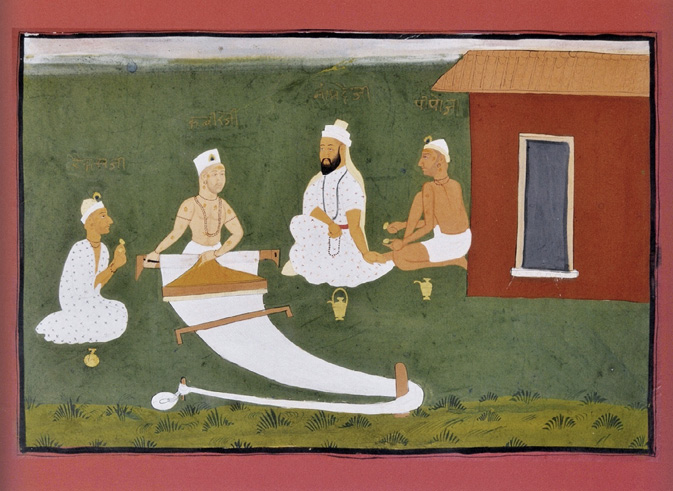
Fig. 9.1 The poet Kabir with Namdeva, Raidas and Pipaji. Jaipur, early nineteenth century, National Museum New Delhi (Public Domain, Wikimedia.org)
Bodies and their memory – particularly the ability to remember text-song – are of central importance. Orality implies sociality – the making of communities. On the one hand, Hess argues that music has a transformative effect on how we receive and understand text; on the other, she argues that texts sung as music, combined with sound, physical presence and social interaction are constituent of oral performative cultures. Rather than using the words and terms as metaphors whose primary significance is to explain cosmological order, Kabir’s poetry could now be read as referencing the practices – of weaving, of singing – themselves, as the basis for producing epistemic, social and material ordering.2
Starting with objects: The loom-body-concept
The handloom is a technological object that is used to produce cloth. Yet, following contemporary norms of technological progress, since the Indian handloom itself is not constantly being innovated, it struggles to maintain its status as a technological object of the present.3 As a counterpoint to the deterministic narrative that frames the handloom as a backward technology – especially within innovation discourses that equate technological newness with progress – activist-weaver Gopi Krishna4 recalls an episode from a 1998 meeting in the village of Chinnur, Adilabad, which instead highlights the technological creativity of the Indian weaver. His weaver colleague Nazeer Kamaal had brought as gifts for the honourable guests bags woven from two-inch-wide tape normally used to weave the base of the traditional ‘charpoy’ or four post bed. When a local dignitary specifically asked an extra one to be made for her, his weaver colleague, unfazed by the absence of his loom, wound threads around the fingers of the upheld hands of two people and set up a warp for weaving the necessary length of tape needed to make a bag. Gopi, in recounting this story, showed that the loom was not an artefact of the past, but a flexible concept that could be materialised as the weaver wished: ‘the loom is not just a material technological object, in the mind of the weaver it is an abstract technical concept that can be used to order threads and to produce a weave using any available resources’ (Mamidipudi 2016). Indeed, as demonstrated, it was a concept that could be creatively deployed as needed, as it was stably embedded as routine practice in the weaver’s body and mind.
This might well explain how the loom played a similar role – as a concept that could be the basis for knowledge exchange – among 300 weavers gathered in the weaving village of Chirala in 2018, for a ten-day conference on ‘Anchoring innovation in handloom weaving,’ organised by the union leader Macharla Mohan Rao. The conference drew weaver participants from Gujarat, Jammu and Kashmir, Chattisgarh, Triura, Manipur, Nagaland and Sikkim, Karnataka, Tamil Nadu, Kerala and Andhra Pradesh and Telangana, and scholar participants from all over the world. Special guests were weavers and dyers from Thailand, Taiwan, China and Laos. Some weavers journeyed over four days and nights, carrying their looms, since that was a prerequisite for participation.
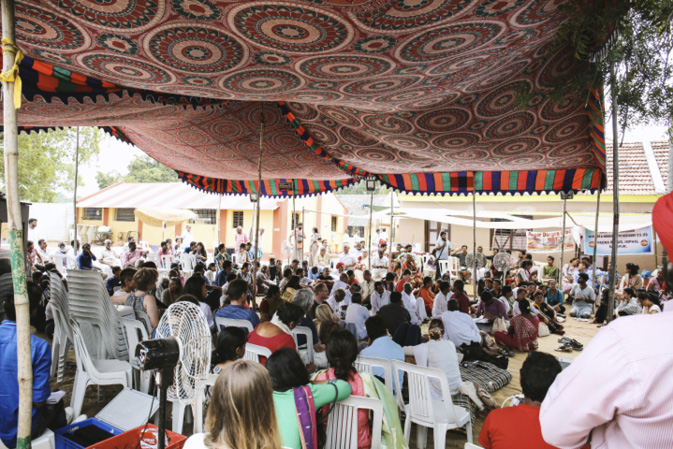
Fig. 9.2 The conference ‘Anchoring Innovation’ in Chirala, attended by 300 weavers, activists and scholars (photo by S. Gopinath in 2018)
The craft activist organisers had a mandate for the conference that brought them all together – there would be no tired talk of diminishing markets and inadequate state aid, berating the industry for its real and imagined woes. Instead, weavers would be treated like delegates at a conference, their travel paid for, their stay accommodated by local weavers of Chirala who opened their homes to the travellers, and most important, what would be spoken would be the language of the loom.5
A weavers’ camp of 72 looms, with exhibition and workspaces, was set up under trees and shelters at a local school, drawing the local community into what was perhaps the first time they had seen such a festival of looms: of weavers coming together from all over India to share knowledge. Translators were at hand, yet workshops and discussion reflected the capacity of artisans to communicate and absorb from one another across barriers. Weaver-to-weaver interactions offered a ‘reality show’ context to two days of discussions that followed, engaging scholars and weavers from around the globe around issues of craft and pedagogy, law, labour, livelihoods and future directions.
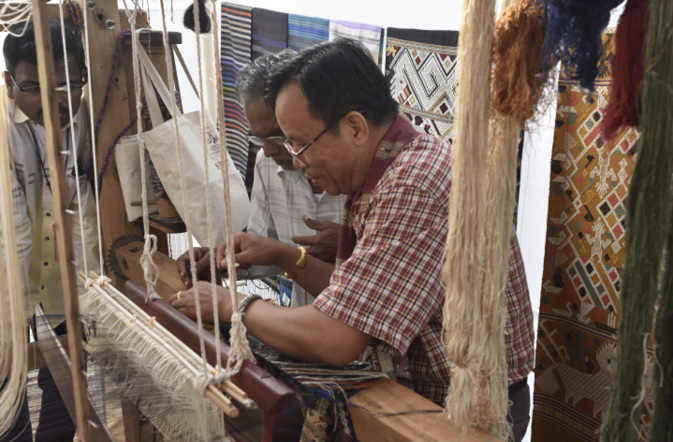
Fig. 9.3 Weavers in Chirala, Bandaru Gangadhara Saibaba from Chirala and Chanhsouck Phommalin from Laos (photo by S. Gopinath)
More than 70 women weavers from the north-east of India set up their very simple loin looms at the front of the meeting space. At the other end of the spectrum of handlooms, an exhibit of looms with elaborate Jacquard mechanisms had been set up by experts from the Weavers Service Centre. Generally seen as the brokers of new technology to the sector, the male technologists were used to getting all the attention from weavers at whichever venues they exhibited their looms. Here though, since the focus was not on technological progress, but the knowledge of the weaver, male weavers from Chirala flocked to the loin looms to watch the women weave complex patterns using the simplest looms. Later, in the discussion sessions, when the same male weavers complained about how high-speed mechanised power looms copied their innovative handloom patterns, the north-east women weavers took the argument to its completion. They could now confidently argue that when weavers used Jacquard and dobby attachments on their looms to make complex patterns, the men were doing to the women’s loin loom techniques6 exactly what the men were accusing the power looms of doing to them.
Starting with people: livelihood-community-ecology
Social relations are the backbone of handloom weaving economies in India (Mamidipudi 2016). These relationships are the living source of an ecology made up of material skills, tools, songs, memories and spaces. For example, the nomadic Kunche Erukula community (primarily living in Telangana and Andhra Pradesh) made the brushes used by weavers to starch cotton warps, a technique called sizing, which made India famous for its cottons. Fearing theft while travelling, they wove their savings, converted into gold nuggets, into the brushes that they repaired, and left them behind in the weavers’ homes for safekeeping. Yet, no weaver ever broke open a brush to steal their gold, for fear that they had no way of putting it together again, and would lose the means of sizing their warps and the trust of the brush makers.
The skill of the brush maker was in knitting the kunche, or brush, using the bark of a particular tree. According to the medieval text Manasollasa, an early 12th-century Sanskrit text composed by the Kalyani Chalukya king Someshvara III7 on the art of living, rope made of this anajan tree bark was so strong it was used to capture elephants. One of the toughest woods of India, its trunk could serve as the base of an oil mill, ganuga, the oil collecting in the hollowed out middle, around which bulls would traverse in circles, grinding the oil seeds. The bulls would be fed on the stalks of the native jowari (sorghum) plant that used to grow seven feet tall, full of sugary sap that gave them the strength to work the mill.8
With the steam engine, the tractors, the motors and the hybrid seeds, the jowari plant became shorter, the bulls weaker and the communities poorer. The reed for the handloom was no longer made by the local carpenter out of the jowari plant, but was mass produced in metal in a factory. When knowledge is performed by bodies, and is embedded in the ecology of social relationships, rather than written in books, it can only be transmitted from person to person. Family and social relationships thus become the backbone of accumulation of any kind of capital in this community, financial or social. Social capital is the currency of both pedagogy and performance. Today, for there to be gold in the brushes of the Kunche Erukula, all these complex relations would have to be reinvented.
This is hardly the business of policy makers today: Macharla Mohan Rao, union leader and handloom activist does not have much positive to say about government policy towards handloom weaving in India. Even as it has a market share of 10% in the domestic market, and is the second largest rural employer after agriculture, the government considers it a ‘sunset industry.’ Yet he has only good words for one particular Textile Minister in the 1990s, and his championing of a policy that was referred to as ‘house-cum-workshed’ that constructed houses for weavers, designed by weavers. This was partly seen as welfare work, but for the weaving villages in Andhra Pradesh, it became the impetus for a new generation of young weavers to take up weaving. For example, weavers from Odisha, a neighbouring state, visiting the weavers’ conference in Chirala, Mohan Rao’s hometown, exclaimed over how well the streets were laid out as well as the spaces for all the different tasks of weaving. The houses are clearly ordered around the loom that was located prominently in view in the front of the sheltered veranda, so the weaver could be seen at work. Houses are also ordered in straight rows, with streets in the front that could be used for sizing long warps. The houses themselves were airy and well lit, and quite modern. The rows of houses are arranged back-to-back; that is, two rows of houses would meet at the back, where the different generations of women could meet, to mind children, wind bobbins or share cooking tasks. Seeing such infrastructure for weaving for the first time, the Odisha weavers enviously named it a ‘five star weaving village’.
Mohan Rao contrasts this to the current largest policy intervention in the Indian Textile Ministry, the ‘technology upgradation fund’. Based on the assumption that upgrading textile technology would always include the purchase of new machine technologies, this policy fund provided capital at low rates of interest to textile entrepreneurs for purchasing new machines.9 This fund did not provide any support for handloom weavers. Rather than acquiring new looms or new technologies, handloom weavers would have gained from acquiring new techniques for using their familiar looms. Such techniques could range from training in more complex weaving methods, to improve the skills of the weavers, to ancillary techniques for using different materials of, for example, dyeing techniques. However, for the mechanised industry, the Technology Upgradation Fund worked very well, since machinery could now be cheaply purchased, and mills increase their spinning and weaving capacities.
In addition to offering an unfair pricing advantage to the mechanised industry over handmade products, this policy further displaced the social relations between producers of cotton and producers of textiles in the village ecology. When linked mutually in terms of scales of production, the production ecology had to grow at an even pace, keeping in mind all the different producers involved. Instead, when the large integrated mills increased spindle power by thousands with no constraint on cotton that could now be imported as a global commodity, it ceased to be a local resource. Since policy makers see textile and cotton production as separate silos, a policy to export cotton yarn was then made to create market for the surplus yarn being produced. But now it had to be aggregated in large quantities for spinning for export, and only middlemen who had capital profited from the policy, rather than the farmers. The result was that cotton farmers lost their local markets, and were at the mercy of exploitative middlemen and fluctuating global demand. Weavers lost access to yarn that was now being exported out of the country. What did not feature in any of these policy decisions is that cotton growing used the maximum of pesticide and fertiliser of all crops in India, causing huge environmental impacts.
Reflecting on the detrimental effect of this fragmentation of the village ecology, craft workers, in their recommendations to the Ministry of Textiles in 2021, advocated for a different attitude to handloom weavers by the State. Using results from the Penelope project, they showed the value of the unitary nature of social, material and epistemic ordering in handloom weaving, at once benefitting communities, economies and knowledge cultures. In the submitted policy note to the ministry, they claim:
The creative capability of the hand loom in India expands outwards from seed, spinning wheel, loom, home, street, village, local environment, state, country to global civilisation, like concentric circles radiating from the hand, heart and mind of India’s weavers. In consultation with weavers, co-operatives, handloom service providers, we propose a radical shift in policies for handloom weaving that recognises its special contributions to our economy, society, and knowledge culture. Focusing on their deep embedding in the flourishing cultures of India’s villages and cities, we propose that our weaver ecologies and their innovative knowledges – not just their products – are living traditions that generate sustainable futures. Rather than classifying handloom weaving separately as process, product, skill, economics, culture, livelihood, heritage, through our fragmented policies, we propose that using a knowledge lens will help us define handloom weaving in a way that we instinctively take for granted, as more than a sum of all its fragmented parts. In doing so, we will learn again to recognise and value handloom knowledge that weavers as part of Indian civilisation carry forward from generation to generation.10
Ordering time/space: occupation-leisure-technology
The Telugu term kaala kshepam generally refers to leisure activity; a weaver in the village of Ponduru used it to explain how he felt about time spent on the loom.11 Historically, since there was always demand for yarn in areas that supported handweaving, spinning too was such an occupation of leisure and at the same time of economic value. Moreover, it could be taken up seasonally by Dalit peasants when there was no agricultural work, or by women of all castes in between household chores. In most weaving villages of coastal Andhra Pradesh, weaving is a household activity; in Ponduru particularly it is combined also with hand-spinning of local cottons, mostly by women, in both weaving and non-weaving households still today. As such, yarn could be exchanged in the market for money, records from even the late eighteenth century show that it was from earnings of women through spinning that households used to pay tax (Wielenga 2020).
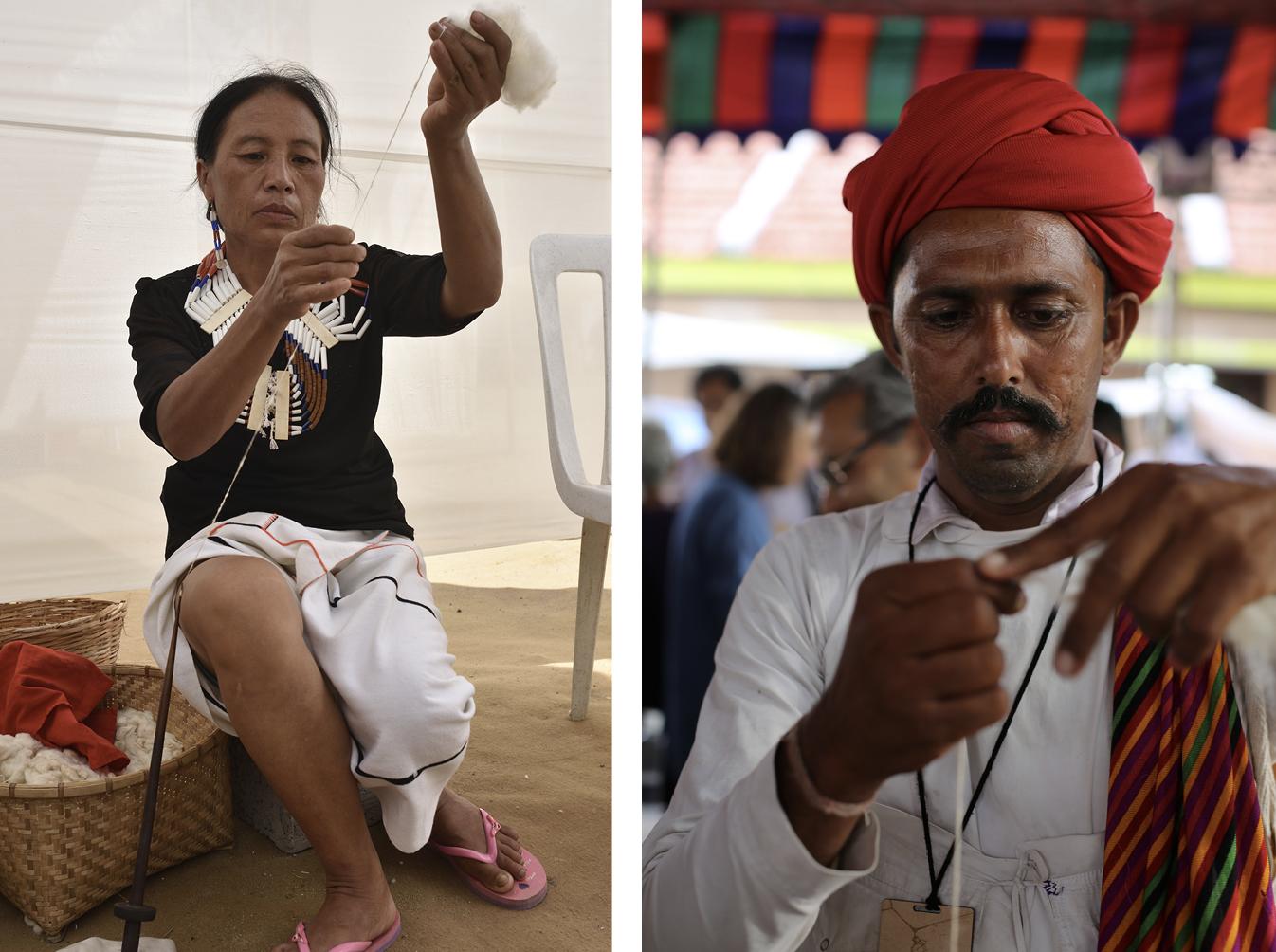
Fig. 9.4 Spinners from the North East and Kutch, Chirala conference (photos by Gopichandin 2018)
In the face of competition from yarn produced by machine, the women spinners of Ponduru seem an anachronism. Asked why she continued to spin when she might prefer to spend time in leisure, an octogenarian spinner replied ‘it is what I do with my leisure’.12 Going against the wisdom of technological determinism that threatens handwork of any kind as productive activity, Poludas Satish, a cotton activist, decided to teach spinning to women as means of generating livelihood in Bihar. Initially attempting to learn to spin at home, young women quickly exchanged their wages for bicycles and lipsticks, cycling into the women’s spinning centre working alongside mothers and mothers in law, to earn, socialise and learn from each other. As a mode of social ordering, spinning technology reproduced familiar community spaces of leisure activity, as well as occupations and technology.
The skill of a hand spinner lies in their being able to spin finer counts, with an even twist that ensures that the yarn does not break apart while weaving. Generally, cotton handloom weavers categorise thickness and fineness of yarn based on ‘counts’.13 The count of the yarn is a number; it expresses the number of weight units in one length unit, so if a unit length of 1000 meters is weighed, then the count is weight divided by unit length, assuming that the weight is evenly distributed across the yarn. Thus, the lower the count, the thicker the yarn. This same number communicates staple length to the farmer, weight to the trader of cotton, and thickness to the spinner. It is used to calculate weight in units of lengths (called hanks) across the chain of production and consumption. Further in the chain, the ‘count’ converts to ‘reed’ and ‘pick’ (i.e., yarn density per inch on the warp and weft) as an indication of the time needed and therefore of the required labour in weaving. The number translates into colour absorption for the dyer, resolution of the motif for the designer and weight and drape for the consumer.
Local production of fabric through the introduction of organic cotton varieties is first and foremost a change in count, as local cottons tend to be short staple and thicker. Initially, this seems a mere numerical change: from 60 to 20. However, in order to be set at work, this change has to be negotiated back and forth at every stage; between cotton trader and dyer, dyer and warper, warper and sizer, sizer and weaver, and so on. As the new number travels across each stage of the work and part of the network, the object it describes takes form and shape, until finally the consumer identifies and chooses it as a textured, local, organic fabric, setting off the next cycle of production and consumption. When this point is reached there is an agreement on the number of the count that will circulate in the ensemble, and organic cotton as a handloom technology is stabilised.
But this is not the complete story of the change involved. At each stage, as the count is being negotiated, another judgment is called for that each actor has to make in parallel. The yarn trader has to judge the quality of the yarn, in terms of its lustre; the warper on what kind of differentiation in warp texture it can take; the sizer in terms of what the smoothness of yarn would do for texture of the final fabric; the dyer for whether colour matching could be achieved and to what extent; the weaver for density of weaving, and the resulting visual and tactile quality of the fabric; the designer for suitability of surface ornamentation – what kind of motif, or print, for example, and so on. These judgments are clearly aesthetic; it is these capabilities that will come into play across the ensemble to construct the design of a new product. These judgments are made from experience, from aesthetic capability as well as by drawing on the historical repertoire that each group carries; colour palettes, motifs, design and product samples and so on. When craftspeople make this evaluation, it also evidences their deep engagement with the material that they work in, and their innate capability of manipulating it. This capability of creating products that are consistent in meeting quality parameters from inputs that are less consistent is seen by skilled craftspeople as part of their expertise.14
In a system fraught with such complex negotiation, one may understand that a person seeking to manage the production and marketing chain of hand weaving would think of the count as the most stable standard to coordinate quality. New to a project that sought to connect vulnerable cotton farmers to hand weavers, using small-scale machinery that could spin cotton in small quantities, the manager of the spinning unit found himself in a rather peculiar situation. The weavers who wove the yarn advocated a very specific count – a count of the number 27. This meant that across the chain of production, this number had to be negotiated – in the reed, in the pick, to the buyers, and so on. Talking to Satish, an expert in spinning, the manager explained his puzzlement at the seeming sacredness of that number, when weavers refused his offer to use the much easier-to-manage yarn counts of 25 or 30. ‘What would happen’, he asked, ‘if I were to insist on changing the count to 30, for example?’ Satish’s response ‘You can’t do it, unless the weaver accepts it’ only elicited further puzzlement from the manager, since after all he supplied the yarn that the weaver must weave.
Satish explained that the 27 pointed to an invisible instability in the nature of the yarn supplied to the weaver.15 Since the yarn was made on experimental small-scale machines, the weaver would encounter varying thickness and thinness in the yarn while he wove, which he would need to manage. This is unlike mill yarn, which is uniformly of the same thickness, stably of the same count. Thus, it is only for the count of 27 that the number of weight units in one length unit varies across the thread. If the count changes to 25 or 30, the weaver expects uniform threads. Keeping to the peculiar number of 27 as count is how the weaver codes the information of the material instability into the count. This serves the purpose of conveying an instability to be managed during weaving. However, this instability is not a problem for the weaver but a specific quality of the supplied yarn that allows for a specific texture. Therefore, the number 27 as count, not completely abstract, but also not entirely material, travels through the chain of production and marketing, stabilising the ensemble without itself being stable.
Embedding numbers in material practices of counting, manipulating and timing requires an understanding of the material being manipulated. Still, it is not the material form that is being manipulated, but the number in its material form; thus, the units of analyses are algorithms made up of operational possibilities in the material – the threads in this case –, rather than the geometric forms of design. Abstracted numbers cannot maintain their claim to provide a superior form of manipulation, unless they are able to take the challenge that such material orderings of numbers pose. Numbers in weaving show that numbers unitarily attached to material realities are manipulated according to the rules of that material – numbers in threads relate as density, thinness, weight, spin in space; while musical numbers relate to each other along the octave in time. Thus, patterns abstracted from one material to another become different mathematical entities, even if they retain the same form. For example, a woven meander is an arithmetical algorithm combining structure and colour in threads, but a painted meander on a vase is a geometrical expression.16 When the pattern is represented through abstract mathematical numbers, it ceases to be material, and becomes symbolic – and completely inadequate as a weaving number.
Coding a colour: body-algorithm-material
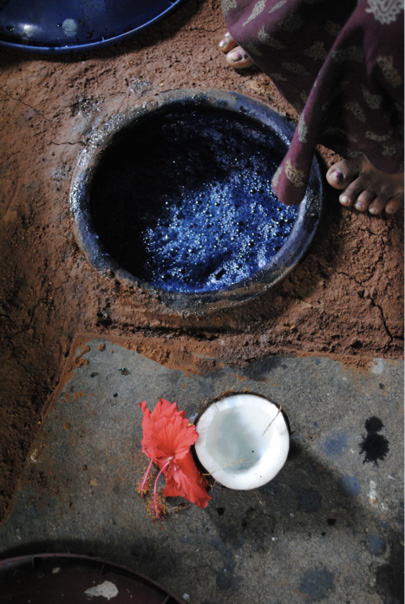
Fig. 9.5 The traditional fermentation vat using natural Indigo (photo Moody Chetananand in 2015)
The construction of a weave is an algorithmic movement included in the making of things, particularly fabric, song, music, dance and colour. However, the algorithm performs with the material and not with notation or wording. Mohammad Salim, a master dyer, evaluating a film made on dyeing Indigo, comments, ‘I don’t trust what the dyer in the film says, because the colour of the dye water is green, where at that stage of dyeing, it should be blue’.17 From the perceived lack of visual authenticity in the practice of dyeing in relation to the spoken word, he questions the veracity of the film as performing dyeing knowledge. The traditional fermentation vat that Salim is an expert in requires bacteria to break down the Indigo dye over a period of fifteen days, so that it can be applied on cotton yarn. During this process, the liquid in the vat turns green, before it turns blue, and green again once the blue dye is exhausted. To keep up continuity in production, the vats are started a day apart from the previous one, thus each is in a different stage of fermentation. The vats perform in tandem to each other, as a continuous source of colour, yet can advance only with the interventions that we could describe as decision making, framed by Salim as the dyeing process.
We could consider the procedural authenticity he refers to as the algorithm that is embedded in the action of dyeing Indigo blue. In a sense, this kind of framing of an algorithm could be thought of as the opposite of the formal algorithms of computer programming – the strictly structural ‘formal unchanging entity (…) that prescribes steps made one after the other, depending on one another’ (Rohrhuber 2018: 1). At one level, Indigo dyeing as algorithm breaks down the opposition of mixture and solution; at another it addresses the predictive and prescriptive functions of algorithms as opposition of process and outcome. Weaving, as well as the procedures that Salim refers to, unfold in time but perform only on the basis of the material ingredients and their effects on each other in space – the perfect presentation of time, in the unfolding of the process in time, and in its perfect vanishing as the performance at once unfolds in the space of a generative process (Rohrhuber 2018: 20).
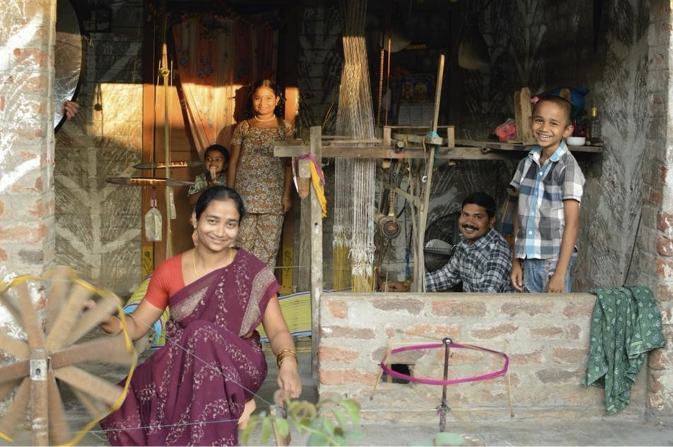
Fig. 9.6 Weaving household in Vellasavaram village showing household engaged in different activities around the loom (photo by Margriet Smulders in 2012)
Hylemorphism, the splitting of a process of generation into plan and implementation in time and space, requires first that such a split be possible. In complex knowledge practices that demand constant decision-making, such a split becomes impossible. Yes, there is a plan, and yes, there is implementation, but it collapses into the same moment. There is a time/space line operating – of memory, weave, outcome. The weaver’s memory is constantly accumulative, through the current iteration of his memory, of the past in the present; the weave is indivisibly both plan and implementation, the outcome is the pattern of decisions made regarding paths taken and paths not taken. Once made, the pattern is a record of the decisions taken. When programmed into a machine, it is exactly implementation, now separated from the plan. What takes time for the weaver, the careful attention to decision making, is exactly what is removed from the machine’s agency. Yet once copied, there is no difference between the weaver’s fabric and the machine-made fabric. The process of decision making that is so critical to one, completely disappears in the other. Worse, this disappearing of decision-making is then projected back onto the weaver, who then only seems to be performing labour, rather than using technology.
As in this case, this has effects on what possibilities craftspeople are allowed in the imagination of the majority in Indian society who do not understand this as a technical mode of existence.
Reading a textile: Text – Technique – Place
Throughout Indian textile history, cloth made for common use was the mainstay of livelihoods, crossing caste barriers in what was thought to be mainly a hereditary occupation. ‘Saudagiri’ in Gujarati alludes to the propensity of a person to trade, or make a sale. It is also the name given to an Indian textile from the mid to late 1800s, made solely for the ‘use of the Siamese’, characterised as ‘a coarse fabric with poor block registration, where the dyes are chemical’ (Guy 1998). The handwritten label affixed on a sample of this textile from the V&A claims that it was dyed at Peethapur, on the banks of the river Mahee – the Mahee Kanta. Such labels are generally understood to be descriptions of the origin of the artefact. The technical claim this label is inscribed with is lost to the eye of the scholar who overwrites its history and describes it as coarse and of common use. This technical claim can be read from the label – a craft technique is named after the place of its use; thus to describe its place of origin is to also describe a print technique – Peethapur – and the colour palette and fastness can be distinguished by the waters of the river where it is dyed – the Mahee Kantha river. The colours wrought from the solutions in this river by the printer dyers of the past continue to draw one’s eye to their simple appeal, recognisable even through the glossy mis-representation of their commonness. Key to the textile pattern is the mordant, which when dissolved in solutions made of the water from the Mahee river infused colour onto cloth. Yet, once the colour is fast, the mordant is washed out. It is these remainders of knowledge gleaned from material traces found in museums, as well as the material absences, that we can read from the textile itself. Thus, craft is twice memory – once as remembered in its material form, and then again in the replication of it, using the techniques, place and skill of the weaver as he weaves them again every day.
What is also at stake here is the representation of complex knowledge – knowledge that is inextricably at once embodied practice, reflexive decision-making and material agency. In particular, the challenge is to highlight non-propositional knowledge and illuminate the conditions of intelligibility of such knowledge (Knorr-Cetina and others 2001: 10), to grasp it as social phenomena and at the same time reconsider dichotomies between human and non-human entities.
Theory does not always exist as text. Particularly when theorising what the weaver knows, but not in words, text loses its ability to represent such knowledge except partially. How then to understand what words can do for understanding weaving if not theorise? What does the form offer? What then is theory, if it cannot be abstracted in words from bodies, objects, which are not seen as knowing, but doing and being? This text is an attempt to describe weaving as unitary and ubiquitous knowledge that orders social, material and epistemic domains. Yet, in this form, it is at best a collection of stories. Retold from experiences of working with craftspeople and activists in the last three decades, it holds within it the hope that these are stories that weavers too will find interesting to hear and bear being told about them.
Towards the goal of scholarship, this text only presents an unfinished description of weaving knowledge. We are left with more questions than answers. What does it mean to talk about epistemology, with reference to hand weaving? Why do we need a frame that the ‘actors’ themselves don’t use, when talking of what they know? The reality of weavers’ knowledge is mediated by the frame by which it becomes visible – thus to the market it is labour, to the designer it is skill, to the connoisseur it is art, to the STS scholar it is tradition recast as innovation. We see what we are trained to see, in the terms that we are trained to use. What does this do then, to the weaver and her way of knowing? There are two issues at stake here. The first, the hierarchy between the epistemology of the viewer, and the epistemology of the weaver. Historically, any claim to epistemology is made only in terms of the viewer; typically, this is the dominant discourse. The effort here is to make visible what would count as epistemology to the scholar, in the weaving practice of the weaver, and there could be two outcomes – one that the epistemology eludes scholarly vocabulary, and therefore the scholar infers that it is absent, or the scholar realises the gap in her own epistemic framework and works to repair it.
The second, much more elusive, task is to grasp the epistemic practice of the weaver in the weavers’ own terms. Yet in order to capture this epistemic practice, assuming that starting from the dominant framing is counter-productive, the endeavour is to start from experiencing as much as possible of the weavers’ reality, suspending at least temporarily one’s own epistemic frame. Particularly if a diverse set of people immerse themselves in a collective experience, and seek to reflect on it as fulfilling epistemic goals, then a common frame may emerge between them that reflects the epistemic frame embedded in the weavers’ experience of his or her reality. Such a collective frame shimmers into existence like a mirror turning into a pane of glass, now offering a view from the eyes of the weaver. Held securely and refracted through multiple perspectives, easily perceived patterns turn into complex code; much as the fabric patterns of the past turn into a frame holding craft knowledge of decision making, both literally and as knowledge.
Endnotes
1 http://ajabshahar.com/songs/details/58/Chaadar-Jheeni-Rang-Jheeni&title=Chaadar-Jheeni-Rang-Jheeni [accessed 11 November 2023].
2 See the contribution of Harlizius-Klück, this volume, chapter 2.
3 Harlizius-Klück and Mamidipudi 2024.
4 Meeting of Dastkar Andhra for inaugurating indigo vats, 1998, co-ordinated by Annapurna Mamidipudi, recounted by Gopi Krishna.
5 Preparation meeting of the Handloom Futures Trust, March 2018, attended by Macharla Mohan Rao, Uzramma, Poludas Nagendra Satish, Vivek Oak, Manisha Kairaly, Shaila Nambiar, Shruti Mahajan, Annapurna Mamidipudi.
6 Field notes of Poludas Nagendra Satish, Chirala 2018.
7 From the Kannada translation https://archive.org/details/Sachidanandendra_Swamiji_Sureshwaracharya_-_Manasollasa [accessed 13 May 2024].
8 Private communication of Author with Uzramma, October 2021.
9 Interview Mohan Rao, January 2020, Chennai.
10 Policy Note submitted to the Ministry of Textiles January 2020, Handloom Futures Trust, Hyderabad. The Handloom Futures Trust is a trust set up to focus on handloom weaving in India as a knowledge culture, particularly as historically it has been perceived as either cultural heritage or vulnerable livelihood. The aim is to build value for weaving ecologies by focusing on the knowledge aspect, bringing together textual research and experimental practices on the field. The Handloom Futures Trust mainly raises resources to provide fellowships for researchers, activists and experimental practitioners who advance knowledge in handloom weaving.
11 Muppena Appa Rao, weaver, Ponduru, Interview 2010.
12 Interview, Poludas Satish January 2020 Chennai.
13 For an analysis of textile production in early modern India, using counts (‘Cotton was sold in candies; thread was sold in bundles; cloth pieces had diverse thread-counts and dimensions; bales or packs of cloth contain different numbers, sizes and weights of cloths’) see Wendt 2005: 4.
14 This brings to focus another important difference between craft and mechanised production. The window of variation in inputs is much less for machines, which cannot handle such variation, compared to craftspeople who are inured to it. But again, if the productivity value overtakes the ensemble, then craftspeople with the capability to deal with non-standard material will demand standardised material in order to meet the productivity demands.
15 Meeting of Malkha Marketing Trust, January 2020, Hyderabad.
16 See Harlizius-Klück, chapter 2.
17 Meeting of dyers on representation by Handloom Futures Trust, October 2019 Hyderabad.
References
Guy, J., Woven Cargoes: Indian Textiles in the East (London: Thames and Hudson, 1998).
Harlizius-Klück, E., and A. Mamidipudi, ‘Reconstructing Knowledge in the Museum: Using the Handloom as Technology’, in T. Boone, E. Haines, A. Dubois, and K. Staubermann, eds, Understanding Use: Objects in Museums of Science and Technology (Washington: Smithsonian, 2024), pp. 109–35. https://smithsonian.figshare.com/articles/book/Understanding_Use_Objects_in_Museums_of_Science_and_Technology_Artefacts_13_/25444927 [accessed 13 May 2024].
Hess, L., Bodies of Song: Kabir Oral Traditions and Performative Worlds in North India (Oxford: Oxford University Press, 2015).
Knorr-Cetina, K., T. R. Schatzki, and E. von Savigny, eds, The Practice Turn in Contemporary Theory (London, New York: Routledge, 2001).
Mamidipudi, A., Towards a Theory of Innovation for Handloom Weaving in India (Maastricht University, 2016).
Rohrhuber, J., ‘Algorithmic Music and the Philosophy of Time’, in R. T. Dean and A. McLean, eds, The Oxford Handbook of Algorithmic Music (Oxford: Oxford University Press, 2018), pp. 17–40.
Wendt, I. C., ‘400 Years of Decline? Understanding the Changing Structure of the South Indian Textile Industry’, Global Economic History Network Conference, Padua, Italy, 2005.
Wielenga, K. D., Weaving Histories: The Transformation of the Handloom Industry in South India, 1800–1960 (Oxford: Oxford University Press, 2020).