10
Comparative reflections on Andean weaving as science
Denise Y. Arnold
Introduction
As an anthropologist with an architect’s training, I was fascinated by Andean weaving from the start of my fieldwork in Bolivia in the 1980s, but far from understanding its scientific and philosophical implications.1 My early questions to weavers were politely brushed aside as not technical enough. They did not resort to the Greek technē, in the sense of epistemē, as a principle of knowledge, craftlike or not. I soon learned that knowing (yatiña in Aymara, the regional language), in an epistemological sense, was not a generalised and abstract idea, but applied to a particular place with defined limits, such as the loom space, or a field (Arnold with Yapita 2006: 113–15). In weaving, the weaver clears the ground, giving thanks to the Earth, then she proceeds to weave life on her loom. In practice too, this is not knowledge in the abstract, derived from an empty universe, but knowing about life, and building on what is already there.
From 2005 to 2012, I worked closely with weavers in the South-central Andes, in partnership with Elvira Espejo, a weaver from the same region, and the linguist Juan de Dios Yapita, on two long projects. The first was more practical, and responded to local demands to improve textile quality by adjusting aspects of the existing productive chain; the second was more academic, aimed at researching weaving structures and techniques in the weavers’ own language. The title of the book that I wrote as a result of these projects, The Andean Science of Weaving (2015), with the collaboration of Elvira Espejo, came from a comment by some local weavers during a workshop we held about recovering finishing techniques with their own weaving terminology. They had heard about these techniques from their grandmothers, but never applied them in practice: they commented that this study of Andean weaving terms and their revival in practice was ‘women’s science.’
A first step in my wider argument is to clarify what I mean by ‘science,’ and then what an ‘Andean’ science might mean, comparatively speaking. In comparing Western science and traditional or indigenous knowledge systems (some call it ‘ethnoscience’), the Austrian philosopher Paul Feyerabend, in his book Against Method (1975), concludes that these distinct approaches reflect different ways of knowing, given clout or not by the more formal institutions, such as universities, according to the paradigms which hold sway at any particular moment. But importantly, for Feyerabend, it is precisely the dynamic interrelation of these interacting traditions that might challenge on occasion these dominant paradigms and lead to new levels of scientific understanding.
Other important comparative studies by Sandra Harding (1996–7), David Turnbull (1997), Wim Van Binsbergen (2007), and Isabelle Stengers (2017), as well as a wealth of essays on what is now known as ‘Traditional Ecological Knowledge’ by M. M. R. Freeman (1992), Douglas Nakashima and Marie Roué (2002) and Fulvio Mazzocchi (2006), among others, often conclude, like Harding herself, that Western science is itself an ‘ethno’science, based on a system of beliefs.
Bruno Latour and his colleagues, in their Actor Network Theory, take a more pragmatic approach, arguing that science is a collective activity, a complex, dynamic network in which scientists, institutions, concepts, physical entities and forces ‘knit, weave and knot’ together into an overarching scientific fabric (Latour 1987, 2005; Latour and Woolgar 1986). Tim Ingold, developing similar ideas, prefers the more organic term ‘webs’ to the technological stance of ‘networks’ (Ingold 2011: 64).
Taking up these ideas, the young scientists Feng Shi and colleagues (2015) conclude that science is a ‘complex system,’ built up from strong interactions between diverse, differentiated components, which manifest emergent and often unexpected collective behaviour, at all scales. For them, the networks described by Latour not only trace the past politics of science, but act as a substrate for future scientific discovery. Their perspective extends the definitions of classic network-oriented human problem-solving, although it still presents this activity in a rather objective and unsituated way. But at least their observations confirm how the nature of woven fabric, explored by Ingold (2011: chapter 7), and feminists such as Sara Ruddick (1995, see also Confortini and Ruane 2013), lends itself to thinking about the world in ways that re-link that torn asunder by modernity, where a woven ‘morphology’ actually enables thinking connectively between and among things, from a life-centred perspective.
The ‘Great Question’ applied to the Andes
Another entry into these debates was to examine the factors at play in asking the ‘Great Question’: of why modern science developed in the West, and not in China, as explored by the English biochemist Joseph Needham, with Wang Ling, in their series of books on Science and Civilisation in China (1956–2016), and more recently by the French philosopher and sinologist François Jullien (1999 [1996], 2000 [1990], 2010 [2009]).
Heather Lechtman, too (1993), a scholar on Andean metallurgy, familiar with weaving technology, applies this ‘Great Question’ to define differences in technological developments, and hence of scientific knowledge, between Europe and the Andes. She notes how Andean technological developments, mainly those under the Inka, were not oriented towards ‘hardware,’ in the sense of developments in tools and machines (swords, ploughshares or wheels), as in the West, but towards ‘software’ that would facilitate coordinations in agricultural and herding production between diverse populations living at different altitudes. So for her, Andean technologies had to do with relations between and among human groups and their sources of survival. Here, Lechtman views weaving as part of a wider normative technology of fibre manipulation, widespread and vital to Andean civilisations. But, she leaves the wider issue of science and its definitions there.
Here I take up Andean weaving practices as ‘science’ in the collaborative and relational sense offered by Ingold, Latour, Van Binsbergen and Lechtman. These practices certainly concern regional explorations into the socio-political and economic interrelations between people. But weaving practice also entails human interactions with the biological domains they engage with, in wider multispecies relations, as well as human relations with material domains, in technological and technical interactions, and in the plays of forces involved in making things, of which Ingold has made us aware (2011: chapter 18). I sense we are dealing with relations among things, of what the Argentine archaeologist Alejandro Haber (2007) calls ‘relations between relations,’ where Andean weaving practice plays a vital part in creating emerging biocultural spaces, as argued by the Argentine ethnobotanist Verónica Lema (2014).
Working with weavers in the South-central Andes affirms that these wider relations involve more than technological developments in looms and instruments, or in weaving structures and techniques. I have suggested that it was the historical integration of these developments into ‘social’ sequences, followed by the cascade effect of these wider ‘social’ activity streams, that articulated the elements of these broader Andean territories into an evolving whole (Arnold 2018: 240). The cascade effects of biological and material activity streams must have articulated these elements in a similar way.
The chaîne opératoire or productive chain of weaving as an organising template
These wider scientific coordinations between diverse groups of social actors (herders, dyers, instrument makers, loom-bar carvers, weavers, finishers), with their epistemological and ontological characteristics, coincided with developments in the chaîne opératoire or operative chain of weaving, the term originally coined by Leroi-Gourhan, in 1943, to describe a normative chain of operative sequences in artefact making. As in our first project with local weavers, I refer to this operative or productive chain to organise this chapter, beginning with planning before moving on to weaving production.
The characteristics of these productive chains operate at a local community level in Qaqachaka, the rural marka with its six ayllu communities, located within the municipality of Challapata in Southern Oruro in Bolivia, where we worked over decades. But these characteristics are also evident in the wider and more ‘radical’ communities of practice (so named by Chantal Conneller 2011: 16–18), where the integration of their technological and human characteristics creates what Lechtman (1977) calls the ‘technological style’ of a regional sense of identity, with its expression of common technical values, cultural symbols and ideas. Qaqachaka’s regional identity is rooted in its history, as a former part of Charkas-Qharaqhara and later of Killakas Asanaqi, two of the great pre-Conquest Aymara federations of the region. However, the practices which help perpetuate this common identity nowadays manifest mainly through dress and fashion, shared visually at festive events, which consolidate, or differentiate, local communities of practice within these wider regions. I propose that these points of articulation are comparable to the modern scientific sharing of ideas, common trends in thinking and forging alliances, achieved in conferences like Homo Textor, in which we participated together.
Planning weaving activities
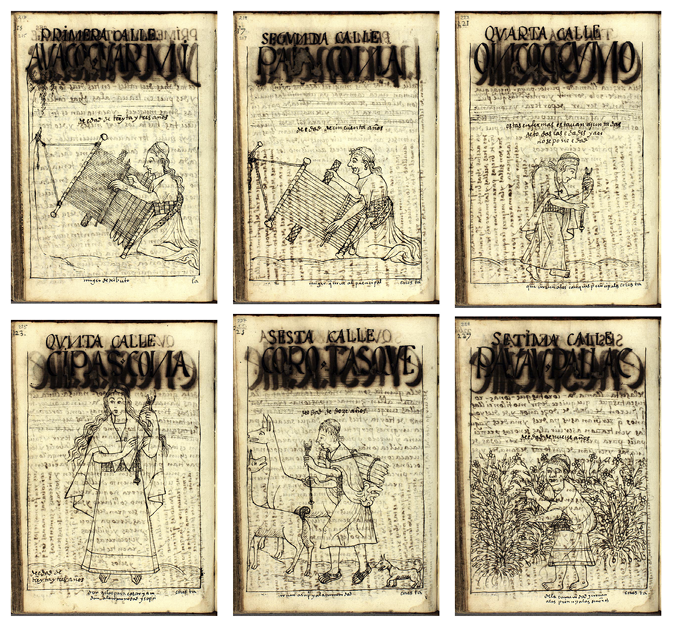
Fig. 10.1 Selection of Guaman Poma’s ‘streets’ (calles), for women, drawn in his early seventeenth century Nueva corónica y buen gobierno (ca. 1615), showing the first, second, fourth, fifth, sixth and seventh streets. Source: Royal Danish Library, GKS 2232 kvart: f.215 [217]), f.217 [219]), f.221 [223]), f.223 [225]), f.225 [227]) and f.227 [229]. http://www.kb.dk/permalink/2006/poma/info/en/frontpage.htm
I start with textile planning, with its far-reaching demands in terms of access to materials, labour and technological supports, which have many qualities of a scientific enterprise. Here, the epistemological focus is not on an abstract or objective ‘making as knowing,’ but on a more encompassing idea of going with the flow of energy in the world, and how to harness this energy constructively, without controlling it directly. This phenomenon is similar to Needham’s focus on wu wei in ancient China as ‘going with the grain’ (Needham 1964: 401) or Jullien’s comments on Taoist philosophy as the basis for the drive to achieve efficacy by working with energy flows already in motion (Jullien 1999/1996).
In achieving and perpetuating this flow, historical evidence suggests that the Inkas, a common point of historical reference in the region, estimated the relative human energy (in Aymara ch’ama, or in Quechua kallpa or qama) and biological time available within regional populations, taking into account sex and age criteria, in terms comparable to our notions of ‘labour force’ or ‘manpower’ (Rostworowski 1993; see also Arnold 2012: 180–87). Information obtained though the Inkas’ five-year census accounts of human and camelid populations was collected and articulated through the widely disseminated decimal system of measurement, documented on knotted khipus, then used to calculate and plan large-scale tasks, some aspects of which still survive in the region. The territorial reach and jurisdictional limits of these tasks were set by the khipus themselves, associated not only with water-related rites (Bennison 2019; Bennison and Hyland 2021), but with specific territories under the domain of particular mountains and their water flows (Arnold and others 2000: 345; Pimentel 2005; Arnold with Yapita 2006: 212, 218–19).
Evidence of this practice can be seen visually in Guaman Poma’s early seventeenth century drawings of what he calls the streets (calles) of these age and sex groups, focused in the female case almost exclusively on weaving practice, which illustrate the obligations of different groups to collect raw materials (dye plants, water, kindling, fibre), prepare thread and then make specific products (thread, slings, ropes, mantles) (Rostworowski 1993; see also Arnold 2012: 180–87) (figure 10.1 A–F).
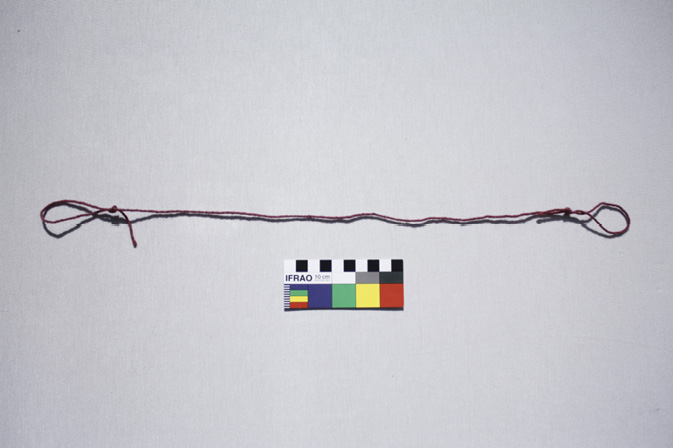
Fig. 10.2 Contemporary knotted tupu used to standardise sizes of weavings (photo by the author, Collection of the Instituto de Lengua y Cultura Aymara (ILCA), La Paz, Bolivia
Other scientific developments in the Andes were oriented towards managing the physical environment through skilled engineering feats, in extensive terraces and irrigation systems, building productive networks connected by road and bridges, and along them intermittent waystations (tampu) or administrative centres (kallanka) for storing supplies or distributing them in incipient markets.
Along these productive hubs, units measured in tupus (figure 10.2) were used to calculate the expected yields of different cultigens in physical units of land measurement, depending on the kind of land (often defined by its soil colour, and hence its degree of fertility), and in terms of the retribution in work owed to the state by specific social units (families, ayllus or the relocated mitimay groups) (Rostworowski 1993; Arnold 2012: chapter 4).
Tupus were standardising measures relating work to an area of agricultural land and pasturing activities (as well as to road lengths, and mineral veins in mining), and were important in textile making (figure 10.2). In return for intermittent corvée labour tasks to make textiles as a form of tribute, the Inka provided weaving families with fibre from the royal herds, food and drink for collective festivities, and security through the storage of items of tribute to be redistributed in cases of food or clothing shortages. Provincial families were also absorbed into Inka kinship systems, to consolidate this royal control over labour power.
This relational pattern of knowledge in calculating and planning work and energy flows, lubricated with reciprocal exchanges, was disseminated through, and accounted for, on khipus at community levels, mainly under the control of men (to be passed upward to higher levels of state administration). For their part, women controlled the production of larger textiles in the making (when knotted tupus measured width and warp length), and finished products, associated with the household economy (see again Arnold 2012: chapter 4).
The use of models and standardising procedures
As in modern science, Andean weaving practice as a form of science drew on model making in the archaeological past. Small portable models called salta waraña, like those used in the past, are still commonly lent between weavers, especially older women, for learning techniques and designs they are not familiar with (Arnold and Espejo 2012). Similarly, for applying new colour combinations, they use musa waraña, in the form of thread-wrapped rods, which are also used to standardise patterns in group activities. We reinstated the use of these musa waraña into our second weaving project, and they worked very well at a planning stage and as standardising devices (figure 10.3).
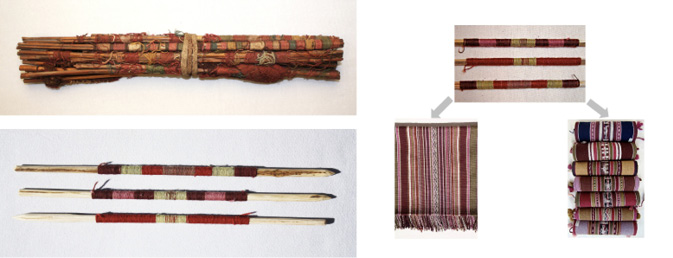
Fig. 10.3 Archaeological (upper left) and modern (lower left) examples of the thread-wrapped rods, called musa waraña, used to standardise colour combinations, for example in the counts of the striping options shown in the scheme to the right. Source: British Museum Collection, London (Am1909,1207.150), and scheme by the author, Collection of the Instituto de Lengua y Cultura Aymara (ILCA), La Paz, Bolivia, respectively
Bruno Latour (1986: 19) has criticised the use of models in Western science, mathematical and otherwise, as evidence of the objectivity and distancing of modern scientists from the real world. François Jullien (1999/1996: 22) is similarly negative about this use of models. And Ingold (2011: chapter 17) has critiqued Aristotle’s hylomorphic model, where such activities are thought to be conceptualised first in the mind and then in reality, or where organic form is thought to precede its development in the real world. However, Andean weaving practice really does involve a number of prior planning decisions, many modelled on small supporting devices (such as thread wrapped stones or corn cobs to aid coordinations in colour use), before the loom is even set up (Arnold 2018: 252–56). Ed Franquemont, an accomplished weaver himself, calculated that, as a weaver plans her work on the loom in places around Cusco, some 80 decisions of this kind are made (personal communication).
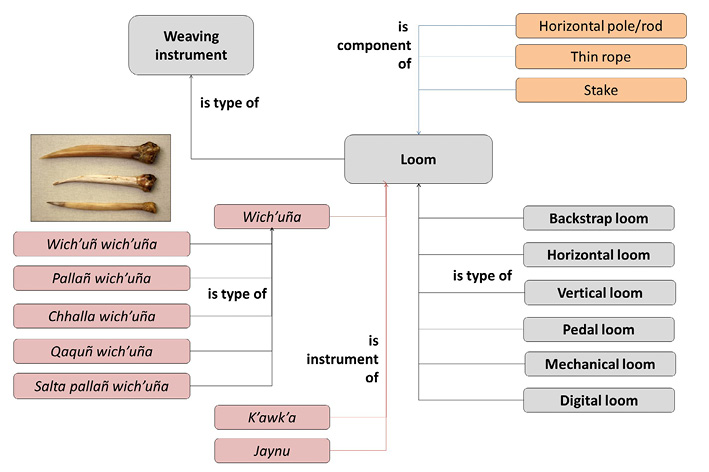
Fig. 10.4 Diagram of regional looms and weaving instruments, with their terminology, organised ontologically. Source: Scheme drawn by the author, Collection of the Instituto de Lengua y Cultura Aymara (ILCA), La Paz, Bolivia
These Andean models were highly situated and contextualised, and, as in their Mesoamerican counterparts (Pitrou 2014), most probably used to scale up planning procedures into household, community or landscape-wide applications, relationally. Apart from resorting to models, there was the deliberate state application of standardising procedures, similar to those described by Latour (1986) in the West. The Inka state developed such procedures to ensure the quality of fleece and other basic materials, the forms and sizes of particular garments (Julien 1999), the range of structures and techniques used by certain social classes, and the content and meaning of certain motifs in weaving iconography. The state imposed these norms in the immense territory they conquered, in mobile objects (textiles and khipus) to which the State could refer constantly.
The presence of a standard set of weaving instruments, with agreed names, is yet another reminder of these Inka standardisation measures of the past to improve cloth quality (figure 10.4). The design of contemporary spinning and plying instruments draws on physical entities (in the measurement and use of energy and forces), with attention to the direction and velocity of spin and ply, and relative whorl weight, depending on whether the thread is camelid fibre, cotton or another vegetable fibre. In weaving proper, pressioning techniques demand the specific tightness or looseness of a certain weave. The selection of threads in the designs of warp-patterned weaves demands more finely pointed and harder instruments such as llama bone or wooden picks, whereas tapestry can be made using blunter instruments, in a categorisation of weaving instruments already standardised under the Inkas, if not before (Rivera 2014). The use of such a set of appropriate instruments has to be planned, as they can break or get lost, and new ones take time to make, and entail visits to specialist workshops, where bone picks are smoked to become hardened.
Rearing camelids with certain colours or developing dye technologies
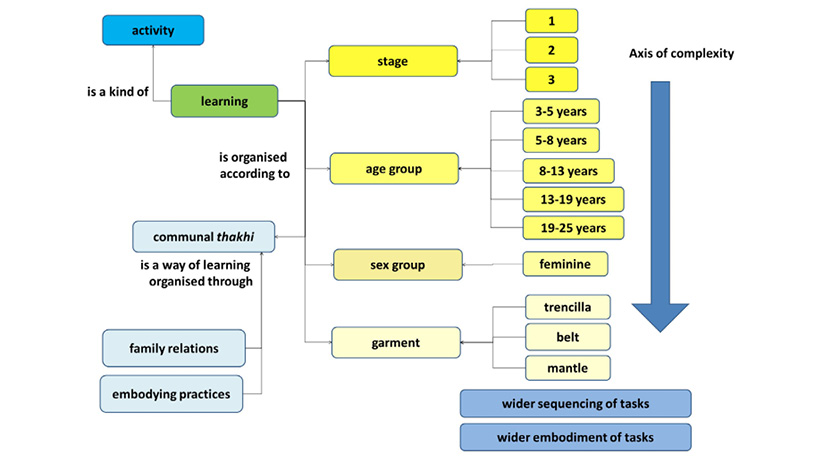
Fig. 10.5 Diagram of the learning pathways called thakhi, organised ontologically. Source: Drawn by the author, Collection of the Instituto de Lengua y Cultura Aymara (ILCA), La Paz, Bolivia
In social terms, the increasing complexity of weaving practices went hand in hand with increasingly complex networks of social actors, their technological supports and developments, and the institutions of which they formed part. Planning ahead ensured a local supply of dye materials at the right moment of the chaine opératoire. Weavers calculate the quantity of animal fibre they will use to obtain thread of different colours for a certain textile, and they need to have an appropriate loom at hand on which to apply the structures and techniques to be executed, the loom poles often coming from valley trees, traded in through networks of established exchange partners, nowadays called caseros.
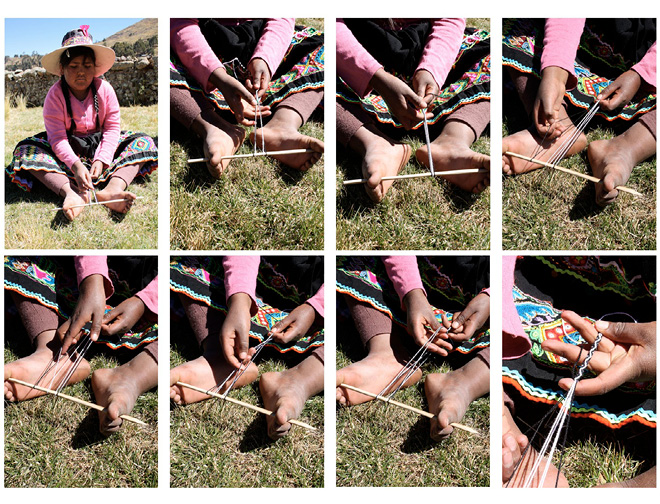
Fig. 10.6 A sequence showing the young Qaqachaka weaver Silvia Espejo weaving warp crossing techniques (photo by the author, Collection of the Instituto de Lengua y Cultura Aymara (ILCA), La Paz, Bolivia)
Weaving institutions formed around practice-centred local associations and their wider exchange networks, and, in the past, state institutions such as the Inka aqlla wasi (closed communities of selected women) and the Inka-established pathways of learning called thakhi, were organised through age sets and sex-gendered groups in these regional groups (figure 10.5). In their modern counterparts, young girls still pass successively from more simple to more complex loom technology, instruments, and woven structures and techniques, in three basic stages (Arnold and Espejo 2015: 64–69; Arnold 2018: 248–49).
In these learning sequences, young girls start with warp crossing techniques on simple looms, learning to manipulate yarns in distinct directions to create zigzags and rhomboids, first with their fingers, then visually (figure 10.6). Regional technology here deals with material developments in tools, and the set of social relations in which weavers participate with others at a family level, which then extends outwards into the wider community of weaving practice.
These phases of intergenerational learning give priority to the interactive aspects of weaving practice as ‘techniques’ to sustain the environment and ensure its continuity, as herds have to be reared on good quality pastures and water supplies to render fine fibre. Here, weaving endeavour reaches out into the biological and material domains. The British anthropologist A. M. Hocart (1935) suggests that it was these kinds of techniques, often associated with rituals, that articulated human social activities with the bio-cosmological aspects of the regional ecology. His view was late echoed by Gilbert Simondon (1980), who held that man-made machines can resemble life and cooperate with life. For Hocart, ritual is a ‘science of life,’ ritual techniques an applied ‘science of life,’ and ritual practice ‘techniques to secure life.’ Hence, many so-called ‘spiritual’ values, even native ‘worldviews’ and ‘cosmopolitics,’ are precisely those directed at ongoing interactions between humans and non-humans in their surroundings.
Other articulations between the social and biological domains include ways of rearing herd animals and ongoing experiments in animal genetics, based on long-term empirical observations. In the past, it was the crossing of different wild camelids, the vicuña and guanaco, which led to the development of alpacas and llamas as particular species. Nowadays, during the animal mating ceremony, when species are crossed, weavers experiment with the colours and qualities of their fleeces to achieve the desired tone, length and degree of fineness, directed at their use in weaving (Arnold and Espejo 2007: 326–31). Here, conceptualisation, interpretation and prediction play their part.
Dye technology, too, achieved great advances that evolved in identifiable steps. In their open-air laboratories, Andean weavers experiment constantly with strange brews of mineral salts and other compounds, dissolved in fermented urine and other strong smelling dissolvents and mordants, in order to obtain the colours they seek in their work. Even regular dyeing processes entail continued experimentation with distinct quantities of dye plants, minerals or insect products, such as cochineal, and their reactions to specific mordants (urine, or alum as sulphate of aluminium and potassium, millu in Aymara) or different qualities of water. Acid mordants (lemon, vinegar or alcohol) render brighter colours, whereas a bath in metallic salts, such as ferruginous clay or iron oxide, generates oxidation to produce darker tones (Arnold and others 2019: chapter 6). Dye remains impregnated in pots on weaving sites are only now being examined in archaeological contexts such as the aqlla wasi on the Peruvian coast. In the recent past, dyeing was a specialist task in the hands of experts, and highlanders visited their workshops, usually in the valleys where the dye herbs grew, to obtain the coloured yarns they needed (Arnold and Espejo 2011: 185–86).
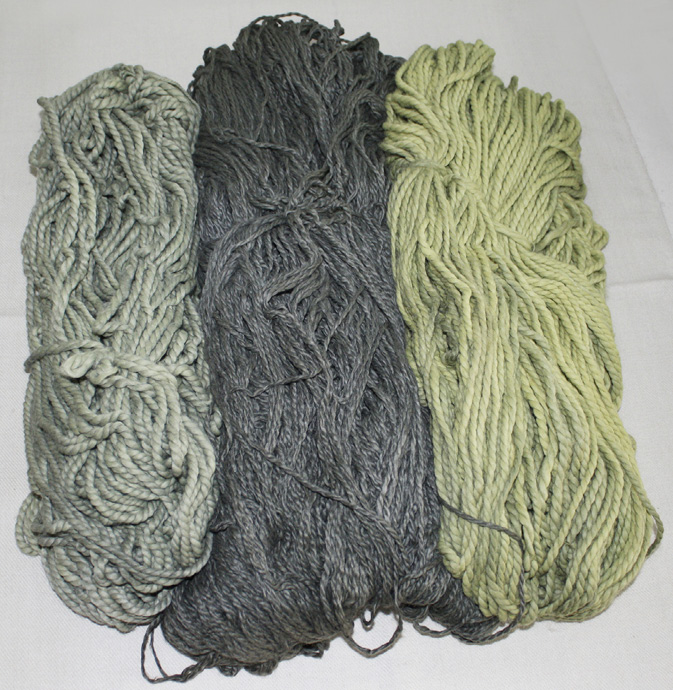
Fig. 10.7 Skeins with graded tones of the natural green from the tola shrub, made in different immersions. Source: Photo in the Collection of the Instituto de Lengua y Cultura Aymara (ILCA), La Paz, Bolivia
These specialist dyers managed colour tones by the number of immersions, hence the dye concentrations they were working with (figure 10.7), as do weavers today. Strong colours, especially red and blue, are associated with youth and power, and washed-out colours with washed-out older people (Arnold and Espejo 2011: 185–86). Colour saturations, like colour combination preferences, were equally relational rather than determined in a vacuum.
Emerging from this practice-based experience, Andean colour theory is not based on the properties of light, as in Newtonian models and the Munsell system, but on the properties of colours in water-based transformations. So the primary colours are not the reds, yellows and blues of refracting light, but violets, oranges and greens, while the reds, yellows and blues are secondary or tertiary colours, arrived at only after previous transformations of the Andean primaries (Arnold and Espejo 2013: 170–77).
Weaving proper
Turning now to weaving proper, some terms used for the emerging units of a specific garment, such as sillku and suyu, still embody former labour systems. In the central design areas, the relative width of coloured stripes (lista) and design bands (salta), in narrow intermediate and wide areas, indicate, relationally, design planning directed towards the visual expression of the quantities of possible cultigen yields (Arnold 2012: 116–21; see Silverman 1988).
In finished mantles, the distribution of borders (t’irja), the plain pampas and the blocks of figurative or geometrical designs called salta, document each productive process, from land at rest in the pampas, to fields under cultivation in the design areas, and then the rows of harvested products piled up at the sides of fields in the stripes and border areas (figure 10.8) (Arnold 2012: 116–21). This visual and conceptual design organisation applies inductive and deductive reasoning combined with theoretical knowledge, and its transmission through woven forms of inscription.
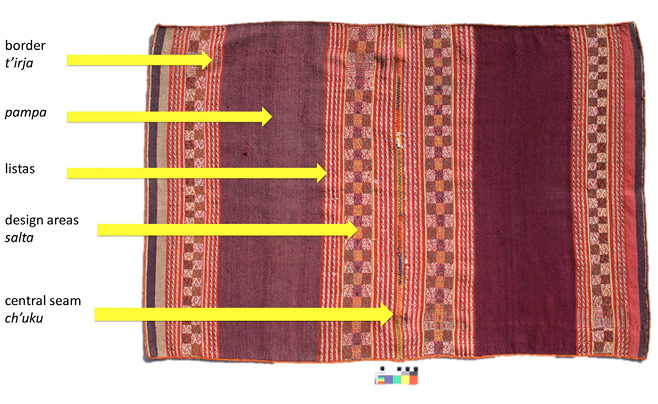
Fig. 10.8 Borders, plain pampas and the design areas (called salta) in a contemporary woven woman’s mantle or lliklla. Source: Photograph of a lliklla from the Museo de Textiles Andinos Bolivianos, La Paz (unregistered), integrated into a diagram by the author, Collection of the Instituto de Lengua y Cultura Aymara (ILCA), La Paz, Bolivia
Ladder designs, where more elaborate designs give way to rows of coloured horizontal lines, or alternating colours in a checkerboard effect, are not just techniques used to finish a weaving. Through their pick-up counts, ladder designs document the potential uses of agricultural products, either destined for household storage and consumption, or to be sent back into regional exchange circuits. Ladder designs, in a household’s food bags, also register the series of transformations undergone in a domestic setting between a raw agricultural product, for example the root crops oca or maize, with the distinct colours of their outer skins or pericarps, and flour ground from these, of a much lighter shade (Arnold and Espejo 2014). So again, the underlying epistemological significance of these designs reaffirms transitions and transformations, in the dynamic flow of the world.
These kinds of practices are articulated visually and conceptually, in the region-wide language of weaving structures, in terms of warp levels, and techniques, in terms of pick-up counts, each of these being organised from simplicity to complexity (see also Arnold in press). One and two warp levels are considered simple (ina in Aymara, siqa in Quechua), whereas three to eight are considered complex (apsu in both languages). In the past, these technical differences were used to create distinctions at a social level, whereby ordinary commoners (ina jaqi) were restricted to wearing simple cloth made with undyed fleece colours, whereas the regional elites (the ‘selected ones’ or apsu jaqi) had access to complex cloth, with strong, dyed or ‘cooked’ colours, notably reds and blues (Arnold and Espejo 2011: 179, 186).
Some technical differences from simplicity to complexity are articulated through the common warp pick-up counts in odd or even patterns, learnt visually and corporeally from an early age.2
These pick-up counts are combined with colour selections and reselections to create certain techniques that present, again relationally, outlining, colour blocking, and the alternation of dark and light designs (qhusi and tika) (figure 10.9).
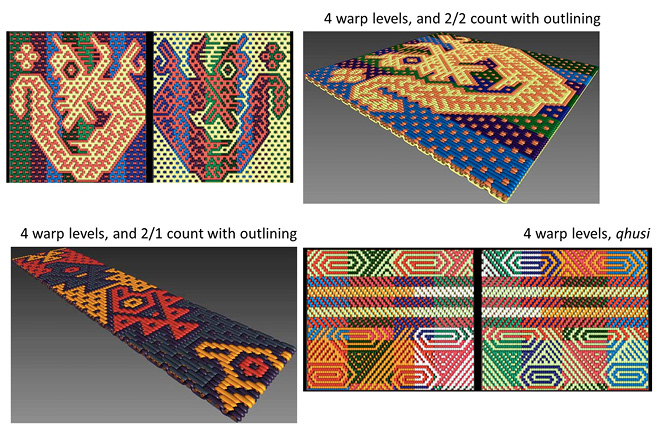
Fig. 10.9 Complex contemporary ‘reselected’ weaving techniques. Source: Drawn in the Sawu 3D programme developed by the Instituto de Lengua y Cultura Aymara (ILCA), in images drawn by members of the ILCA team, under the supervision of Elvira Espejo, La Paz, Bolivia
Odd and even pick-up counts also generate the specific patterns of figurative or geometric weaves, with their different significations. Even counts tend to give rise to figurative patterns that document agricultural and herding products in the making. Odd counts, on the other hand, give rise to geometrical patterns that document the contexts for this production (for example in terraces, or walled enclosures) (figure 10.10). Our documentation of these pick-up counts allowed us to develop our software program, Sawu-3D, to document these visually (Arnold and others 2019: chapters 1 and 7).
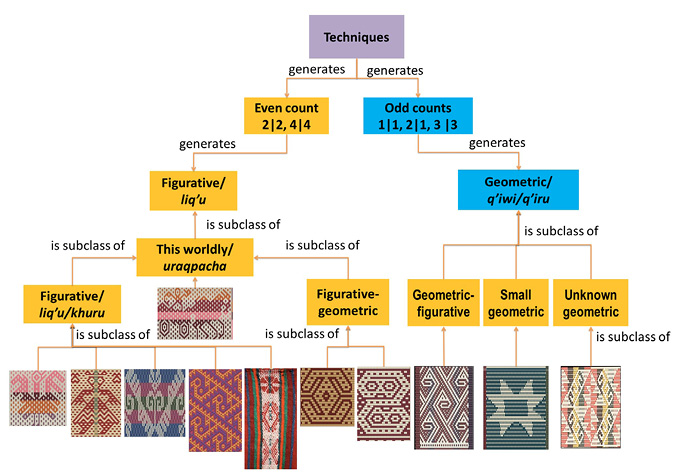
Fig. 10.10 Figurative and geometric pick up counts in warp-patterned weaves and their resulting iconography. Source: Diagram drawn by the author based on images in the ILCA Collection
These relations became consolidated through history, and more so with modern schooling when girls had a better grasp of arithmetic. We noted this in a comparison of warp count and motif type between archaeological textiles and contemporary ethnographic ones, in a corpus of 419 out of 704 museum registers, where the percentage of correspondence of odd counts giving rise to geometrical motifs increased from 69 to 72 per cent in modern examples, and of even counts from 88 to 96 per cent, respectively (Arnold, De Diego and Espejo 2011: 290–91). Thus, these iconographic and other aesthetic values arise from deep textile structures and patterns, and not from surface ‘decorative’ features, as Lechtman (1984) also found in the case of Andean metallurgy. This is why the weavers themselves classify these iconographic differences in a science of relations and patterns.
Complexity and emerging social-technical institutions
As in modern scientific developments, identified by Latour and colleagues, the technical demands by weavers themselves to be able to apply ever more complex structures and techniques, with greater colour combinations, would have generated a cascade of increasing technological complexity in looms and instruments. Evidence suggests that an early development of this occurred in Early Horizon Paracas (700 BC–200 AD) when the availability of a wider colour palette coincided with contemporary loom developments to create examples of triple cloth (with three warp layers) (Doyen-Bernard 1990).
Any consideration of Andean weaving practice as science must also take into account the productive process, the finished product, and its circulation in the world. Like writing, khipus and weavings embodied forms of codification at different stages in their making. Then finally, like a written text, the finished product became externalised from the human body. This allowed their makers, in their communities of practice, to reflect upon the technical or aesthetic success of their enterprise, as well as to contemplate any adjustments they might make in the future. The linguist Roy Harris (1989) and the philosopher Richard Menary (2007) perceive this process of externalisation as the development of detached or ‘autoglottic” spaces’ for cognitive reflection (Arnold 2015: 45–46). In other words, producing inscriptions in weaving, as in writing, facilitates a way of thinking. In the productive chain, this happens first with the subproducts of different stages (spun threads, plied threads, dyed threads), then with the finished weaving product, each providing a cognitive support for their analysis by the maker, and by others.
Weaving wider connections
In terms of the regional lifeworld, beyond the social and biological fabric of Andean living organisms and landscapes, weavers making woven artefacts ‘ensoul’ material form. In the productive chain, it is common for the ontological aspects concerned with this ‘ensouling’ of life to allude to maternal care, and to its counterparts in agricultural and pasturing productive processes, in a language of ‘giving birth to,’ ‘growing’ and ‘mutually caring for’ (uywaña), with its botanical equivalents of ‘seeding,’ ‘sprouting’ and ‘blooming.’ As it grows, a weaving becomes a vibrant interface for documenting and disseminating cultural ideas and symbols that express these living processes (Arnold 2018: 240–41).
Importantly, the whole process of weaving is regarded by weavers as creating living beings as ‘persons’ (jaqi), in a deliberate personalisation of the artefact which they call jaqichayaña: ‘making persons’ (Arnold 2018: 243). They identify the moments of creating its body (its ‘genesis’ in Simondon’s terms), and of nourishing it through eating and breathing, when the warp shed opens and they introduce the weft thread. A weaver with ample ability to introduce life into artefacts is regarded as intelligent, for having developed her skills in the three-dimensional manipulation of threads, and her mental skills and those held in her heart, to understand this three-dimensional world (Arnold and Espejo 2013: 54–60).
The powerful way that weaving practice acts as inscription, and as a support for these kinds of ontological connections, contributed to its development as a manner of codifying across media, rather like mathematics in our Western tradition. In this mediating guise, the units of Andean weaving become reference points for song, dance and music, herding and agriculture. For example, the wayñu songs and dances of the rainy season are considered to be the unravelling of the main village plaza, perceived as a giant loom housing a colourful coca cloth, into its component elements (Arnold 1992; Arnold and Yapita 2000: chapter 2).
At an ontological level, the intergenerational transmission of this socio-biological drive to embed weaving practices in the natural world, symbiotically, occurs in the way that learning to weave privileges respect for the living nature of materials. Girls begin by learning to visualise the quantity of camelids in their herds in a practice of visual gestalt, and to count visually with their fingers. Then they learn to identify, with their fingers and palms, fibre textures, and how to differentiate between opaque fibre cut from the hides of dead animals as opposed to vibrant fibre, sheared from live ones. They recognise which part of the animal this has come from by its smell and texture (Arnold 2018: 245, 251).
Passing on to a more complex iconographic content, the girls then learn to document in their designs the regional repertory of natural and material resources (in flora, fauna and avifauna, as well as the watch faces, ships and planes of today). Some textiles document regional history, others interpret meteorological phenomena, medicinal herbs, water management, agricultural and pasturing processes and stages, biological classification systems and economic patterns of exchange and household management.
Final reflections
I conclude with the French sinologist and philosopher François Jullien’s comments on Needham’s ‘Great Question,’ originally asked by Max Weber: ‘Why was there science in Europe and only in Europe?’ Jullien arrives at his answer in terms of language and technology. His proposal is that Greek thought, as the basis of the Western philosophical tradition, concerns the language of ‘being,’ linked to demands directed at determination, through logos, which permits developments in abstraction, to produce that which is ‘truthful.’ However, in practice, Jullien acknowledges that Greek thought was to proceed away from the dynamics of living in the world, with its silent transformations, towards interminable construction and abstraction (Julien 2000/1990, 2010/2009; Arnold 2022: 218).
Jullien emphasises that at the heart of these notions of being is the use of the verb ‘to be,’ present in Greek but absent in archaic Chinese, as it is, in an independent form, in Andean languages such as Aymara and Quechua. For Jullien, this resulted in the emergence in the West of the individualised subject, imbued with a sense of heroic agency, always intent on intervening actively in the world (2010/2009: 15). This sense of agency is absent in ancient China as it is in the rural Andes we knew, where philosophy has been more intent on going with the flow of things to participate in their efficacy.
From this standpoint, Andean weaving as science concerns an alternative worldview that seeks to replenish the living world constantly, in a communion of subjects. It does not seek to interpret reality through linear conceptions of cause and effect, or pursue heroic changes in the world, but interacts in constantly forming multidimensional cycles, in which all elements are part of an entangled and complex web.
Endnotes
1 Many thanks to Elvira Espejo for our debates over the ideas expressed here, and to Juan de Dios Yapita for his help with Aymara language terms. Fieldwork was made possible thanks to a grant from the Interamerican Foundation of the USA, from 2005–2009, and from the Arts and Humanities Research Council (AHRC) (No. AH/G012180/1), from 2009–2012, in a collaboration between Birkbeck, University of London, and the Instituto de Lengua y Cultura Aymara (ILCA) in La Paz, Bolivia, with colleagues including Germán Apaza, Rodolfo Velásquez, Claudia Rivera, Miriam de Diego and Efraín Yujra. See, too, the project website: http://weavingcommunities.org/.
2 Arnold and Espejo 2013: Chapter 6; Arnold, De Diego and Espejo 2014: 295–97; see also the classic essay on the theme by Mauss 1968/1934).
References
Arnold, D. Y., ‘At the Heart of the Woven Dance-floor: the Wayñu in Qaqachaka’, Iberoamericana, Frankfurt, 16, Jahrgang, Nr. 3/4 (47/48) (1992): 21–66.
Arnold, D. Y., El textil y la documentación del tributo en los Andes: los significados del tejido en contextos tributarios (Lima: Fondo Editorial de la Asamblea Nacional de Rectores, 2012).
Arnold, D. Y., ‘Del hilo al laberinto: replanteando el debate sobre los diseños textiles como escritura’, in F. Garcés V. and W. Sánchez C., eds, Textualidades. Entre cajones, textiles, cueros, papeles y barro (Cochabamba: INIAM, 2015), pp. 39–64.
Arnold, D. Y., ‘Making Textiles into Persons: Gestural Sequences and Relationality in Communities of Weaving Practice of the South Central Andes’, Journal of Material Culture, 23.2 (2018): 239–60.
Arnold, D. Y., ‘Reflexiones sobre el giro ontológico en la Antropología de los Andes’, in D. Y. Arnold and J. de Dios Yapita, eds, Lengua, cultura y mundos entre los aymaras: Reflexiones sobre algunos nexos vitales (La Paz: Plural editores e ILCA, 2022), pp. 203–24.
Arnold, D. Y., M. de Diego, and E. Espejo, ‘On the Relation between Andean Textile Iconography and Woven Techniques’, in Denise Y. Arnold and P. Dransart, eds, Textile, Technical Practice and Power in the Andes (London: Archetype Publications, 2014), pp. 283–302.
Arnold, D. Y., and others, Aprendizaje colaborativo en hacer una ontología del dominio del textil andino (La Paz: ILCA, 2019).
Arnold, D. Y., ‘Pickup counts in Andean warp-faced weaves, their iconographic implications in a practice-based numeracy’, in Ernst Halbmayer and Kasia Mikulska, Amergraphics (Leiden: Brill, in press).
Arnold, D. Y., and E. Espejo, ‘De qeros y constelaciones: algunas relaciones entre las prácticas astronómicas y textuales aymaras’, in D. Y. Arnold, J. de Dios Yapita, and E. Espejo, Hilos sueltos: los Andes desde el textil (La Paz: Plural editores e ILCA, 2007), pp. 301–50.
Arnold, D. Y., and E. Espejo. ‘Andean Weaving Instruments for Textile Planning: The Waraña Coloured Thread-wrapped Rods and their Pendant Cords’, Indiana, 29 (2012): 173–200.
Arnold, D. Y. and E. Espejo, El textil tridimensional: La naturaleza del tejido como objeto y como sujeto (La Paz: IAF, Fundación Xavier Albó and ILCA, 2013).
Arnold, D. Y., and E. Espejo, ‘Woven Techniques and Social Interactions in the South Central Andes: Ladder Designs and the Visualisation of Productive Output’, in D. Y. Arnold and P. Dransart, eds, Textile, Technical Practice and Power in the Andes (London: Archetype Publications, 2014), pp. 303–26.
Arnold, D. Y., and E. Espejo, The Andean Science of Weaving: Structures and Techniques of Warp-faced Weaves (London and New York: Thames and Hudson Press, 2015).
Arnold, D. Y., and J. de Dios Yapita, River of Fleece, River of Song: Singing to the Animals, an Andean Poetics of Creation (Bonn: BAS 35, 2000).
Arnold, D. Y., with J. de Dios Yapita, The Metamorphosis of Heads: Textual Struggles, Education, and Land in the Andes (Pittsburgh: University of Pittsburgh Press, 2006).
Arnold, D. Y., Weaving as Writing: A Serious Omission in the Bolivian Educational Reform of 1994’, in a special issue of Cultura & Psyché: Journal of Cultural Psychology, eds, Carlos Kölbl and Erdmuter Alber (published online 12 May 2023), https://doi.org/10.1007/s43638-023-00066-2. Online: https://rdcu.be/db1DX.
Bennison, S., ‘You are What you Speak? Talking with the Huacas in Huarochirí (Peru)’, Talk in the Workshop on Critical Language Research: Applied Linguistic and Anthropological Approaches, in the Centre for Latin American and Caribbean Studies (CLACS)/School of Modern Languages, Newcastle University, UK, 25 October 2019.
Binsbergen, W. van, ‘The Underpinning of Scientific Knowledge Systems: Epistemology of Hegemonic Power? The Implications of Sandra Harding’s Critique of North Atlantic Science for the Appreciation of African Knowledge Systems’, in P. J. Hountondji, ed., La rationalité, une ou plurielle (Dakar: Conseil pour le développement de la recherche en sciences sociales en Afrique/CODESRIA and UNESCO, 2007), pp. 294–327.
Confortini, C. C., and A. E. Ruane, ‘Sara Ruddick’s Maternal Thinking as Weaving Epistemology for Justpeace’, Journal of International Political Theory, 10.1 (2013): 70–93.
Conneller, C., ‘Introduction: Making Materials Matter’, in C. Conneller, ed., An Archaeology of Materials: Substantial Transformations in Early Prehistoric Europe, (New York and London: Routledge, 2011), pp. 1–23.
Doyon-Bernard, S. J., ‘From Twining to Triple Cloth: Experimentation and Innovation in Ancient Peruvian Weaving (ca. 5000–400 B.C.)’, American Antiquity, 55.1 (1990): 68–87.
Feng Shi, J. G. Foster, and J. A. Evans, ‘Weaving the Fabric of Science: Dynamic Network Models of Science’s Unfolding Structure’, Social Networks, 43 (2015): 73–85.
Freeman, M. M. R., ‘The Nature and Utility of Traditional Ecological Knowledge’, Northern Perspect, 20 (1992): 7–12, www.carc.org/northern_perspectives.php (inaccessible in November 2023).
Haber, A. F., ‘Arqueología de uywaña: un ensayo rizomático’, in C. Aschero and others, eds., Producción y circulación prehispánicas de bienes en el sur andino, (Córdova, Argentina: Brujas, 2007), pp. 13–36.
Harding, S., ‘La science moderne: est-elle une ethnoscience?’, in R. Waast, ed., Les sciences hors d’Occident au XXe siécle, Vol. 6. Les sciences au sud: état des lieux, (Paris: Orstom, 1996/1994), pp. 239–60.
Harris, R., ‘How Does Writing Restructure Thought?’ Language and Communication, 9.2/3 (1989): 99–106.
Hocart A. M., ‘The Purpose of Ritual’, Folklore, 46 (1935): 343–49.
Hyland, S., S. Bennison, and W. P. Hyland, ‘Khipus, Khipu Boards, and Sacred Texts: Toward a Philology of Andean Knotted Cords’, Latin American Research Review, 56.2 (2021): 400–16. https://doi.org/10.25222/larr.1032 (accessed 12 November 2023).
Ingold, T., The Perception of the Environment: Essays on Livelihood, Dwelling and Skill (London and New York: Routledge, 2000).
Ingold, T., Being Alive. Essays on Movement, Knowledge and Description (London and New York: Routledge, 2011).
Julien, C., ‘Spanish Use of Inca Textile Standards’, Indiana, 16 (1999): 57–81.
Jullien, F., Las transformaciones silenciosas (Barcelona: Edicion Bellaterre, 2010 /2009).
Jullien, F., Tratado de la eficacia (Barcelona: Ediciones Segucia, 1999/1996).
Jullien, F., La propensión de las cosas. Para una historia de la eficacia en la China. Trans. by A. Sucasas (Rubí /Barcelona: Anthropos Editorial, 2000/1990).
Latour, B., ‘Visualisation and Cognition: Drawing Things Together’, in H. Kuklick, ed., Knowledge and Society. Studies in the Sociology of Culture Past and Present (Greenwich, Connecticut: JAI Press, vol. 6, 1986), pp. 1–40.
Latour, B., Science in Action: How to Follow Scientists and Engineers Through Society (Milton Keynes: Open University Press, 1987).
Latour, B., Reassembling the Social: An Introduction to Actor-Network-Theory (Oxford: Oxford University Press, 2005).
Latour, B., and S. Woolgar, Laboratory Life: The Construction of Scientific Facts (Princeton University Press, 1986).
Lechtman, H., ‘Style in Technology: Some Early Thoughts’, in H. Lechtman and R. S. Merrill, eds., Material Culture: Style, Organization, and Dynamics of Technology, Proceedings of the American Ethnographical Society, 1975 (St Paul, MN: West, 1977): 3–20.
Lechtman, H., ‘Andean Value Systems and the Development of Prehistoric Metallurgy’, Technology and Culture, 25.1 (1984): 1–36.
Lechtman, H., ‘Technologies of Power: The Andean Case’, in P. J. Netherly and J. S. Henderson, eds, Configurations of Power in Complex Society (Ithaca, NY: Cornell University Press, 1993), pp. 244–80.
Lema, V. S., ‘Criar y ser criados por las plantas y sus espacios en los Andes Septentrionales de la Argentina’, in A. Benedetti and J. Tomasi, eds, Espacialidades altoandinas. Nuevos aportes desde la Argentina. Tomo I (Buenos Aires: Editorial de la Facultad de Filosofía y Letras de la Universidad de Buenos Aires, 2014), pp. 301–38.
Leroi-Gourhan, A., Evolution et techniques: l’homme et la matière (Paris: Albin Michel, 1943).
Mauss, M., ‘Techniques du corps’, Sociologie et Anthropologie (Paris: Presses Universitaires de France, 1968/1934): 364–86.
Mazzocchi, F., ‘Western Science and Traditional Knowledge: Despite their Variations, Different Forms of Knowledge Can Learn from Each Other’, Viewpoint. EMBO (European Molecular Biology Association) reports, 7.5 (2006): 463–66.
Menary, R., ‘Writing as Thinking’, Language Sciences, 29 (2007): 621–32.
Nakashima D. J., and M. Roué, ‘Indigenous Knowledge, Peoples and Sustainable Practice’, in P. Timmerman, ed., Encyclopedia of Global Environmental Change. 5: Social and Economic Dimensions of Global Environmental Change (Chichester, UK: Wiley, 2002), pp. 314–24.
Needham, J., ‘Science and Society in East and West’, Science & Society, 28.4 (1964): 385–408.
Needham, J., with Wang Ling, Science and Civilisation in China, 7 vols., (Cambridge: Cambridge University Press, 1956–2016).
Pimentel, H. Nelson. Amarrando colores: La producción del sentido en khipus aymaras (La Paz: CEPA, Latinas Editores, 2005).
Pitrou, P., ‘Life as a Process of Making in the Mixe Highlands (Oaxaca, Mexico): Towards a “General Pragmatics” of Life’, Journal of the Royal Anthropological Institute, 21.1 (2014): 86–105.
Rostworowski, M., ‘Mediciones y cómputos en el antiguo Perú’, in M. Rostworowski, ed., Ensayos de historia andina. Elites, etnias, recursos, segunda parte, (Lima: IEP, 1993), pp. 171–97.
Rivera C. C., ‘Prehistoric Textile Production in Highland Bolivia: Instruments for Spinning and Weaving Processes’, in D. Y. Arnold and P. Dransart, eds, Textile, Technical Practice and Power in the Andes (London: Archetype Publications, 2014), pp. 233–57.
Ruddick, S., Maternal Thinking: Toward a Politics of Peace (Boston, MA: Beacon Press, 1995).
Simondon, G., On the Mode of Existence of Technical Objects, ed. J. Hart, trans. N. Mellamphy. Unpublished manuscript, University of Western Ontario [translation of Du Mode d’existence des Objects Techniques. (Paris: Aubier Montaigne, 1958)], 1980.
Silverman, G., ‘Significado simbólico de las franjas multicolores tejidas en los wayakos de los Q’eros’, Boletín de Lima, 57 (1988): 37–44.
Stengers, I., Another Science is Possible: A Manifesto for Slow Science (London: Polity Press, 2017).
Turnbull, D., ‘Reframing Science and Other Local Knowledge Traditions’, Futures, 29.6 (1997): 551–62.