1
Introducing homo textor
Ellen Harlizius-Klück, Annapurna Mamidipudi, Giovanni Fanfani, Alex McLean
Although Penelope, wife of Odysseus and tricky weaver, is probably well known to most readers,1 we begin our introduction with a quote from Homer’s Odyssey. The extract presents the complaints of Antinous, the leader of the band of Penelope’s suitors, to Telemachus, Penelope’s son, about her flaw of being ‘crafty above all women’. It is by her craft, Antinous says, that she ‘keeps the Achaeans from knowing’ how they are being forestalled in their plans to coerce her to marry one of them. Penelope is being forced to choose a suitor, even though she still believes her husband Odysseus will come back from his journey:
Nay, I tell thee, it is not the Achaean wooers who are anywise at fault, but thine own mother, for she is crafty above all women. For it is now the third year and the fourth will soon pass, since she has been deceiving the hearts of the Achaeans in their breasts. To all she offers hopes, and has promises for each man, sending them messages, but her mind is set on other things. And she devised in her heart this guileful thing also: she set up in her halls a great web, and fell to weaving – fine of thread was the web and very wide; and straightway she spoke among us: ‘Young men, my wooers, since goodly Odysseus is dead, be patient, though eager for my marriage, until I finish this robe – I would not that my spinning should come to naught – a shroud for the lord Laertes, against the time when the fell fate of grievous death shall strike him down; lest any of the Achaean women in the land should be wroth with me, if he, who had won great possessions, were to lie without a shroud.’ So she spoke, and our proud hearts consented. Then day by day she would weave at the great web, but by night would unravel it, when she had let place torches by her. Thus for three years she by her craft kept the Achaeans from knowing, and beguiled them…2
What Antinous addresses as Penelope’s craft is not just her weaving nor her unweaving, but rather her silent knowledge of the net of responsibilities and duties that even the suitors cannot escape when they want control over Ithaka, the realm of Odysseus; and the shroud she weaves is an important token in that network.3 In a chapter analysing the connection of Penelope’s weaving to Odysseus’ position of power and honour (geras),4 Beate Wagner-Hasel writes: ‘By undoing at night what she has woven during the day, Penelope effectively halts the passage of time and makes it impossible for the suitors to obtain Odysseus’ geras, which they hope to gain through marriage to her’ (Wagner-Hasel 2020: 234). Penelope uses this knowledge from within her mode of being a weaver to resist the suitors and finally rescue the estate on her husband Odysseus’ return. Contrary to Homo faber, or man the maker, who is able to control his environment through the use of tools, establishing a monodirectional cause-effect-relation, Penelope instead not only weaves back and forth in a continuous zigzag movement, but even unweaves her fabric at night, accentuating the possibility of re-turns.
Because of this possibility of returns and this knowledge of technical, social and political weaving, Penelope is our most prominent example of Homo textor, (wo)man the weaver, and the (technical) mode of existence of weaving that we aim to exemplify with this book.
. . .
By looking at weaving as a mode of existence, we invoke Bruno Latour’s Inquiry into Modes of Existence (AIME, 2013), a project that is supposed to be a corrective to Western modernity where Homo faber,5 man the maker, employs technology to control his environment by cause-effect relations.6 Latour wants to move away from such ‘first empiricism’, namely the modern conviction that the world can be divided into primary and secondary qualities and that this ‘naturalism’ needs to be maintained (Latour 2011: 2).
As a philosophical category, modes of existence were introduced in 1943 by Etienne Souriau to explore a philosophical ontology with different ways of being (Souriau 2015). Taken up in 1958 by Gilbert Simondon for technical objects (Simondon 2017), these modes of being then attracted the attention of Latour, who had been looking out for a possibility to tell the history of the Moderns in a new way. Latour extends the modes and establishes a Cartesian coordinate system where pairings of modes generate the cells of a grid.
As Simondon shows, problems arise in the case of the technical mode when it is understood as the application of form to matter by a human being who invents and controls tools, i.e., Homo faber. This idea of making, conceptualised as hylemorphism7 or hylemorphic schema, has been arguably established by Aristotle as the way nature acts on matter to bring forms into being (Simondon 2017: 176, 184, 248).
(T)he attention is given to form and matter, not to the process of taking form as operation. […] The generalized use of the hylomorphic schema in philosophy introduces an obscurity that comes from the insufficiency of this schema as technical basis (Simondon 2017: 248).
For Latour, this specific understanding of production is bound up with the concept of Homo faber in the following manner:
If you succeed in seeing in all technology a preexisting form that it applies to a hitherto inert and formless matter, then you are going to be able, by sleight of hand, to make the material world disappear even while giving the impression that you are populating it with objects whose materiality would have the same phantasmatic character as that of Nature! Here is where Homo faber comes on stage, shaping his needs through tools by ‘effective action on matter’ (Latour 2013: 218–19).
As the reader will learn from this book (chapters 2 and 12) and the meander construction on the cover, the composition principles enacted with the loom do not fit the hylemorphic scheme: the meander is not applied to textile matter but emerges from the composition of two distinct orders: the binary structure of the weave and the arrangement of colours. It is this mode of existence of weaving, termed histomorphism (from Greek histos, loom, and morphê, form) in our book, that makes weaving a powerful paradigm for complex order transgressing the simplicity of the cause-effect relation. The anthropologist Tim Ingold, who argues that making is less a mode of formation than one of growth, therefore shifts attention to weaving in his enquiry:8 ‘If the basket is an artefact, and if artefacts are made, then weaving must be a modality of making. I want to suggest, to the contrary, that we should understand making as a modality of weaving’ (Ingold 2000: 339).
Ingold’s use of the term weaving goes beyond (or stops short of) the factual technological import of the word, taking on a rather metaphorical and analogical function (Ingold 2010). In fact, a central claim of this volume is that the potential of weaving as a paradigm for non-hylemorphic and in-formational modes of production mainly follows from understanding and acting with its technological features and material conditions. To be sure, Ingold is aware that the material context of a technology or craft determines what is capable of being composed. For him, making is a process in which different materials unfold their potentials orchestrated by the capacity of the maker, while in Latour’s approach, material does not really enter the picture.
Latour’s idea is that the modes of existence would be included in diplomatic negotiations that remain true to the respective modes, and focus on relations, transformations and translations as instances of compositions. This ‘comparative anthropology’ would replace the concept of knowledge and allow the STS researcher to speak for other civilisations, cultures and technologies.9 As a vision of such a diplomatic encounter, Latour refers to the Panathenaic festival in ancient Athens:10
I have often wondered, contemplating the mutilated frieze of the Parthenon through the black clouds of pollution in Athens or in the room in the British Museum housing the marbles stolen by Lord Elgin, what a contemporary Panathenaic procession would look like. Who would be our representatives? How many genres and species would be included? Under what label would they be arrayed? Toward what vast enclosure would they be heading? How many of them would have human form? If they had to speak, swear, or sacrifice in common, what civic or religious rites would be capable of assembling them, and in what agora? If a song had to accompany their march, or a rhythm were to punctuate their long undulations, what sounds would they make, and on what instruments? Can we imagine such Panathenaics? (Latour 2013: 483)
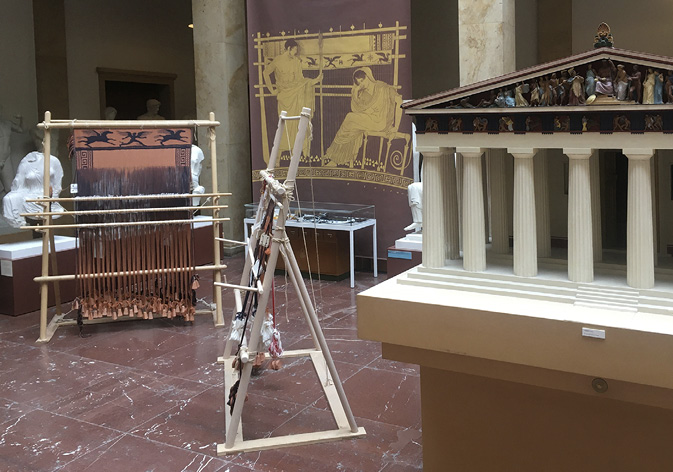
Fig. 1.1 Penelope laboratory with model of the Parthenon temple in the Museum for Casts of Classical Sculptures, Munich. Photo by Ellen Harlizius-Klück in 2019
The Panathenaia were the most important events in ancient Athens, publicly celebrating Athena as patron of the city-state by rhapsodic recitations of the Homeric epics, agonistic performances of music and dance, horse races and other athletic competitions in the guise of the Olympics. Compared to other festivals in Greece, the Panathenaics are famous for including women and even slaves,11 possibly because these were key to the preparation of the weaving of the peplos (a Greek fabric, usually to make a female dress) depicting the founding myth of the city: the battle of gods and giants. Crucially for our argument here (although not mentioned by Latour), the most important part of the festival was a huge procession carrying this peplos to the Parthenon, the temple of Athens, through streets crowded with visitors from all over Greece and representatives of other cities – so-called theôroi.
In the traditional practice of theoria, an individual (called the theoros) made a journey or pilgrimage abroad for the purpose of witnessing certain events and spectacles. In the Classical period, theoria took the form of pilgrimages to oracles and religious festivals. In many cases, the theoros was sent by his city as an official ambassador: this ‘civic’ theoros journeyed to an oracular center or festival, viewed the events and spectacles there, and returned home with an official eyewitness report (Nightingale 2004: 3).
It is on this notion of theôria that Plato builds his idea of theory as a vision of everlasting universal ideas. To him, the depiction of the gigantomachy on the peplos is a case of a philosophical theory, albeit a false one that is dragging down universal ideas of gods to the material ground of the giants clad in the myth of a battle and presented on a fabric.12 While the theôroi, as representatives, witness the truth of the woven story for the people in their home cities with their eyes and their physical presence, the theorists invented by Plato only trust everlasting universal ideas that need no body or material to exist.
The Panathenaic festival demonstrates that weaving indeed was once able to compose a common world; the peplos is the emblem of the unifying power of the festival. However, the purification of knowledge as science is already on its way when Plato rejects the woven peplos of the Panathenaic festival as a case of a ‘materialistic’ and thus false theory, one in which matter takes part in the genesis of political kosmos (or ‘order in the state’).
The peplos escapes the attention of Latour, the scientist. He goes back in time to Greece only as far as the point where the split of culture and technology is already at work, where weaving is either ignored or claimed to be man’s work, where numbers and geometry are about to be established as universal immutable mobiles, where the prevalence of idea over matter is already set on track. We contend, in fact, that the way Latour revisits Greece and starts the modernity project anew reinforces the very gestures that established the universality claim of Western metaphysics, the very same categories that blind us to women’s work and to alternative approaches to social and cosmic order.
Here is where we depart from Latour’s discursive diplomacy, and introduce – with the contributions of this book – a different thematic encounter of several representatives: our theôria of weaving. While a Latourian approach suggests that negotiations would do the job of ‘teaching the art of speaking well to one’s interlocutors about what they are doing – what they are going through, what they are – and what they care about’ (Latour 2013: 64), we contend that weaving knowledge resists such discursive negotiations by scholarly representatives. If we take weaving seriously in its material, social and technical specificity, these recourses turn out to be shortcuts that tend to exacerbate the problems they are trying to solve, thus perpetuating phantasies of universality and representation.
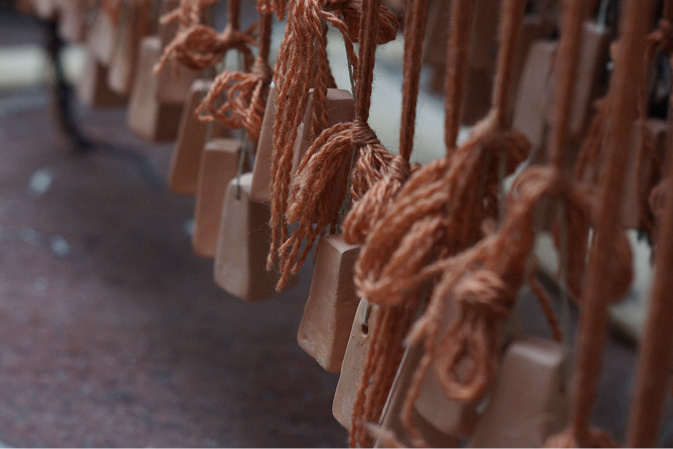
Fig. 1.2 Clay weights attached to the warp on the warp-weighted loom (photo by Viktoria Lubomski in 2019)
We further contend that weaving and its technological mode are obliterated not only in Latour’s image of the Panathenaic procession, but also in the standard descriptions of the advent of science in ancient Greece (for instance by Jean-Pierre Vernant, see chapter 2) as well as in the discussion establishing modern art theory (by Alois Riegl, see chapter 2). Indeed, we argue that these blind spots that ignore the composition principle of weaving (introduced here as histomorphism), have been and remain constitutive of the development and epistemological trajectory of science and the success of the hylemorphic description of making.
We also insist that it is not sufficient to claim symmetry for the actors involved (be they human or non-human). Arguably established as the most distinctive contribution of STS (representing all agents from their standpoint), symmetry, according to Latour, is imagined as a universal translatability principle for multiple moving frames of reference (Latour 1988). This principle seems to be at work where formulas and diagrams – immutable mobiles in the words of Latour – are employed for the purification and standardisation of practices. However, where Latour detects zigzags, detours and discontinuities – what he terms ‘shifting’ (2013: 228) or ‘technical folding’ (2013: 227; emphasis by Latour) – these cannot be straightforward descriptions of technology. Looking at the weaver and her/his loom as such a technical folding (see chapter 2) of symmetrical agents, Latour would suggest that it is the product that makes the man (and not the man that makes the product, as in Homo faber) and abandon the notion of mastery (2013: 230). However, we felt that such a practice would not allow but in fact deny a symmetric negotiation of scholars and master weavers where translatability does not exist per se, since the frames of reference are incommensurable.13
This implies, however, a specific difficulty in describing not only the mode of existence of/in weaving but also how it travels across domains. We would submit that it is not possible to capture this mode in diagrams and texts. Not that the weavers deliberately keep others from knowing, but that the knowledge is embedded in the network of threads, weaver and tool established when the weaver is working at the loom.
. . .
The book is the result of two encounters. First there was the project Penelope: A Study of Weaving as Technical Mode of Existence,14 conducted by the team of editors and supported by David Griffiths.15 In the Penelope project, we, Ellen Harlizius-Klück (philosopher and mathematician), Giovanni Fanfani (ancient philologist), Alex McLean (live coder) and Annapurna Mamidipudi (historian of technology and science, and handloom activist), aimed to set out the mode of weaving as it travelled across ancient Greece, emphasising its binary character and ordering concept, its atomistic and algorithmic features, its knowledge and artistic approach.
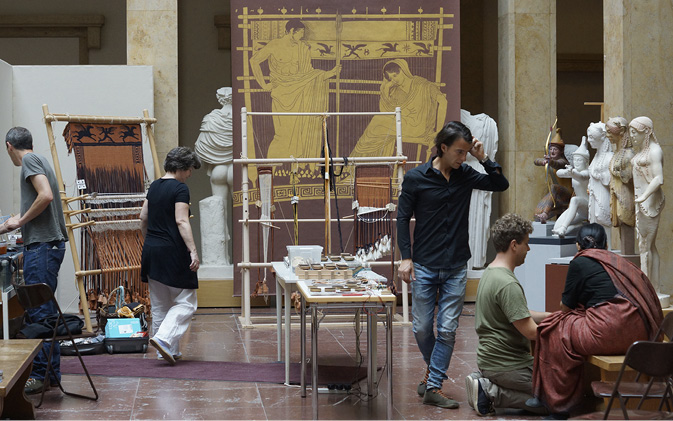
Fig. 1.3 Penelope laboratory, preparation for the Homo textor pre-conference workshop (photo by Viktoria Lubomski in 2019)
The second encounter was with the participants of a workshop/conference entitled Homo textor, who reflected and extended this mixture with their own works and projects. When conducting our research, we came across the works of scholars who stood out for their inspiring approaches to textiles, its role in history and in organising societies. These scholars were also involved in incorporating new technologies and approaches to formalise weaving techniques. We invited these scholars to our Penelope laboratory where we practically explored ancient weaving and developed digital tools to make the patterning and ordering processes accessible (figure 1.3). The encounter consisted not only of presentations in the laboratory but also of talks and small performances. By these means the scholars contributed their own diplomatic encounter on weaving and finally found their way into this book.
For the Homo textor encounter, we not only contravened Plato’s interdiction against presenting the battle of gods and giants16 (see figure 1.2) but also his warning to take weaving seriously: ‘No one in his right mind would ever consider weaving for its own sake’ (Statesman 285d). However, to consider weaving for its own sake is precisely what we asked of our contributing authors. We even asked them to try to be speculative about what would result for their fields of enquiry from such a serious look at weaving with regard to its theoretical potential. The idea was to see what happens when weaving, and textile processes and concepts are used as interpretative keys for geometric pottery design, classifications of codes, structures of poems, robot movements, dancing textile workers, patterns in nature, social and environmental organisation, the history of electronics and even mathematics.
The contributions form clusters and socialise around challenges of referencing terminology, technology, and form (part I), explorations of patterns as knowledge of order (part II), and stories about missing and seizing textile opportunities (Part III).
Part I: Challenges of referencing technology, terminology and form
In engaging with weaving technology as generative of concepts and notions, the five contributions forming the first thematic subsection of this volume take further issue with well-established paradigms of production and making: the superimposition of form upon matter (hylemorphism), the opposition of (extrinsic) structure and (intrinsic) substance, and the search for exact correspondences between terms and objects. To these models of exploring, grasping, and interpreting processes of creation, weaving poses a radical challenge.
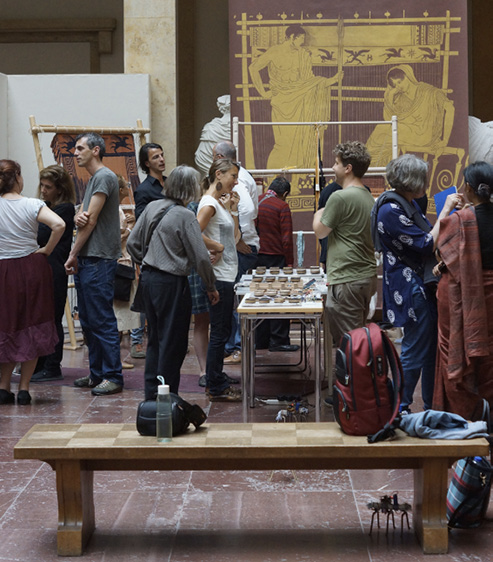
Fig. 1.4 Pre-conference workshop in the Penelope laboratory at the Museum for Casts of Classical Sculptures, Munich (photo by Viktoria Lubomski in 2019).
In the chapter following this introduction, Ellen Harlizius-Klück provides a detailed account of the scope and structure of ‘The Technical Mode of Existence of Weaving’ whose core term is introduced as histomorphism. The paper demonstrates that most of the misunderstandings about weaving stem from the problem of preferring hylemorphic explanations. This hylemorphic bias perpetuates through history and across disciplines an idealistic view of making that does not account for material and technical details and bodily and social embeddedness. The term ‘histomorphism’ (from Gr. histos, for loom or fabric and morphê, form) prevents several category errors resulting from such idealistic explanations and provides the necessary knowledge to understand how (ancient) weaving creates order. By shedding light on a misrepresentation of pattern weaving in art theory as based on geometry, Harlizius-Klück clarifies what histomorphism through weaving practice means, and how it proceeds from threads to society and the cosmos in ancient times. By doing this, she situates weaving in ancient Greece as a technê capable of integrating culture and technology, thus providing a paradigm of pattern-generation that goes beyond the hylemorphic model in the sense that it is able to prevent the difficulties and paradoxes of the categories of objective knowledge and material practices. Histomorphism can indeed serve as a counter-model to the matter-form and technology-culture dualisms.
In chapter three ‘Merge, Weave, House, Trap: First Steps Towards a Reverse Palaeoanthropology of Identity Concepts’, Julian Rohrhuber ponders the hylemorphic paradigm at work in the very different epistemic environment of contemporary programming and computer science, through the opposition of substance (essence/matter) and structure (form), which is addressed and questioned. The chapter explores weaving and merging as means to shape concepts of identity in the field of computer programming, and as intuitions rooted in ‘primitive’ material practices. Rohrhuber argues that taking such intuitions seriously sheds light on the concepts themselves. Both merging and weaving exhibit a specific explanatory power for making sense of the idea of ‘identity’; in merging, the different elements may still be distinguishable at times, but the concept of identity resulting from it is strongly characterised as intrinsic. Identifying something as the result of weaving, on the other hand, means situating its identity extrinsically as a mode of interaction. As Rohrhuber makes explicit, the nature of the reference to weaving is not metaphorical but functional: the explanatory power of weaving rests on the specific structure of the technology, and it is the interaction of elements that gives these their identity – like in the histomorphism of pattern weaving (see chapter 2).
However, the distinction drawn between intrinsic merge and extrinsic weave, which seems to be a subdivision of (intrinsic) substance and (extrinsic) structure/form, proves to be less stable than expected. Rohrhuber refines the opposition by adding reversibility (winkingly pointing to Penelope’s unweaving) and irreversibility, which he introduces as dimensions of contingency and which complicate the initial picture by enabling new associations (the reversibly intrinsic and the irreversibly extrinsic) and new categories (housing and trapping).
While Rohrhuber thus proposes a reverse palaeoanthropology of concepts, the fourth chapter goes back to the epistemic landscape of ancient Greece and seeks to lay ground for an archaeology of notions of order rooted in weaving technology. Insecurity in reference and the identification of objects and words is characteristic of a (Classical) philology that cannot approach ancient terms as if they were immediately comprehensible. In ‘Lost in Lexicography? Kaîros as Concept of Order’, Giovanni Fanfani proposes an alternative approach to the ‘word excavation’ model of much scholarship in textile terminology that aims at matching words to objects or functions. The chapter explores the possibility of grasping notions of order (as core to ancient weaving terms) in two sets of textual material. On the one hand, the notion of ‘order at the loom’ is investigated through Greek lexicographers’ accounts of the elusive word kaîros, a terminus technicus of weaving technology which ancient lexica and scholia unambiguously connect to a particular operation at the warp-weighted loom. That operation, namely distributing the warp threads in front and behind the shed bar, guarantees the ordered configuration of warp threads which enables weaving. On the other hand, the notion of ‘order from the loom’ emerges from the way in which the Archaic Greek abstract term kairós, an all-important concept of balance, appropriateness, and symmetry in Archaic thought, may have derived part of its semantic range from the weaving term kaîros. Fanfani proposes an integrated notion of kairos as order: a particular configuration of space and time at the loom which permits the insertion of the weft into the warp.
A lost play by Sophocles tells the disturbing myth of Philomela, Procne, and her husband Tereus where Philomela secretly communicates to her sister Procne that Tereus raped her – by sending a fabric she has woven. Many of the details of the story are lost to us, but Aristotle in his Poetics refers to this fabric as a plot device of the play, addressing it in a recognition scene as the ‘voice of the shuttle’.
Anthony Tuck is searching for this voice in his paper ‘Woven Witness: Philomela, Procne and Visualised Narratives through Textiles’. Following a serendipitous encounter with weavers singing in India and encoding pattern information into songs, Tuck investigates the nature of such encoding. Does it refer to a communication which is pictorial (a scene woven into a fabric), symbolic, or a text written in threads? Or does it refer to a weaving pattern that relates to a specific song – a secret language between women?
A technological tradition of committing pattern-related information to memory and performing it as/in songs seems to have been widespread in the Indo-European linguistic environment, as passages from the Vedas attest to the connection between weaving and song. Together with Cole Reilly, Cinzia Presti and Joseph Capozzi, Tuck tries to verify the intriguing hypothesis that a reconstruction of the metrical structure of a rhapsodic performance – reflected in the patterns of alternating long and short syllables in each dactylic hexameter – may provide a graphic rendering of metrical sequences exposing the visual appearance of woven patterns. Entertaining the further hypothesis that the patterns of long and short might have communicated pattern-related information to weavers, Tuck and his team have developed an algorithm capable of generating patterns and displaying them as images where each pixel has a ‘colour’ or grey tone corresponding to the duration (long or short) of each syllable in the sequence of the dactylic hexameters of the Homeric poems. With the experiment allowing for different standardisation of the many combinations with which the Homeric hexameter occur, some of the visual results shown in the chapter’s images exhibit a striking resemblance to textile patterns, especially the checkerboard-like designs depicted on funerary ceramic vessels from the Geometric and Archaic period of Greek art.
As this discussion of metrical patterns by Anthony Tuck and his team can demonstrate, an especially rewarding way to approach weaving as an integrated technology is to start from the woven pattern and the structural zigzag composing it. However, in his paper ‘The Textile Expression Gap’, Lars Hallnäs reminds us that it is not so clear how textiles are defined, nor what the definition and the textile can express. Some years ago, Hallnäs introduced ‘Slow Technology’ as a turn in the technology perspective. It is ‘a search for mastering a technology as means of expressions, as means of expressing’ (Hallnäs 2015: 32). Here, if ‘“function”’ refers to what a thing does as we use it, “expression” then refers to what the thing displays as we use it’ (Hallnäs 2015: 33). The paradox of a textile definition, a pattern formula, is that this expression is invariant under those transformations, while the textile expression itself is not invariant under transformations of use. Hallnäs proposes a ‘near field reading of a textile’, referring to an algebraic structure which is applied in the study of geometries. Textiles can then open up a space for definition by use in a very specific manner. While the expression of a formula is by nature abstract, in the case of yarn, material becomes a means of expression. Thus, textile is a theory, a definition, a formula, where its quality of being exact is expressed in the way in which the yarn ‘in its places’ displays the textile formula, as ‘Slow Technology’.
Part II: Explorations of patterns as knowledge of order
The papers following in part II look at what weavers do and know, and how this knowledge travels to other types of objects and beings as well as their relation to each other, the world in which they live, and how it is ordered. The phenomenology of pattern migration sets the first two contributions in dialogue with chapter 2 on the technical mode of existence of weaving, where Harlizius-Klück tackles the complexity of the relations between weaving technology and the visual representation of textile patterns. This relation is now addressed in different contexts. For investigations into ancient, and even prehistoric weaving, where the lack of material textile remains is compensated by the pervasiveness of textile patterns on pottery in Neolithic art, such pottery can be seen as potential evidence of a consistent practice of craft exchange and of pre-mathematical awareness that indeed has its origin in the woven pattern ‘migrating’ across different domains and media, and displaying modes of ordering and knowing. The same can be shown for a particular Greek term, namely poikilia, a notion that mediates between order in nature and in the craft of weaving. The reader will finally be drawn into the textile concepts of ordering economic, social and ecological routines in India and the Andean region, which demonstrate that the extension of textile concepts across nature and the cosmos is not specific to ancient Greece.
In the first contribution of Part II, ‘Modular Patterns: A Survey on the Textile Origin of Neolithic Design and Its Calculational Implications’, Kalliope Sarri takes us back to prehistory and offers a detailed account of the emergence and development of geometrical design in pottery as possibly inspired by textile patterns. The central hypothesis of the contribution makes a case for craft transfer – the manipulation and transference of patterns from the three-dimensional reality of textiles to the two-dimensional surface of pottery – and argues for the influence of weaving technology in other artistic and technological media. Due to the way in which symmetry is embedded in woven patterns, and the level of calculational skills required in weaving geometrical motifs, Sarri draws a connection to the operations of counting and manipulating numbers done at the abacus, as well as a three-dimensional binary system featuring a horizontal and a (virtual) vertical axis. The hypothesis animating the chapter proposes a cognitive environment in prehistory where it is possible to detect a connection between a) weaving and the generation of geometrical pattern, b) early forms of mathematical reasoning, and c) the visual outcome of that connection as displayed in visual design in media like pottery. Sarri argues that Neolithic weavers were able to create the geometrical patterns and symmetrical coloured shapes seen in their pottery because of the counting implied in weaving. She further contends that, through this experience, they developed their awareness and knowledge of geometric shapes.
Drawing partly on her own ground-breaking investigation of the ancient Greek notion of poikilia, Adeline Grand-Clément makes a robust case for establishing a connection between instances of poikilia in nature (namely, in the skin and plumage of two particular animals) and woven patterns in her contribution ‘Poikilia: Geometry and Living Patterns in the Greek Archaic and Classical Mind’. While Harlizius-Klück’s contribution introduced the Greek term poikilos with reference to order in textile patterns, Grand-Clément takes a deeper look at occurrences that somehow blur the divide between the natural and the crafted world. The two cases discussed as instantiations of poikilia are the iunx (wryneck) and the snake, both described as being poikilos in literary sources. Such poikilia, which is primarily referring to the pattern on the plumage and skin of the two animals, is associated with further features which the wryneck and the snake share: the length of the tongue, the mobility of the neck and the sound they emit. By drawing on the characterisation of poikilia as mêtis (uncanny and deceptive intelligence), a trait that in animals such as the iunx and the snake seems to be transferred from their physical poikilos appearance to their behaviour, Grand-Clément explores the nature of the common ground that such poikilia shares with patterned textiles, as well as the role of geometrical patterns in the connection. When such features of poikilia are in turn transferred, via geometrical patterns on fabric, to depictions of humans, we find associations with Oriental/barbarian characters (who in Archaic Greek literature are connected to luxury, splendour and delicacy) as conveying the same traits of ‘otherness’ and hybridity as the snake.
Annapurna Mamidipudi takes ordering, coding and reading seriously in the context of textile production by hand weaving in India in her contribution ‘Epistemic, Social and Material Ordering through Weaving Threads’. To do this, she uses the zigzag movement that always needs at least three nodes: loom – body – concept (for epistemic ordering) or livelihood – community – ecology (for social ordering). Ordering space and time is the work of modern science, but for weavers in India, time and space is ordered through their practices of weaving. Mamidipudi shows how weavers understand time through the example of the dyer nurturing the Indigo vat as one would nurture a child: not just caring for it, but also feeding and stimulating it regularly in order to keep it healthy. Memories are archived in products, like the nine-time dipped Indigo fabric, or into bodies that draw from the past to produce patterns for the future. Bodies are needed to smell colour, to sing the song of the shuttle and to form relationships that make weaving a mode of existence. Like Penelope weaving and unweaving at her loom, the Indian weavers, in keeping their techniques honed, seem to halt time and refuse progress.
Finally, in an event like the weaver festival in Chirala in India in 2018, representatives of different kinds of knowledge met over their looms, and for the festival’s duration suspended the hylemorphic shadow that puts weavers into categories of labourers or design implementers, and cast their looms as primitive technology. At the festival, where veridiction of the weavers’ knowledge was suddenly graspable because weaving was known to all the participants – exactly like in ancient Greece where everyone could witness the woven battle of Giants and Gods in the Panathenaic festival – weaving knowledge suddenly emerged into existence. Not through the single mirror of universal science, but as a reflection from the multiple perspectives of scholars, coders, designers, sellers, consumers and most importantly, the weavers themselves.
Likewise, for the Andean weaver, according to Denise Arnold, weaving creates a regional sense of identity through the expression of common technical values, cultural symbols and ideas. In her ‘Comparative Reflections on Andean Weaving as Science’, Arnold demonstrates how the threads carry information – as do textiles themselves: the relation between arrangements of threads visually expressing relations between entities in the real world – such as planning and predicting quantities of possible cultigen yields. Weaving becomes a vibrant interface for documenting and disseminating cultural ideas and symbols that express these living processes. The textile is a bodily outcome that carries the record of social, technical, financial and ecological decisions made in a society, disciplined into material order through weaving, passing knowledge from one body to the other, on ordering tasks, on cultivating fields and creating social hierarchies. Yet weaving is knowledge as a means – to a sustainable livelihood, to an interconnected web of practice or a simply to ensuring continuity of life.
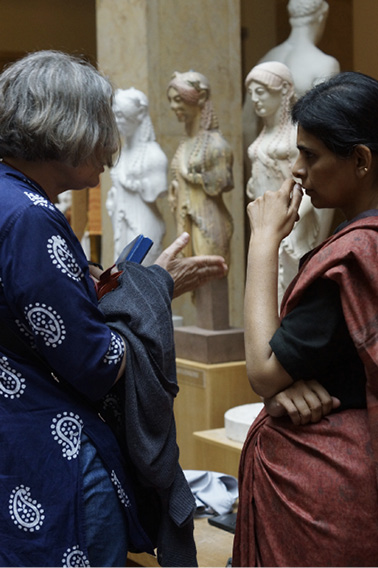
Fig. 1.5 Denise Y. Arnold and Annapurna Mamidipudi discussing in the Penelope laboratory (photo by Viktoria Lubomski in 2019)
Part III: On missing and seizing textile opportunities
The contributions in this third part bring together chapters demonstrating that not only the textile object as outcome of a textile production process, but also the production process itself (with its social relations and movements), when considered seriously, can open new perspectives not only in art, but also in coding and developing new technologies. The chapter authors provoke alternative views on the role of textiles in the history of electronics and machines, respectively.
In ‘The String: Rewiring Women and Electronics’, Ebru Kurbak reveals the relationship between textiles and electronics, with a focus on string-as-technology, mapping out the politics of an unrealised past and, in so doing, suggesting a potential textile future for electronics if the gender gap is further overcome.17 Kurbak focuses on the demonstrable interchangeability between wire and threads. Yet she does not advance a simplistic hypothesis that would posit women as moving from ignorance into technological skill. Neither does she see weavers as supported by the efforts of feminists who use textile work as the type of a gendered activity that establishes woman weavers as metaphors for oppressed and home-bound women (like the usual reading of Penelope). For Kurbak, it is the string itself that presents the opportunity to make the ‘strangely familiar’ relation between an electrical circuit and a skein of yarn. She proposes that the textile threads and electronic wires that are materially compatible are rendered incompatible through social processes. Gender stereotyping hinders interactions, while crossovers occur due to the archetypical nature of string. Thus, she argues, today with the lifting of these segregating forces, we see current inventions that seem futuristic, but are in fact manifestations of unrealised pasts and lost possibilities.
The second contribution in this part, ‘Algorithmic Patterns on the Live Loom’ by Alex McLean, takes an auto-ethnographic approach to comparing weaving with computer programming by connecting them into a single, live and embodied system. The usual approach of representing weaving is by code (or formula, as presented by Hallnäs in chapter 6). Here one may invent new ways to weave or construct fabrics by exploring the code’s possibilities (which are claimed to be bigger than the factual possibilities that weavers are able to explore). Instead, one could claim that coding falls short in aspects that weavers do not like to miss, and that addressing this shortfall could enhance our understanding of code’s relation to thinking. This possibility was explored by Alex McLean throughout the Penelope project, where he developed a language for coding weave-structures on a small rapid prototype of a warp-weighted loom (figure 1.6) for exploring the code and understanding its relation to the resulting weave.18 Instead of following a pre-designed draft, as is usual with computer-controlled looms, this system allows the weaver to compose the pattern as part of the process of weaving it. The reflections on his practical explorations allow McLean to consider algorithmic patterns and metrics that operate in music as well as weaving, and conclude that notation is no necessary requirement for making and thinking about such algorithmic patterns.
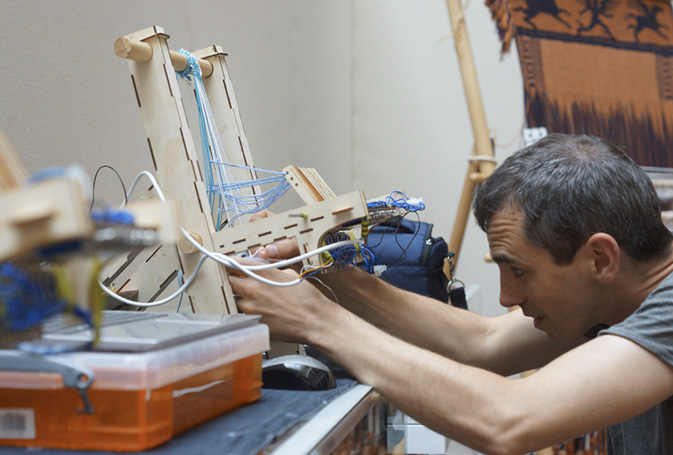
Fig. 1.6 Alex McLean preparing the Live Loom for presentation (photo by Viktoria Lubomski in 2019)
As a result, McLean is able to introduce algorithmic pattern weaving as one of the missed opportunities that Kurbak points to.
Radcliffe’s contribution, ‘Embodying Patterns of Textile Machinery: A Dialogue’ builds a bridge between historical and contemporary technological practices, albeit in the history of Lancashire textile mills during the Industrial Revolution. During the conference discussion, Radcliffe asserted that clog dancing was the ‘hip-hop of the nineteenth century’ – an incredibly popular working-class dance movement. In a close collaboration with composer and arts technologist Sarah Angliss, she has been staging a particular dance included in a video installation, The Machinery, which mimics both the movements and sounds of textile machines. In the form of a dialogue with Alex McLean, her contribution brings out the political aspects of labour and creativity that resonate through this piece of performance art.
In Radcliffe’s view, it is not the domesticated woman weavers at home who are oppressed, but the artisan weavers forced into alienated factory work. Yet those factory workers responded to the repetitive noise of the industrial machines by composing clog dancing steps that humanised the machinic patterns. Relating this to the experience of call-centre workers, and home-workers during the COVID19 pandemic, Radcliffe speculates that the clog dancers prove that capitalism can be challenged, and that the human spirit can overcome adversity through creativity. Today the clog dance survives as a codified pattern of the body, as McLean suggests as patterns that are associatively digital.
In the absence of the original context of clog dancing choreography, Radcliffe wonders whether coding the steps into another register would allow the dancer to work with the structure in a new way. Here notation would not be used to stabilise the pattern into stasis, but to create new patterns that operate on another register. This is important for both McLean and Radcliffe, because whether coding algorithms or working in a mill, it is important to realise when the machine has power over you, and when you have power over the machine – when you can challenge the machine through your creative practice.
The last two contributions take the conversation from weaving to the related techniques of braiding. Victoria Mitchell’s piece, ‘Braiding and Dancing: Embodied Rhythm and the Matter of Pattern’ brings together research from anthropology, robotics, textile history, archeology and cognition to explore braidings and the bodily movements which make them. She investigates the successive crisscrossing of braiding and dancing, from the hands dancing when braiding to the synchronised motions of the dancing body, as a basis for social interaction and the formative patterns of thought. The contribution tackles a basic question regarding reciprocity between the manipulation of materials, synchronised dance motions and social interaction, connecting physical acts of braiding or dancing to cognitive systems of relational interaction. Mitchell explores how this works across biological organisms and robots, when the body is not always conscious of what it knows.
Contending that technique is the preserve of collectives as well as individual bodies, Mitchell suggests that braiding’s sequential reciprocity has an ordering propensity in respect of perception, conception and cognition. Thus, the finished basket or braid becomes an extension of this ordering, carrying the memory of its coming into being. Bodily movements are involved in braiding and dancing, particularly in the case of maypole dancing, where people interact with one another, sharing the stimulus of rhythmic music, negotiating the pattern of the dance. Each moving body is a strand, and the strands are braided together, even as relationships between the dancing partners are made, braiding social coherence. Here again is the performance of social ordering through dancing bodies, like the choral dancing of ancient Greece. Rather than take social braiding as a metaphor, Mitchell shows how braiding lends itself to extension, being carried by the body’s actions across and between phenomena of making products, dancing patterns or negotiating social interactions.
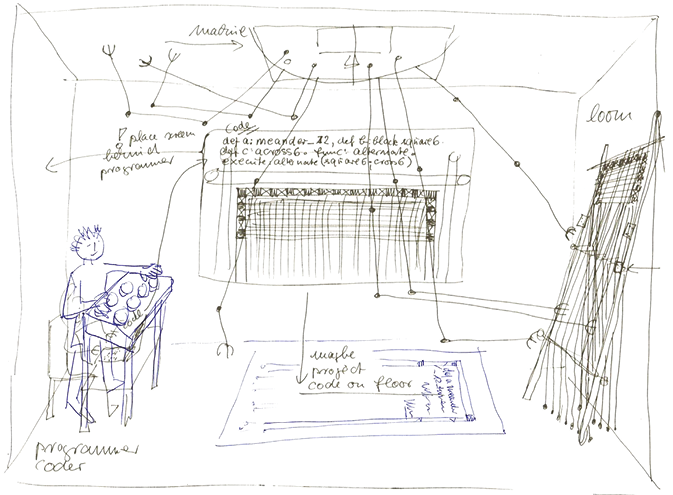
Fig. 1.7 Sketch of live coded warp-weighted loom that guided the Penelope project as a vision (drawing by Ellen Harlizius-Klück)
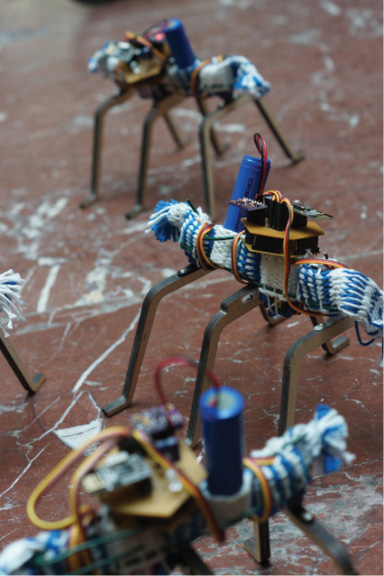
Fig. 1.8 Penelopean robots populating the stone floor of the Museum for Casts of Classical Sculptures, Munich (photo by Viktoria Lubomski in 2019)
David Griffiths also picks up on braid dancing in his contribution ‘Untangling knowledge work by maypole weaving with a Penelopean robot swarm’. His robots are one answer to the vision of a final Penelope project performance (figure 1.7), featuring a demonstration of the weaving process split up into the warp-weighted loom, a live-coding weaver and an arachnoid robot operating the loom according to the code that is also made visible to the public by being projected onto the wall or floor.
In Griffiths’ approach, our vision found a new form with the robots as choral dancers, with live coded music in time with Homeric recitation.19 Griffiths takes a trajectory similar to McLean by employing a critical engineering method to reconsider contemporary technology from the perspective of ancient technology. As part of a performance in the Penelope laboratory presenting the idea of ancient dancers ‘braiding’ ribbons stretched from an upright shaft, Griffiths introduced robots to dance around a maypole (figure 1.8). In order to throw light on the human hand in robot technology, the robots themselves are made by tablet-weaving, exposing and exploiting the algorithms underlying such textile craft. Furthermore, the robotic dancers themselves are only able to complete something like a braid with human help, demonstrating how entangled we are with technology, and indeed, always have been (figure 1.9).
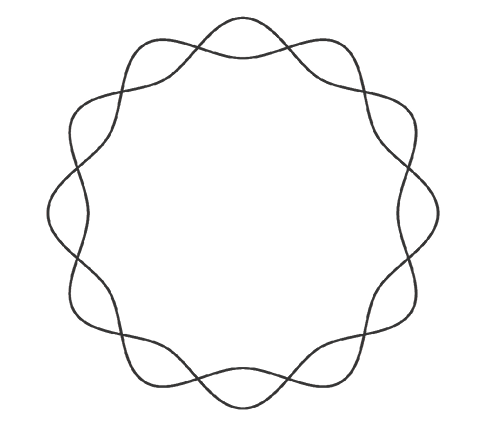
Fig. 1.9 Track for 12 pairs of maypole dancers (graphics by Viktoria Lubomski in 2020)
. . .
The maypole dancing robots close the circle of the contributions by questioning our understanding of the social and the technical, or the cultural and the technological, as disparate fields. Indeed, the chapters evidence the scope of the (technical) mode of existence of weaving not only with their content, but also in the way they correspond with each other across borders of scientific disciplines. They iterate the story of Penelope, the zigzagging path of the shuttle in weaving as well as unweaving, and thus the technical mode of existence of weaving.
While Latour and Simondon both argue that our times are not able to integrate technology and culture, in Archaic Greek thought – with categories such as nature, culture and technology not yet shaped – weaving not only encompassed all of them, but also provided a pervasive model for the generation, implementation and projection of order in several domains: in craft, in nature, in poetry, dance, the community and even the cosmos. While providing us with a mode of knowledge integrating a series of dichotomies (culture vs nature, human vs non-human) and preceding the split between pure and applied science introduced by Plato and perpetuated by Aristotle, weaving not only in its Archaic Greek incarnation but also as a craft still processed by hand all over the world presents a technical mode of existence that is not yet distorted by loom developments that speed up the production process at the cost of reducing the possibilities of fabric and pattern composition for the weaver. This is why Penelope is our paradigmatic weaver – not only for representing ancient weaving itself, but also its paradoxes. Against the trajectory of technological development, the most primitive looms may yield the most complex fabrics; despite its seemingly geometrical construction, weaving is not well suited for geometric design, but based on arithmetic and properties of numbers; from the beginning it is a digital/binary art and analogue at the same time, discrete (up and down of warp/weft) and continuous (the linear thread) in one and the same object. Ancient weaving and the way it operates as a model of order in archaic communities furthermore enables us to understand similar types of order bound up with non-Western textile technologies.
By explicating weaving as a technique/culture/art, a technê, that – from outside the typical Western trajectory of technology20 – is able to provide order concepts travelling across domains, and eventually even establishing cosmologies (see chapters 2, 4, 8, 9, and 10), this book breaks down the phantasies of immutable mobiles that reign within technocratic narratives of science and technology, and questions the idea that STS researchers may speak for others without being acquainted with their situated practices.
The book reflects the weaving together of the disciplines in our project as well as in the Homo Textor conference. Moreover, it does so, not as a graph of intersections meeting at a crossing in a cartesian grid, like in the AIME project, but as a non-directional infinite dance of pairs socialising in space and time without being localised at a definite point. Sometimes the chapters correspond historically, sometimes technically, sometimes culturally in a way that reveals something about weaving that remains invisible if presented according to disciplines or chronology.
Woven together, the chapters present interventions in a very Western understanding of technology and its terms and principles, including the assumption that technological logic should be universal and that it travels effortlessly and without loss along chains of translation. Such effortless travel or transformation of modes across domains, graspable and mobilisable by sociologists of science in speaking for others that cannot or do not speak for themselves, is a phantasy we do not subscribe to. Instead, we stay with the material, the processes, the concrete circumstances and the material history of the object or technology in question. As this will not lead to a purified description of weaving, we beg the reader to accept this impurity as a necessary condition to do justice to the various modes of weaving. Although we point to the epistemological value of weaving by addressing the blind spots in scholarly discussion that have been constitutive for science since Plato and Aristotle, we know that we cannot get rid of them by integrating them in a discursive way. Our book instead shows that the weaving mode transgresses boundaries of disciplines, that the idea of immutable mobiles like geometry or diagrams fails (they may stabilise production but they do not stabilise the knowledge of the weaver that needs to be mobile to be productive), that recipes cannot be given, categories fail, and terminology remains unstable.
Endnotes
1 Penelope and Odysseus are the main characters of the epos Odyssey by the poet Homer (8th century BCE) written down at the turn of the eighth and seventh centuries BCE. When Odysseus did not return from the Trojan war, a crowd of young men gathered in his home in Ithaka and tried to persuade Penelope to marry again. Laertes, for whom Penelope weaves a shroud, is Odysseus father.
2 Homer, Odyssey, 2.85–105. Translation by Augustus Murray from http://data.perseus.org/citations/urn:cts:greekLit:tlg0012.tlg002.perseus-eng1:2.84–128. Murray’s translation for the Loeb Classical Library was published in 1919 and presents an antiquated language style. However, his translation of this passage shows Penelope as a person of knowledge, craft and wit – not as a housewife doing needlework – which is our reason for choosing his seemingly outdated translation.
3 For the important role of textiles in establishing such networks, see Wagner-Hasel 2020; Weiner 1992.
4 Wagner-Hasel explains that geras has ‘both a material and an intangible meaning. On the one hand, geras denotes the concrete privileges of a high-status leader, a woman skilled in weaving, and a portion at the feast, which give visible expression to his status. On the other hand, geras can be understood as the ability to store or memorise social norms and knowledge and to use these stores of wisdom in counsel and decision-making.’ Wagner-Hasel 2020: 244; see also chapter 4.3, 232–45.
5 According to François Sigaut, the concept of Homo faber arose from discussions, debates, and protest against the exclusion of technology from culture and education, and was introduced by Henri Bergson to claim that technique is an integral part of human nature (Bergson 1959: 88; Sigaut 2018: 18). In anthropology it is employed to distinguish modern man as active changer of his environment from his forerunners who produced for necessity and ceased work when their needs were fulfilled.
6 See http://modesofexistence.org/, last accessed 8 February 2024.
7 In this contribution, we use the spelling ‘hylemorphic’. English publications usually refer to this concept as hylomorphism; however, both spellings are possible. See Manning 2012: 1, note 2.
8 Ingold on the art of inquiry: 2013: 6–8.
9 See http://modesofexistence.org/, last accessed 8 February 2024.
10 Latour speaks of his ‘odd dream of doing for contemporary collectives what had been done – on the Elgin marbles – for the Panathenaic festival’ (Latour 2010: 607).
11 ‘The Great Panathenaia, held every four years, is generally taken to be Athens’ attempt to rival panhellenic festivals such as the Olympic games. In this festival, the procession included not only male Athenian citizens, but also Athenian maidens and priestesses, metics (male and female), freed slaves and non-Greeks living in Attica.’ Nightingale 2004: 55. The time of the founding of the celebration is unknown. An earlier rite, known as the Arrhephoria, where young girls prepared the beginning of the weave of the peplos, had been introduced already in the twelfth century BCE (Burkert 2001: 38). Peisistratos formalised the Panathenaic festival in 566 BCE. The Elgin Marbles from the Parthenon, to which Latour refers for his vision, were created under the reign of Perikles and probably erected around 433 BCE.
12 ‘And indeed, there seems to be a battle like that of the gods and the giants going on among them, because of their disagreement about existence. … Some of them drag down everything from heaven and the invisible to earth, actually grasping rocks and trees with their hands; for they lay their hands on all such things and maintain stoutly that that alone exists which can be touched and handled; for they define existence and body, or matter, as identical, and if anyone says that anything else, which has no body, exists, they despise him utterly, and will not listen to any other theory than their own.’ Plato, Sophist 246b–c after Plato in Twelve Volumes, Vol. 12 translated by Harold N. Fowler (Cambridge, MA, Harvard University Press; London, William Heinemann Ltd. 1921).
13 Ganaele Langlois, in a recent book on textile as medium of communication, speaks of ‘incommensurable worlds and modes of being’ (Langlois 2024: 154; see also 61, 118).
14 The Penelope project has received funding from the European Commission under the Horizon 2020 Research and Development Programme (Grant Agreement No 682711).
15 Dave provided digital tools and support for the experimental parts of our project with his company FoAM Kernow, later turned into ThenTryThis, see https://thentrythis.org/.
16 The Penelope laboratory was placed right next to the Parthenon Model showing the battle on its east side. The famous model was made around 1888 in Paris by Adolphe Jolly and Charles Chipiez and is now in the Museum for Casts of Classical Sculptures in Munich. It also shows the Elgin Marbles with the procession admired by Latour, and the dedication of the peplos right above the entrance to the temple.
17 This potential can be seen clearly in Kurbak’s own work, for example within her Stitching Worlds project (see Kurbak 2018).
18 In the Penelope project, we call it a prototype, because some important features of the warp-weighted loom are missing, namely the starting and framing borders that pre-organise the pattern possibilities.
19 See https://zenodo.org/records/3246038, accessed 8 February 2024.
20 The warp-weighted loom that Penelope and her time employed for weaving fabrics is hardly ever mentioned in histories of textile technology. And the cases where it is mentioned reveal specific misunderstandings caused by modern categories of labour, market and the idea of gaining time by technological progress. We thus contend that ancient weaving on the warp-weighted loom is as alien to the common understanding of technology as traditional weaving in, for instance, South-America, Laos or Ladakh.
References
Bergson, H., L’évolution créatrice (Paris: Les presses universitaires de France, 1959).
Burkert, W., ‘The Legend of Kekrop’s Daughters and the Arrhephoria: From Initiation Ritual to Panathenaic Festival’, in W. Burkert, Savage Energies: Lessons of Myth and Ritual in Ancient Greece (Chicago: University of Chicago Press, 2001), 37–63, 38.
Hallnäs, L., ‘On the Philosophy of Slow Technology’, Acta Univ. Sapientiae, Social Analysis, 5.1(2015): 29–39.
Ingold, T., The Perception of the Environment: Essays in Livelihood, Dwelling and Skill (London and New York: Routledge, 2000).
Ingold, T., ‘The Textility of Making’, Cambridge Journal of Economics, 34 (2010): 91–102. doi:10.1093/cje/bep042.
Ingold, T., Making: Anthropology, Archaeology, Art and Architecture (London and New York: Routledge, 2013).
Kurbak, E., ed., Stitching Worlds: Exploring Textiles and Electronics (Berlin: Revolver Publishing, 2018).
Langlois, G., How Textile Communicates: From Codes to Cosmotechnics (London: Bloomsbury, 2024.
Latour, B., ‘Reflections on Etienne Souriau’s Les différents modes d’existence’, in G. Harman, L. Bryant and N. Srnicek, eds, The Speculative Turn: Continental Materialism and Realism, (re.press 2011) 304–33. https://hal-sciencespo.archives-ouvertes.fr/hal-01054002.
Latour, B., ‘Coming out as a Philosopher’, Social Studies of Science 40.4 (2010): 599–608, https://www.jstor.org/stable/25746348, accessed 10 October 2022.
Latour, B., An Inquiry into Modes of Existence: An Anthropology of the Moderns (Cambridge: Harvard University Press, 2013).
Latour, B., ‘Drawing Things Together’, in M. Lynch and S. Woolgar, eds, Representation in Scientific Practice (Cambridge and London: MIT Press, 1990), pp. 19–68.
Latour, B., ‘The Netz-Works of Greek Deductions’, Social Studies of Science 38.3 (2008): 441–59.
Manning, G., ‘Three Biased Reminders about Hylomorphism in Early Modern Science and Philosophy’, in G. Manning, ed., Matter and Form in Early Modern Sciences and Philosophy (Leiden: Brill 2012), pp. 1–32).
Murray, A. T., Homer: Odyssey, London: Loeb Classical Library, 1919.
Sigaut, F., ‘Die Homo faber-Kontroverse’ Zeitschrift für Kulturwissenschaften 2 (2018): 17–33.
Nightingale, A. W., Spectacles of Truth in Classical Greek Philosophy: Theoria in its Cultural Context (Cambridge: Cambridge University Press, 2004).
Simondon, G., On the Mode of Existence of Technical Objects (Minneapolis: Univocal, 2017).
Souriau, É., Les différents modes d’existence (Paris: PUF, 1943).
Souriau, É., The Different Modes of Existence (Minneapolis: Univocal Publishing LLC, 2015).
Wagner-Hasel, B., The Fabric of Gifts: Culture and Politics of Giving and Exchange in Archaic Greece (Lincoln, Nebraska: Zea Books, 2020).
Weiner, A. B., and Schneider, J., Cloth and Human Experience (Washington: Smithsonian Books, 1989).
Weiner, A. B., Inalienable Possessions: The Paradox of Keeping-While-Giving (Berkeley: University of California Press, 1992).