This year’s EASST/4S conference, hosted by Vrije Universiteit (VU) Amsterdam, was a life affirming moment for Mattering Press, even as we recognise what a rare privilege the event afforded us, something we will come back to.
Gathering and celebrating
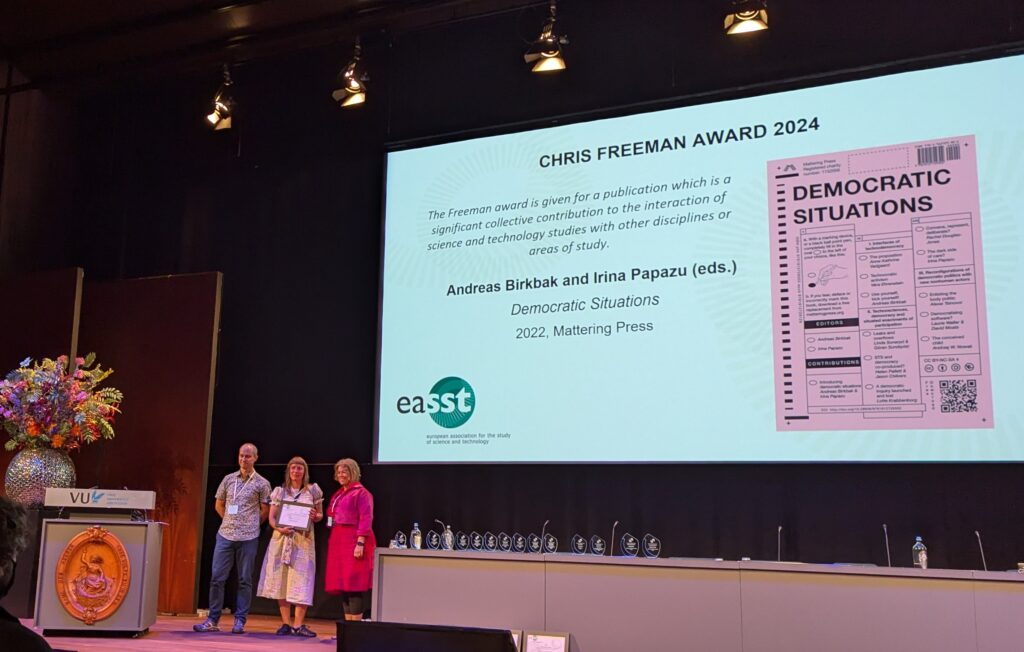
First and foremost, we were very pleased to be present to witness Irina Papazu collect the 2024 Chris Freeman Award for Democratic Situations, which Irina edited jointly with Andreas Birkback. It felt like an incredibly important moment for the press, to see our work being institutionally legitimated in such a public way. Many congratulations to Irina, Andreas and all the book’s authors.
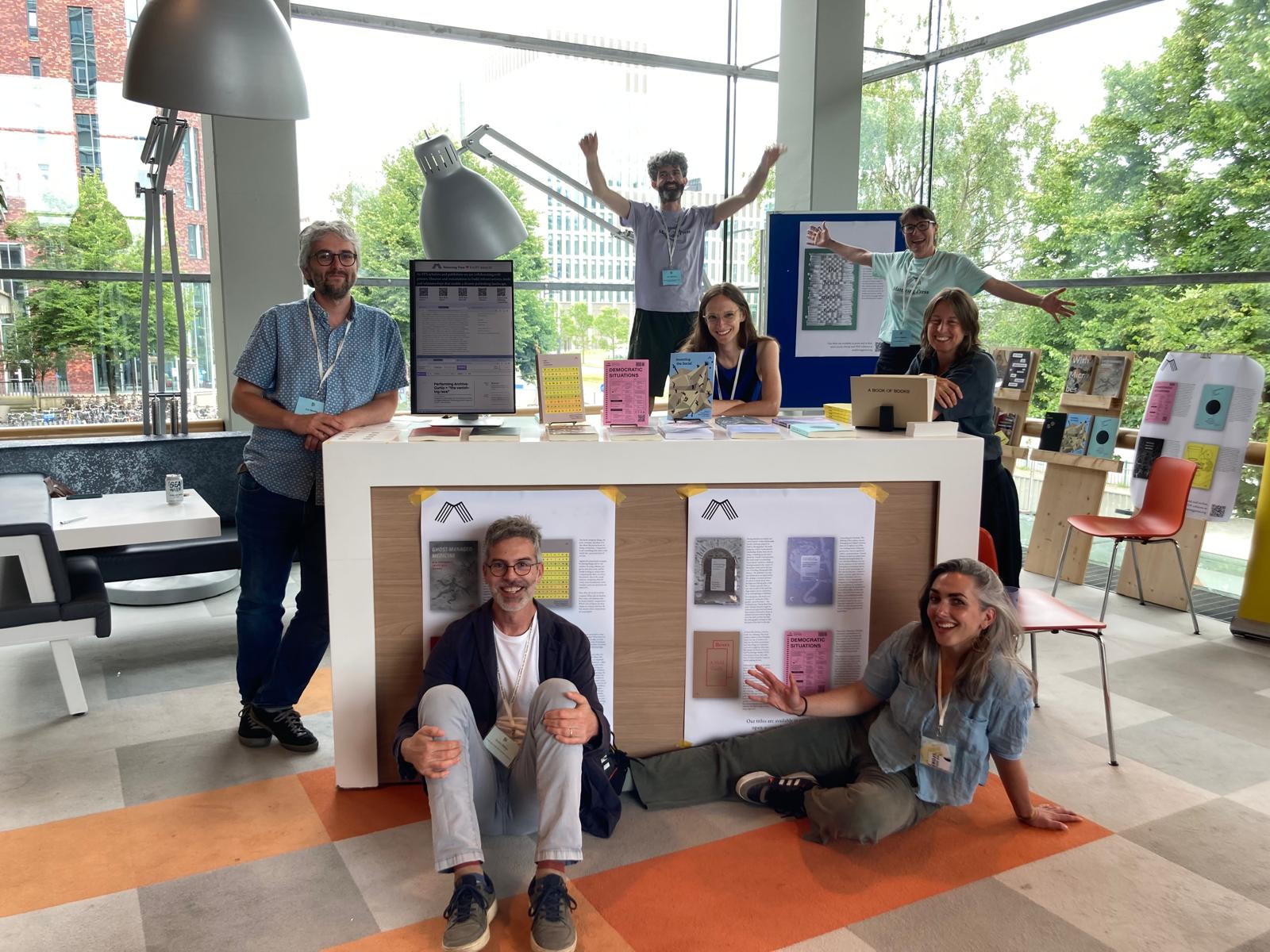
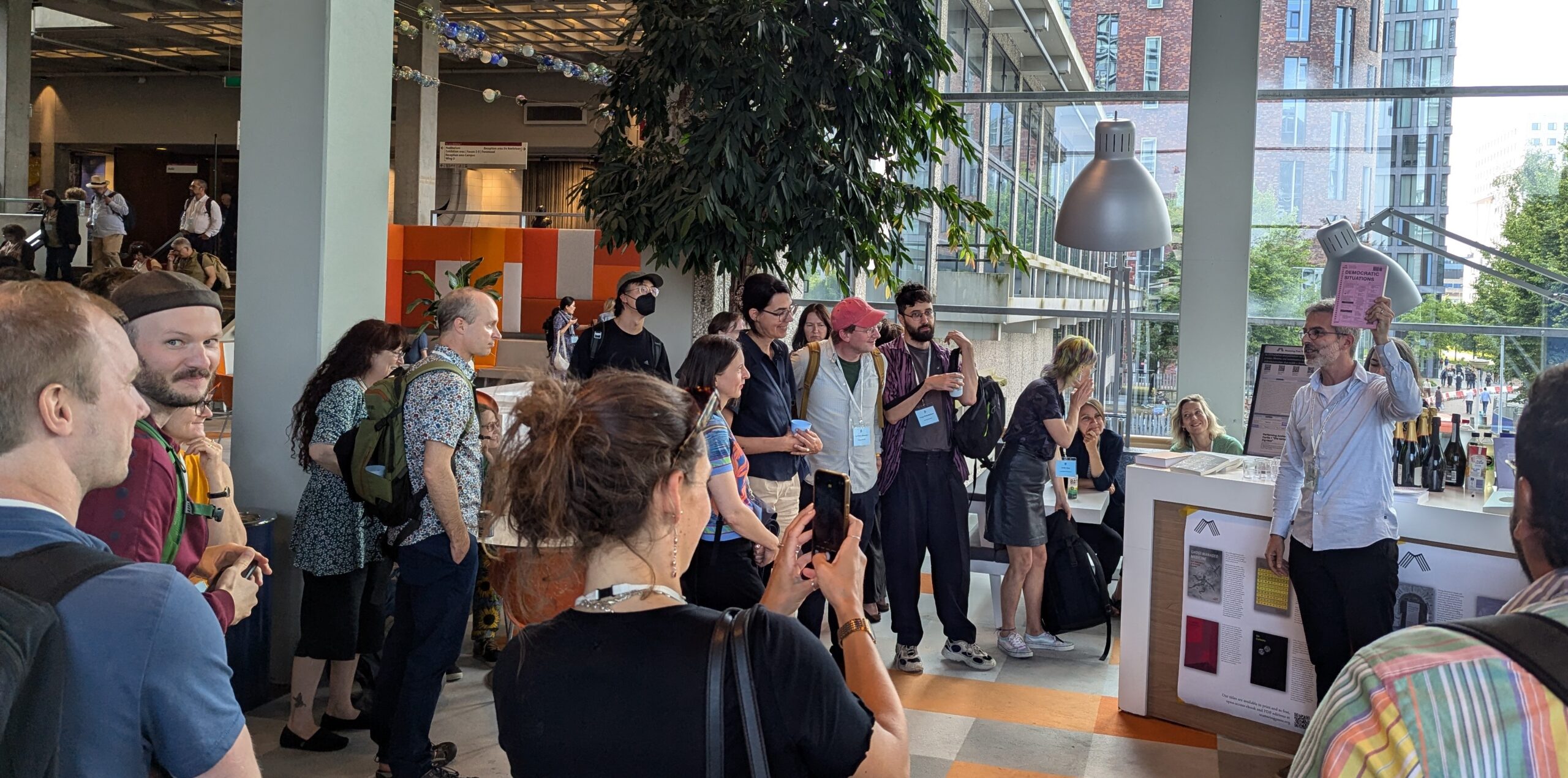
Mattering was present at the conference in many other ways. We had a stand, kindly offered to us by the conference organisers. This presented the opportunity for the press’ current seven editors to come together in person for the very first time (!!). This was an emotional experience in and of itself, but so too was the opportunity to be able to have a site around which friends old and new could gather, as well as being able to host a celebration for Democratic Situations after the completion of the award ceremony.
Diverse interventions
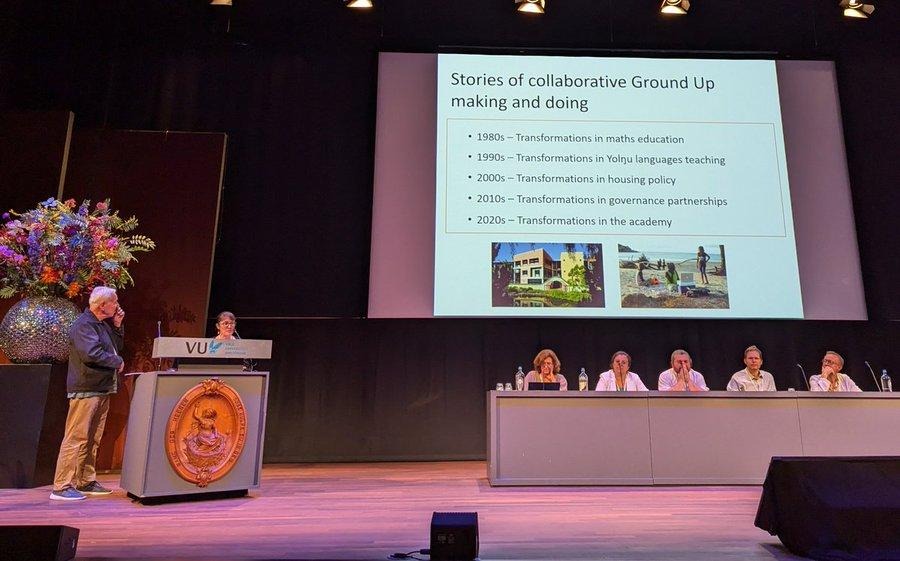
The press’ editors themselves intervened in the conference. Michaela Spencer contributed to a collective plenary on making and doing transformations, in which she and her colleague Michael Christie presented the work that they, alongside Helen Verran and Matthew Campbell, have been involved with in a 40 year period involving ongoing Ground Up research under Yolŋu authority in East Arnhem Land, in Australia’s Northern Territory.
Michaela was also involved in a panel on ‘Voicing Places’, which she and Mattering Press colleague, Endre Dányi, convened. Rivers were at the heart of each of their contributions. Michaela presented collaborative work she has been involved with Larrakia elders in northern Australia, including reflecting on how, as they walked together along a creek – ‘doing creek work’, as she put it – differing configurations and (cosmo)politics of people, seasons, stories, and actions emerged. Endre was helped by a different river: the Danube. His particular focus was on what rivers do to politics, using ethnographic fragments to indicate how a particular political imaginary – the Danube Confederacy, a more than a century old proposal to organise countries along the river into a political entity – has been shaping more recent political practices on the shores of the river.
The politics of place also figured in Uli Beisel’s contribution. Uli took part in a roundtable discussion on how STS might understand cities as sites of intersecting inequalities. This included drawing attention to the diverse regimes of valuing that are negotiated in urban settings, deeply shaped by migration and postcolonialism, economic inequality, and, more recently, neoliberal projects of green re-growth.
Anna Dowrick explored an absence: specifically, how absences of cancer – negative diagnoses – come to figure in imaginaries of futures with and without cancer. She examined how those anticipated not to have cancer are figured in UK planning and resource allocation, as well as sharing insights from patients who have received an ‘all-clear’ after passing through novel pathways for vague symptoms. Anna also convened a panel exploring how to move beyond polarisation in discourses on vaccines.
Engaging scholarly publishing
One of the real pleasures of being involved in Mattering Press as both publishers and scholars, is the opportunities it has afforded to turn STS lenses onto the practicalities and politics of scholarly communication. So Julien McHardy not only presented his collaborative work on how startup practices and logics come to transform climate activism, he also took part in the panel Demystifying Publishing Landscapes for Early Career Researchers organised by the 6S council and a roundtable on the potentials of bringing approaches from STS to experimental publishing. Julien introduced the recently funded Deep Maps: Blue Humanities book by James Louis Smith that he is involved with, to be published by University of Westminster Press. Drawing in part on Juncture’s markdown-based approach to visual essaying, the form of the book will continually adapt to reflect the book’s analysis of deep ocean mapping. As the reader proceeds through the book, its colours and textual arrangements will reflect the books various intellectual and spatial movements, initially diving deep into ever darker ocean depths, before returning to lighter shallows.
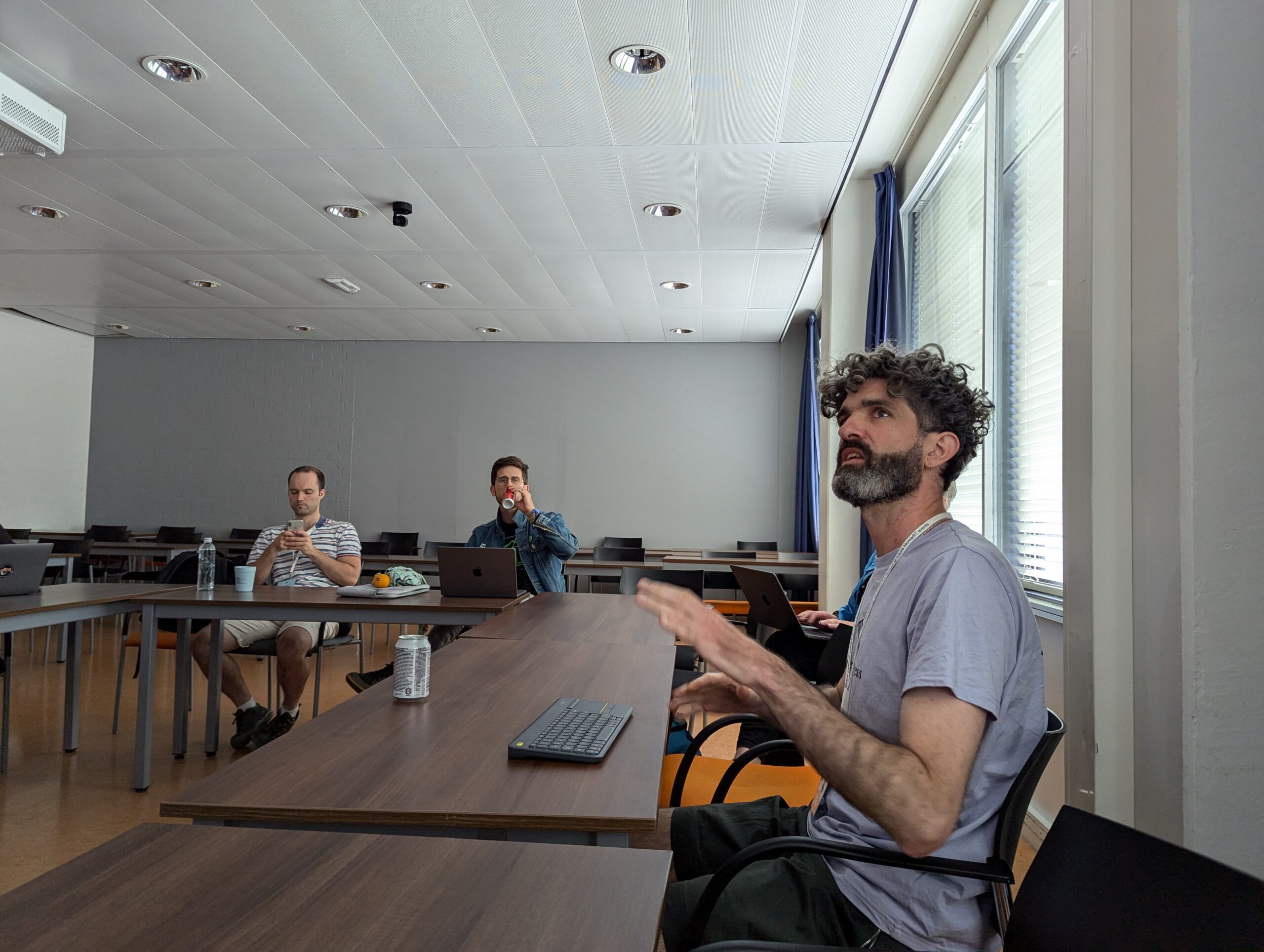
Joe Deville, in his presentation as part of a three part panel on scholarly publishing, explicitly asked what role STS might play in helping to transform the status quo. As he showed, presses like Mattering Press face a continual struggle for survival, in the face of a scholarly publishing system which privileges large, for-profit presses. This same system entrenches local and global scholarly inequalities, in terms of both access to scholarship and researchers’ publishing practices. Joe introduced the work of the Open Book Collective. This new charity, of which he is also the Managing Director, is providing vital new funding streams to publishers like Mattering Press. But it also, he argued, is materialising and infrastructuring the hope for a different higher education future: one focused simultaneously on community-led infrastructure building work, alongside research on the politics and practicalities of publishing, and involving new collaborations between scholars, libraries, publishing communities, in both Global Northern and Southern settings.
Unavoidable entanglements
It was an immense privilege to be co-present in Amsterdam. VU students made this point viscerally, in a protest which succeeded in shutting down the conference for a period. In the context the genocide being inflicted on the people of Gaza, it built on an ongoing call by VU students for the university to take a stronger position on these events, and was also seemingly aimed at 4S and EASST as the conference’s two organising associations. As it did for Mariana Alves, it should prompt reflections on “all the subtle ways that we can (choose to) be complicit with sweeping urgencies, violences, ‘uncomfortable’ truths under the rug of proclaimed critical, feminist, transformation oriented fields”.
There is an entangled local and global politics to scholarly conferencing, as there is to publishing. As much as we undeniably enjoyed meeting and sharing stories about work, family, life, and as much as we gained from the fierce intellectual charge of the event, it is important that we all continue to engage with the socio-material conditions of our field in the context of the ever more violent geopolitical relationships in which we are all inevitably involved.
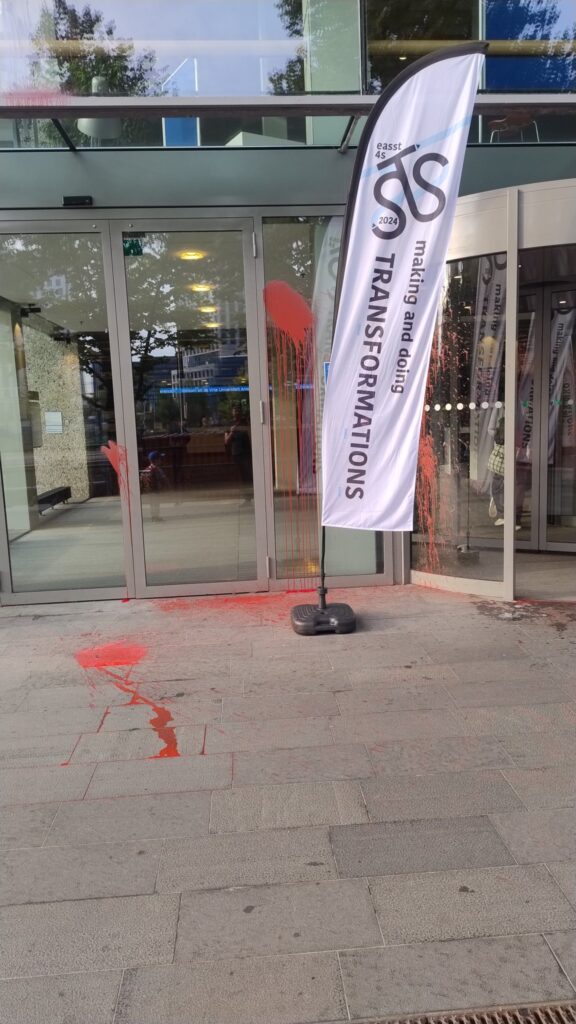
Image courtesy of Des Fitzgerald.